Key takeaways
- Best overall value: Samsung S90D OLED (55″, 65″, 77″) – Perfect blacks, excellent gaming, and lower price than S95D.
- Best for bright rooms and daytime sports: Samsung QN90D Neo QLED – Much higher sustained brightness and anti-glare handling than OLED or standard QLED.
- Best budget Samsung that still looks premium: Samsung Q80D QLED or Samsung DU8000 Crystal UHD (43″ to 85″) – Direct-lit QLED and Crystal UHD for smaller budgets and secondary rooms.
- Best for design-first spaces: Samsung The Frame (2024/2025) – QLED panel with matte anti-reflection coating and customizable bezels, you pay extra for the art mode, not picture performance.
- Best large screen for the money: Samsung QN85D Neo QLED (75″, 85″) – Cheaper than QN90D at 85 inches with most of the gaming features intact.
The best Samsung TV for the money in 2026 is the Samsung S90D OLED for most living rooms, because it delivers true OLED contrast and premium gaming features for significantly less than the flagship S95D, while the Samsung QN90D Neo QLED is the better value if you need a very bright room performer.
Our top picks
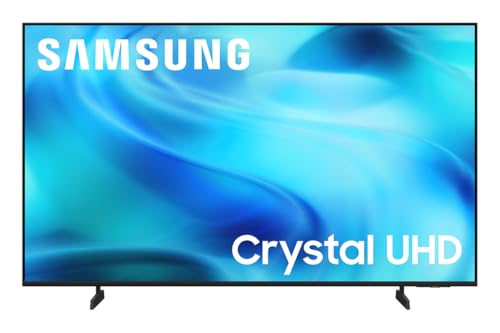 Samsung 65-Inch Class Crystal UHD U8000H Series
- Powerful processor enhances colors and sharpens details for…
- Watch 2,700+ free streaming options, including 750+ subscription-free…
- Experience clear picture and smooth motion in games…
 SAMSUNG 40-Inch Class Full HD F6000 Smart
- HDR: Enjoy great contrast in all your content
- Feel like you're part of the scene with…
- Your TV experiences are secured
 Samsung 55-Inch Class M80H Series
- Mini LED with AI Mode combines compact, high-efficiency…
- Get the edge in fast-paced games and sports…
- Pure Color Spectrum delivers one billion true-to-life colors,…
| Product | Key specs | |
|---|---|---|
| Samsung 65-Inch Class Crystal UHD U8000H Series | Powerful processor enhances colors and sharpens details for… Watch 2,700+ free streaming options, including 750+ subscription-free… Experience clear picture and smooth motion in games… | Check price |
| SAMSUNG 40-Inch Class Full HD F6000 Smart | HDR: Enjoy great contrast in all your content Feel like you're part of the scene with… Your TV experiences are secured | Check price |
| Samsung 55-Inch Class M80H Series | Mini LED with AI Mode combines compact, high-efficiency… Get the edge in fast-paced games and sports… Pure Color Spectrum delivers one billion true-to-life colors,… | Check price |
 Samsung 50-Inch Class The Frame LS03F 4K Samsung 50-Inch Class The Frame LS03F 4K | Looks like real art with a slim design… When you're not watching TV, the Frame transforms… LIFELIKE PICTURE WHEN IT’S ON, MUSEUM-WORTHY WHEN IT’S… | Check price |
As an Amazon Associate we earn from qualifying purchases at no extra cost to you.
Quick Value Picks by Situation
If you just want the best all-around value without overthinking panel tech, choose based on your room and primary use:
- Best overall value: Samsung S90D OLED (55″, 65″, 77″) – Perfect blacks, excellent gaming, and lower price than S95D.
- Best for bright rooms and daytime sports: Samsung QN90D Neo QLED – Much higher sustained brightness and anti-glare handling than OLED or standard QLED.
- Best budget Samsung that still looks premium: Samsung Q80D QLED or Samsung DU8000 Crystal UHD (43″ to 85″) – Direct-lit QLED and Crystal UHD for smaller budgets and secondary rooms.
- Best for design-first spaces: Samsung The Frame (2024/2025) – QLED panel with matte anti-reflection coating and customizable bezels, you pay extra for the art mode, not picture performance.
- Best large screen for the money: Samsung QN85D Neo QLED (75″, 85″) – Cheaper than QN90D at 85 inches with most of the gaming features intact.
Head-to-Head Comparison: The Models That Matter for Value
Samsung’s 2024-2025 lineup is still the core of what you’ll find in stores in 2026. Prices overlap heavily by size, so panel type and brightness matter more than model year.
| Model | Panel Type | Sizes Available | Peak Brightness (10% window) | Refresh Rate | HDMI 2.1 (4K 120Hz+) | Gaming VRR / ALLM |
|---|---|---|---|---|---|---|
| Samsung S95D OLED | QD-OLED, Matte Coating | 55″, 65″, 77″ | ~1,650 nits | 144Hz | 4 ports | Yes / Yes, FreeSync Premium Pro |
| Samsung S90D OLED | QD-OLED (55/65/77″) / WOLED (42/48/83″) | 42″, 48″, 55″, 65″, 77″, 83″ | ~1,300 nits | 144Hz | 4 ports | Yes / Yes, FreeSync Premium Pro |
| Samsung QN90D Neo QLED | Neo QLED (Mini-LED) VA | 43″, 50″, 55″, 65″, 75″, 85″, 98″ | ~2,000-2,200 nits | 144Hz | 4 ports (up to 144Hz) | Yes / Yes, FreeSync Premium Pro |
| Samsung QN85D Neo QLED | Neo QLED (Mini-LED) ADS/VA | 55″, 65″, 75″, 85″ | ~1,200-1,400 nits | 120Hz | 4 ports (up to 120Hz) | Yes / Yes, FreeSync Premium |
| Samsung Q80D QLED | QLED Direct Full Array | 50″, 55″, 65″, 75″, 85″ | ~600-750 nits | 120Hz | 4 ports (up to 120Hz) | Yes / Yes |
| Samsung DU8000 Crystal UHD | Crystal UHD LED | 43″, 50″, 55″, 65″, 75″, 85″ | ~350-450 nits | 60Hz | 0 ports (HDMI 2.0 only) | No / No |
Note on S90D panel lottery: The 55, 65, and 77-inch S90D models use Samsung Display QD-OLED panels with brighter color volume. The 42, 48, and 83-inch versions use LG Display WOLED panels. They still offer OLED contrast but are not as bright or color-rich as the QD-OLED sizes.
Panel Type and Brightness: What Actually Affects Value
OLED (S95D / S90D): Contrast for Dark to Moderate Rooms
OLED turns off individual pixels, so black is truly black and contrast is infinite. This is visible immediately in movies with letterbox bars or gaming in a dim room. QD-OLED adds a quantum dot layer for higher brightness and more saturated colors at high luminance than traditional WOLED. You do not need the S95D unless you watch in a very bright room and want the anti-glare matte coating and the One Connect Box. For most buyers, the S90D gives you 90% of the S95D picture for a much lower general market price.
Neo QLED (QN90D / QN85D): Brightness for Daytime Viewing
Neo QLED uses Mini-LED backlighting with hundreds of dimming zones. It cannot match OLED pixel-level contrast, but it sustains 2,000+ nits in highlights and handles bright, window-heavy living rooms without washing out. The QN90D also has an ultra-wide viewing angle layer, so color does not shift as much when you sit off-center. The QN85D is a step down in dimming zones and peak brightness, which is why it costs less at 75 and 85 inches. If you watch a lot of sports during the day, Neo QLED is the more practical value.
Standard QLED and Crystal UHD (Q80D / DU8000): Budget Reach
The Q80D uses a conventional LED backlight with fewer dimming zones, so blacks look gray in a dark room and brightness tops out around 700 nits. The DU8000 is an entry 60Hz panel with no local dimming. Both are fine for bedrooms, kitchens, or kids’ rooms where you prioritize size per dollar over HDR impact. Do not buy them expecting the same HDR punch or 120Hz gaming as the models above.
Gaming Features That Determine Long-Term Value
Samsung reserves full gaming specs for its higher tiers. If you own a PlayStation 5, Xbox Series X, or gaming PC, this is where the money is best spent:
- 4K 120Hz and 144Hz: S90D, S95D, and QN90D support 4K at up to 144Hz on all four HDMI ports. Q80D and QN85D support 4K 120Hz. DU8000 is limited to 4K 60Hz.
- VRR and ALLM: S90D, S95D, QN90D, QN85D, and Q80D all support Variable Refresh Rate and Auto Low Latency Mode to eliminate tearing and reduce input lag automatically. DU8000 does not.
- Input lag: Samsung’s Game Mode on the S90D, S95D, and QN90D measures around 9-10ms at 4K 60Hz and ~5-6ms at 4K 120Hz. Q80D is similar. DU8000 is higher at ~17ms and lacks game-specific processing.
- FreeSync and G-Sync Compatible: The OLEDs and Neo QLEDs are certified for AMD FreeSync Premium Pro, and work with G-Sync Compatible PCs via HDMI VRR, even if not officially labeled as such.
If gaming is secondary, you can safely save by choosing Q80D and still get 120Hz. If you game daily on a next-gen console or PC, the S90D or QN90D will hold value longer because they will not bottleneck new games that target 120Hz performance modes.
Screen Size and Viewing Distance: Buy the Right Size, Not Just the Biggest
Value disappears if you buy too small and sit too far, or too large for a small wall. Use this quick sizing guide based on SMPTE-recommended field of view for mixed 4K viewing:
| Screen Size | Best Viewing Distance (4K) | Room Fit | Best Value Model at This Size |
|---|---|---|---|
| 43-50″ | 4 – 6 feet | Bedroom, office, small den | QN90D or Q80D |
| 55″ | 5 – 7 feet | Apartment living room | S90D, QN90D |
| 65″ | 6 – 9 feet | Most average living rooms | S90D, QN90D |
| 77-85″ | 8 – 12 feet | Large open-plan, basement theater | S90D (77″), QN85D/QN90D (85″) |
| 98″ | 11 – 14+ feet | Dedicated large wall | QN90D 98″ |
A worked example: At 8 feet, a 65-inch TV fills about 30 degrees of your view, while a 77-inch fills about 36 degrees. That 15% larger diagonal feels almost 40% larger in screen area, which is why moving from 65 to 77 inches is often more impactful than moving from QN85D to QN90D at the same size. If your seating is fixed at 9 feet or more, allocate budget to size first, then panel quality.
Decision Matrix: Match Your Situation to the Right Samsung TV
| Your Situation | Top Value Choice | Why |
|---|---|---|
| Dark to moderately lit room, movies and streaming at night | Samsung S90D 65″ or 77″ | Perfect blacks and wide color beat any LED at the same price |
| Very bright living room with windows opposite the screen | Samsung QN90D Neo QLED | 2,000+ nits and matte-handling coating overcome glare |
| Competitive gaming on PS5/Xbox/PC | Samsung S90D or QN90D | Four HDMI 2.1 ports, 144Hz, lowest input lag, VRR |
| Need the biggest screen under a mid-range budget | Samsung QN85D 85″ or Q80D 85″ | Large Mini-LED or Direct LED without OLED premium |
| Secondary room, need 43-50″ cheap and efficient | Samsung DU8000 or Q80D 50″ | 60Hz is fine for casual viewing, much lower market price range |
| Interior design priority, TV as art when off | Samsung The Frame | Matte art display with interchangeable bezels outweighs raw picture value |
Durability and Ownership Realities
Samsung TVs are generally low-maintenance, but a few ownership details affect long-term value:
- What wears first: On OLEDs, organic pixels can show image retention if you leave static news tickers or game HUDs at maximum brightness for thousands of hours. Samsung uses pixel shifting and logo dimming to reduce risk, but varied content and keeping OLED Care settings on is the most effective prevention. On Neo QLED and QLED, the backlight does not have burn-in risk, but the VA panels can develop slight clouding or dirty screen effect visible on hockey or sky panning if pushed to maximum backlight for years.
- Cleaning: The matte coating on S95D and The Frame scratches more easily than glossy coatings. Use a dry microfiber cloth, then lightly dampen with distilled water only. Never use glass cleaner, alcohol, or paper towels. For Neo QLED glossy screens, the same rule prevents coating wear.
- One Connect Box (S95D only): The external connection box reduces cable clutter but adds a proprietary cable between box and panel. Keep that cable unpinched and avoid tight bends behind furniture.
- Common money-wasting mistakes: Paying extra for 8K (QN900D) for streaming at 9 feet provides no visible benefit over 4K, turning off all eco dimming and running OLED at 100% brightness in a dark room accelerates wear, and mounting too high forces neck strain and off-angle color shift on VA panels.
- Power use: A 65-inch S90D OLED averages 90-130W in typical SDR viewing, while a 65-inch QN90D Neo QLED averages 110-160W and can peak higher in bright HDR scenes. Both drop below 0.5W in standby.
How to Get the Best Value When You Buy
Instead of chasing a single best overall, shop by configuration:
- Choose panel for room: OLED if you control light, Neo QLED if you cannot. This one choice eliminates half the lineup.
- Choose size for distance using the table above, then see which panel fits your budget at that size. A 77-inch S90D often costs less than a 65-inch S95D and will look more immersive from 9 feet.
- Check HDMI layout: If you need multiple 120Hz devices (console + PC), avoid the DU8000 entirely and prioritize models with four HDMI 2.1 ports.
- Factor in sound: Thin OLED and Neo QLED sets benefit from a soundbar. Budget 15-20% of the TV cost for audio if you do not already own one, rather than stretching for the next TV tier.
- Look at general market price ranges by tier rather than model year: Crystal UHD is the entry range, QLED is budget-mid, Neo QLED is upper-mid, QD-OLED is premium. Last year’s mid-premium often beats this year’s entry plus.
Frequently Asked Questions
Is the Samsung S90D worth it over the S95D?
For most people, yes. The S90D uses the same QD-OLED picture technology in 55, 65, and 77 inches and shares the same 144Hz gaming suite. The S95D adds a glare-free matte coating, slightly higher peak brightness, and the One Connect Box. If those two extras are not critical, the S90D is the better value.
Is Neo QLED better than OLED for a bright room?
Yes. Neo QLED can sustain roughly 700-900 nits more full-screen brightness than OLED and has no risk of permanent image retention from static elements, making it more comfortable for all-day news and sports with windows open.
What size Samsung TV is best for the money?
65 inches is the value sweet spot for most living rooms in 2026, with the widest availability and most competitive pricing. If your seating is 8.5 feet or farther, a 77-inch S90D or 85-inch QN85D/QN90D gives you more immersion per dollar than a smaller flagship.
Do I need HDMI 2.1?
Only if you game at 4K 120Hz or plan to keep the TV 5+ years with new consoles. For movies and streaming only, HDMI 2.0 bandwidth is sufficient, which is why the DU8000 remains adequate as a non-gaming secondary set.