Key takeaways
- Taping knives spread mud over drywall seams in smooth, wide passes. Compare blade widths, flex levels, handle grips, and stainless or carbon builds.
As an Amazon Associate we earn from qualifying purchases.
A taping knife is the wide, flexible blade that carries joint compound from the mud pan to the wall and then feathers each coat out until the seam disappears under paint. Narrow joint knives handle tape bedding and small patches, but the wide taping sizes, from 8 inches up to 14 inches, do the heavy work of floating butt joints, skimming rough patches and laying down the broad finish coats that make a wall read flat in raking light. Blade material matters: stainless steel wipes clean and shrugs off rust between jobs, while blue steel and carbon builds flex with a different spring and need a wipe of oil before storage. Handle shape matters just as much, because a finisher may make thousands of passes in a day, and a soft grip with a solid back plate keeps the blade tracking straight without chewing up the hand.
The five picks below cover the main ways these knives are sold: two single wide knives from long-running tool brands, a three-knife set with a mud pan, a five-piece finishing kit built around two taping sizes, and a seven-piece set that pairs its taping knife with a pan and painter tools. Every blade width named here is printed on the product listing itself, and every compound figure is stated the way the maker prints it.
Disclosure: This article may contain affiliate links. If you buy through these links, we may earn a small commission from Amazon.
LEVEL5 12-Inch Soft-Grip Stainless Steel Taping Knife (5-137)

This single 12-inch knife is the classic finish-coat tool: wide enough to feather a butt joint in a few passes, with a medium-flex stainless blade that the maker positions for applying and floating coats of compound. The handle core is double riveted to a heavy-gauge aluminum back plate, which keeps the blade spine rigid while the edge does the flexing, and the soft grip profile was shaped from finisher feedback so it stays comfortable even when wet with compound. A metal hammer end caps the handle for tapping in stray fasteners or nudging a pan into place. At 0.3 kilograms it is light for its width, and the stainless blade rinses clean under a hose or in a bucket without rust worries afterward.
Specs
- Blade width: 12 inches
- Blade material: stainless steel, medium flex
- Handle: nylon soft grip with metal hammer end
- Back plate: heavy-gauge aluminum, double riveted handle core
- Item weight: 0.3 kilograms
- Model number: 5-137
Warner 10-Inch ProGrip Stainless Steel Taping Knife (10920)
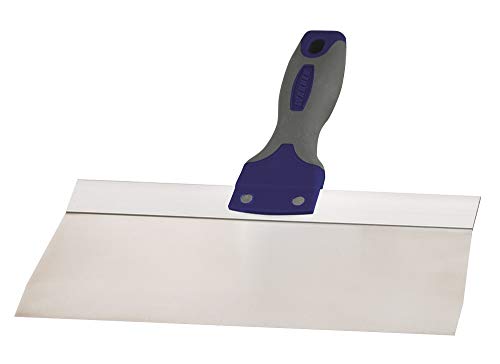
Warner’s ProGrip line pairs a stainless steel blade with a soft grip, ergonomic handle, and this 10-inch version sits in the middle of the taping range: broad enough for second coats over flat seams, yet easier to control in corners and around outlets than a 12-inch blade. The maker notes that 6-inch and 8-inch knives are the usual tape-setting sizes while 10-inch and 12-inch knives handle the finishing coats, which is exactly the role this blade fills. The knife weighs 6.7 ounces, so long skim sessions stay manageable, and the listing carries a limited lifetime warranty. Warner has made paint and drywall tools since 1927, and the ProGrip handle shape is its long-running answer to hand fatigue on repetitive passes.
Specs
- Blade length: 10 inches
- Blade material: stainless steel
- Handle: soft grip ergonomic handle
- Item weight: 6.7 ounces
- Part number: 10920
- Warranty: limited lifetime, per the listing
- Recommended uses on the listing: applying drywall compound to joints and covering screw holes
DEWALT Stainless Steel Taping Knife and Mud Pan Set (DXTT-3-174)

This set builds a full coat sequence around three taping widths: an 8-inch knife for bedding and first passes, a 10-inch for the second coat, and a 12-inch for finishing and skimming, all in stainless steel with soft grip nylon handles. A 14-inch mud pan comes in the box, sized to feed the widest blade without the edges hanging over the pan rim, and a bonus 6-inch soft grip putty knife covers screw spots, patches and tape setting in tight areas. Buying the widths together suits a finisher who wants one handle feel across the whole sequence, and the pan means the set works straight out of the box with nothing else to gather. The set is listed for applying joint compound or mud on drywall, and the handles share the same soft grip shape across all four knives.
Specs
- Taping knife widths: 8, 10 and 12 inches
- Blade material: stainless steel
- Handle material: nylon soft grip
- Mud pan: 14 inches, included
- Bonus tool: 6-inch soft grip putty knife
- Model number: DXTT-3-174
LEVEL5 Drywall Finishing Hand Tool Kit (5-600)

This five-piece kit pairs the two most-used taping widths, 10 and 12 inches, with 5-inch and 6-inch joint knives for tape setting and patch work, plus a 14-inch stainless mud pan. The blades are rigid 21 gauge polished stainless steel at 0.0315 inches thick, with a precision hollow grind that puts the flex point midway up the blade rather than near the handle, so pressure at the grip translates into a smooth, even bend along the edge. The maker describes the 10-inch as the workhorse for the first layer of mud over set tape and the 12-inch as the smoothing and skim-coating blade. The mud pan uses thick, heavy-gauge stainless with heli-arc welded inside corners that keep compound from building up in the seams and make washout simple. Soft grip handles run across the set, and the whole kit weighs 1.73 kilograms.
Specs
- Taping knife widths: 10 and 12 inches
- Joint knife widths: 5 and 6 inches
- Blade material: 21 gauge (0.0315 inch) polished stainless steel
- Flex design: precision hollow grind, flex point midway up the blade
- Mud pan: 14 inches, stainless steel, heli-arc welded corners
- Handle material: nylon soft grip
- Item weight: 1.73 kilograms
- Model number: 5-600
SHALL Drywall Tool Kit, 7 Pieces (SH260001AE)

SHALL’s seven-piece set rounds out a work belt in one purchase: a taping knife for seams and finishing passes, a putty knife for spot work, a painter scraper tool, and a 12-inch mud pan, all with stainless steel blades. The handles use a bi-material build of PP and TPR with anti-slip texture on both sides and a finger guide rail, which helps keep the hand indexed on the grip when palms get slick with compound. The blades are flexible and durable per the listing, with a smooth polished surface that resists rust and wipes clean, and each handle tail carries a hanging hole for pegboard storage. The listing frames the set around joint taping, finishing, patching and smoothing work, and the full kit weighs 1.97 kilograms.
Specs
- Set contents: taping knife, putty knife, painter scraper tool and 12-inch mud pan, 7 pieces total
- Blade material: stainless steel, polished finish
- Handle material: TPR and PP bi-material with anti-slip texture and finger guide rail
- Storage: hanging hole in each handle tail
- Item weight: 1.97 kilograms
- Model number: SH260001AE
How to Choose
Match the width to the coat. Taping work runs in a sequence, and each width has a job. A 6-inch knife sets tape and spots screws. An 8-inch or 10-inch knife lays the first and second coats over flat seams, carrying enough mud to fill the bevel without leaving heavy edges. A 12-inch knife floats the finish coat and skim work, spreading compound wide enough that the edges fade into the board. A 14-inch blade, where offered, suits long butt joints and broad skimming. A single 10-inch or 12-inch knife covers most repair and room work; a set with two or three widths covers the full sequence without swapping tools mid-coat.
Pick a blade material and flex level. Stainless steel is the low-care choice: it resists rust, rinses clean, and tolerates being left in a wash bucket. Blue steel and carbon blades flex with a spring many finishers like for finish coats, but they need drying and a light oil wipe before storage. Flex matters as much as material. A medium-flex blade with the bend point midway up the blade, the way hollow-ground blades are built, feathers edges without digging in. Very stiff blades suit scraping and heavy first coats but leave ridges on finish passes.
Check the handle and back plate. The handle core should be riveted or molded to a metal back plate that runs the width of the blade; that plate keeps the spine straight so the edge stays even. Soft grip and bi-material handles reduce fatigue and stay put in wet hands. A metal hammer end is a small bonus that earns its keep for setting proud screws and tapping bead into place.
Think about the pan and the kit. A taping knife works out of a mud pan, and the pan should be at least as wide as the blade: a 12-inch knife wants a 12-inch or 14-inch pan. Sets that include a pan, joint knives or a scraper save gathering pieces one by one, while single knives suit finishers replacing one worn blade in an established kit.
FAQ
Which taping knife width should a beginner buy first?
A 10-inch or 12-inch knife is the most useful single purchase. It handles second coats, finish coats and skim patches, and pairs later with a 6-inch joint knife for tape setting and small repairs.
What is the difference between a taping knife and a joint knife?
Both share the same flat, flexible blade shape. Joint knives are the narrow sizes, roughly 4 to 6 inches, used for bedding tape, filling screw holes and patch work. Taping knives are the wide sizes, 8 inches and up, used to spread and feather coats over seams.
How do you clean a stainless taping knife after a session?
Scrape leftover compound back into the pan, rinse the blade under water or swish it in a bucket, and wipe it dry. Stainless blades resist rust, so no oil coat is needed, but dried compound should never be left to harden on the edge.
Why does blade flex matter for a smooth finish?
A blade that bends slightly under pressure lays compound in a thin, even film and feathers the edges of each coat into the board. That gradual edge is what makes a seam vanish once the wall is painted, while a blade that is too stiff leaves lines that show through.
Conclusion
For a single finish-coat blade, the LEVEL5 12-inch soft grip knife brings a medium-flex stainless edge, a riveted aluminum back plate and a hammer end in a light package. The Warner 10-inch ProGrip covers the middle width with a long warranty behind it. Anyone who wants the whole coat sequence in one box is served by the DEWALT three-knife set with its 14-inch pan, the LEVEL5 five-piece kit with its hollow-ground blades, or the SHALL seven-piece set with its grippy bi-material handles and included scraper. Choose the width for the coat you run most, keep the blade clean, and the seams will take care of themselves.
More from Amazon
Programs that pair well with the guide above. Offers and eligibility are set by Amazon and may change.
Collect the home and kitchen items you want in one registry that guests can shop from.
Create a wedding registrySet up recurring deliveries of everyday items on eligible products. Terms and savings are set by Amazon.
Explore Subscribe & SaveFree shipping on eligible items, Prime Video and more. Eligible new members can start with a free trial.
Start a Prime free trialAudiobooks and podcasts to listen to on the go. Eligible new members can start with a free trial.
Try Audible freeAs an Amazon Associate we earn from qualifying purchases.