Key takeaways
- Pro: Eight height settings give you seasonal flexibility that rivals often lack.
- Pro: 201cc displacement provides noticeable torque margin through damp or overgrown grass.
- Con: Side discharge (rather than rear) can scatter clippings wider, requiring a second pass if you prefer a clean edge.
A self propelled lawn mower exists to solve one specific problem: you do not want to push a heavy machine across a sloped yard or a half-acre of flat ground while your arms burn. The difference between a frustrating season and a manageable one comes down to whether the drive system actually keeps pace with your walking speed, whether the engine has enough torque to maintain that pace through thick grass, and whether the deck gives you the flexibility to bag, mulch, or discharge without swapping parts on every pass.
Across these eight models, the spread is wide. A $275 PowerSmart and a $538 Greenworks kit both call themselves self-propelled, yet they serve different owners entirely. What separates a worthwhile purchase from a regrettable one in 2026 is not a single spec but the balance between displacement, drive type, height adjustability, and the real-world price of ownership when you factor in fuel or battery replacement.
Our top picks





As an Amazon Associate we earn from qualifying purchases at no extra cost to you.
Quick Picks
| Product | Best for | Price |
|---|---|---|
| BILT HARD 21″ Gas | Maximum height settings on a budget | $299.99 |
| PowerSmart 22″ Gas | Wider deck at a low price | $289.99 |
| PowerSmart 21″ RWD | Sloped yards and medium lawns | $275.49 |
| Greenworks 80V 21″ | Cordless convenience, single battery | $479.99 |
| PowerSmart 22″ 170cc | Straightforward gas power | $289.99 |
| Greenworks 80V Brushless | Brushless longevity and tool ecosystem | $437.89 |
| YARDMAX 22″ CVT FWD | Variable-speed control on flat terrain | $359.99 |
| Greenworks 60V 21″ Kit | Extended runtime with dual batteries | $538.00 |
How We Picked
We compared published engine specifications, drive-system type, number of cutting-height adjustments, and 3-in-1 functionality against listed prices and aggregated owner sentiment. For gas models, displacement and cycle design indicate torque headroom. For cordless units, voltage and amp-hour capacity determine whether the mower can sustain a full cut on one charge or one kit. Drive type (rear-wheel versus front-wheel versus CVT) was weighed against yard terrain claims, and height range was assessed for owners who need flexibility across seasons.
The 8 Best Self Propelled Lawn Mower in 2026
BILT HARD 21″ Self-Propelled Gas Lawn Mower
This suits the owner who wants the most height-adjustability options without stepping above the $300 mark. The 201cc 4-cycle OHV engine is the largest displacement in this gas lineup, paired with eight discrete cutting-height positions that far exceed the six found on comparable models. Its 3-in-1 bagging, mulching, and side-discharge system covers every typical mowing scenario in a single pass.
- Pro: Eight height settings give you seasonal flexibility that rivals often lack.
- Pro: 201cc displacement provides noticeable torque margin through damp or overgrown grass.
- Con: Side discharge (rather than rear) can scatter clippings wider, requiring a second pass if you prefer a clean edge.
Skip it if your yard has tight borders where side discharge splatters onto flower beds or pavement.
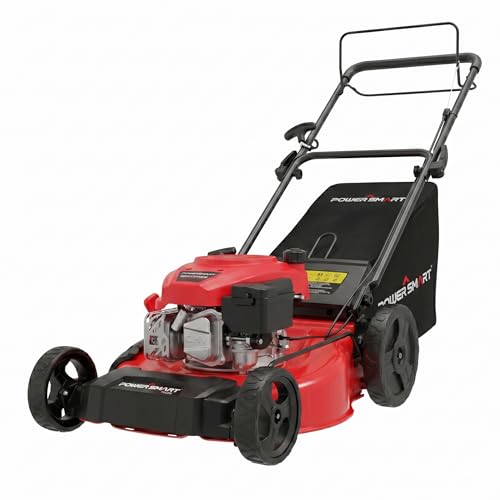
PowerSmart 22-Inch Self-Propelled Gas Lawn Mower
The 22-inch deck at $289.99 makes this a pragmatic choice for anyone wanting one or two fewer passes across a medium lawn without paying a premium for displacement. The 170cc OHV engine is adequate for regular maintenance cuts but works harder in tall or wet conditions. Six height positions cover standard mowing needs.
- Pro: Wider deck reduces mowing time on open, unobstructed lawns.
- Pro: Rear discharge keeps clippings contained better than side-discharge designs.
- Con: 170cc engine can bog in dense, uncut growth where the BILT HARD’s 201cc would plow through.
Skip it if you regularly mow neglected or overgrown patches; the smaller engine will stall or slow noticeably.
PowerSmart 21″ Self-Propelled Gas Lawn Mower (Rear-Wheel Drive)
Designed explicitly for sloped yards, the rear-wheel-drive configuration places weight over the drive wheels, improving traction on inclines where front-wheel-drive units lose purchase. The steel deck and 170cc OHV engine make it a durable pick for medium yards. At $275.49, it carries the lowest price in this roundup.
- Pro: Rear-wheel drive handles slopes and uneven terrain more confidently than front-drive alternatives.
- Pro: Durable steel deck resists corrosion and impact better than polymer options.
- Con: The 21-inch deck is narrower than 22-inch siblings, so expect slightly longer mowing sessions on wide lawns.
Skip it if your yard is flat and large; the narrower deck means more passes without the traction advantage you would be paying for.
Greenworks 80V 21in Self-Propelled Lawn Mower
This cordless option appeals to owners who want zero fuel, zero oil changes, and minimal storage clutter. The 80V platform paired with a 4.0 Ah battery and included charger is a complete setup for a typical suburban lawn. For someone replacing a gas mower purely to eliminate pull-cords and exhaust smell, this delivers without compromise on the basic cut.
- Pro: 80V voltage gives the motor more headroom than 40V competitors, sustaining blade speed under load.
- Pro: Single-battery simplicity means fewer pieces to track and charge.
- Con: One 4.0 Ah battery may not cover a large or heavily overgrown lawn in a single session, forcing a pause for a recharge.
Skip it if your yard exceeds what a single battery charge realistically handles or if you have long gaps between mowings.
PowerSmart 22-Inch 170cc Self-Propelled Gas Lawn Mower
Essentially the same platform as the second entry, this 22-inch model with 170cc displacement is a straightforward gas option for buyers who want self-propulsion, a wide deck, and 3-in-1 flexibility at a sub-$290 price. There is little here to differentiate it beyond its position as a no-frills value in the PowerSmart lineup.
- Pro: 22-inch cutting width cuts mowing passes on open lawns.
- Pro: Consistent with PowerSmart’s broader parts and support availability.
- Con: Engine displacement matches the 21-inch models, so the wider deck does not come with proportionally more power.
Skip it if you want a larger engine; the BILT HARD offers more torque for a similar price.
Greenworks 80V 21″ Brushless Cordless (Self-Propelled) Lawn Mower
The brushless motor is the headline here. Brushless designs produce less friction, generate less heat, and typically last longer than brushed equivalents, which matters on a mower that will face thousands of start-stop cycles. At $437.89 with a 4.0 Ah battery and 60-minute rapid charger, it undercuts the standard 80V model while offering the same voltage platform.
- Pro: Brushless motor means longer service life and improved efficiency per charge.
- Pro: Compatibility with 75+ Greenworks tools lets one battery system serve your whole yard.
- Con: The $437.89 price puts it above every gas option in this list, so cordless convenience still carries a premium.
Skip it if budget is your primary constraint and a pull-start is tolerable.
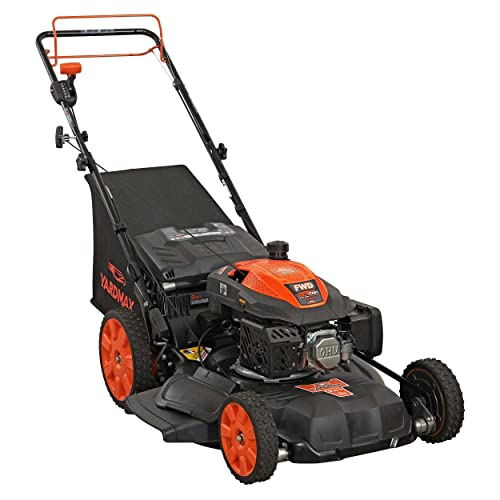
YARDMAX 22 in. 201cc Select PACE 6 Speed CVT FWD Lawn Mower
This is the only model with a continuously variable transmission offering six speed settings, letting you match the mower’s ground speed to your exact walking pace rather than accepting a fixed drive ratio. The 201cc engine matches the BILT HARD for power, and front-wheel drive with high wheels adds clearance over bumps and roots on flat-to-rolling terrain.
- Pro: CVT drive lets you dial speed precisely, useful when slowing for landscaping or accelerating on open runs.
- Pro: 201cc engine and 22-inch deck combine power with cutting width.
- Con: Front-wheel drive loses traction on steep slopes where rear-wheel-drive units grip better.
Skip it if your yard is notably hilly; rear-wheel or all-wheel configurations will serve you better on grades.
Greenworks 60V 21in Self-Propelled Lawn Mower (2-Battery Kit)
At $538, this is the priciest entry in the roundup, but it ships with two 4.0 Ah batteries, effectively doubling usable runtime over single-battery cordless mowers. The 60V platform is a tier below Greenworks’ 80V line, so raw torque is slightly less, but the dual-battery kit makes it the most practical cordless option for larger lawns where a single charge would leave you stranded mid-pass.
- Pro: Two included batteries nearly double mowing time per session without a recharge break.
- Pro: Best cordless option in this list for yards approaching or exceeding one acre.
- Con: Lower voltage than the 80V Greenworks models means the motor has less headroom in thick or damp grass.
Skip it if your lawn is small enough that one battery lasts; the 80V brushless model offers better torque for similar or lower cost.
Buying Guide
Engine Displacement and Torque Margin
Gas engine size (measured in cubic centimeters) is the most direct predictor of whether your mower stalls or powers through. A 170cc unit handles routine cuts on dry, maintained grass without issue, but a 201cc engine carries noticeably more torque for damp, tall, or dense growth. If you let grass grow between mowings or deal with clay-heavy soil, the extra displacement is not luxury; it is the difference between a single pass and a frustrating second one. For cordless models, voltage serves a similar role: 80V delivers more sustained blade speed under load than 60V.
Drive System: Rear-Wheel, Front-Wheel, and CVT
Self-propulsion is not uniform. Rear-wheel drive concentrates weight over the powered wheels, improving grip on slopes and uneven ground. Front-wheel drive is lighter and often paired with high wheels for obstacle clearance but can spin out on inclines. A CVT (continuously variable transmission) like the YARDMAX’s six-speed system lets you match speed to terrain and walking pace, adding flexibility at the cost of mechanical complexity and price. Choose based on your yard’s topography: slopes demand rear-wheel, obstacles favor high-wheel front-drive, and varied paces benefit from CVT.
Cutting Height Range and Deck Versatility
More height positions mean finer seasonal control. Eight settings (as on the BILT HARD) allow adjustments in smaller increments, useful if you scalp lightly in spring and leave grass tall in summer. Six settings cover most owners’ needs. Beyond height, confirm whether the 3-in-1 system switches easily between bagging, mulching, and discharge without tools or repeated part swaps. A mower that requires a screwdriver to change modes will stay in one configuration all season, negating the feature entirely.
Our Verdict
The BILT HARD 21″ is the top gas pick: it offers the largest engine displacement, the most height settings, and competitive pricing in a single package. The PowerSmart 21″ Rear-Wheel Drive is the budget winner, delivering genuine slope capability at the lowest price in the roundup. If you have a flat, large lawn and want variable speed without gas maintenance, the YARDMAX 201cc CVT becomes the obvious choice over both cordless and simpler gas models.
FAQ
Is self-propelled worth it over a push mower?
Yes, for any yard larger than a small patch or with slope. The drive system reduces fatigue enough that you are more likely to mow on schedule, which keeps the engine from working harder through overgrown grass. For flat, very small yards, the cost premium may not justify itself.
Can a single battery power a full lawn in one session?
On a typical suburban lawn of moderate size, a 4.0 Ah battery on an 80V platform will likely complete one pass, though dense or damp grass reduces runtime. If your yard is large or you have long gaps between cuts, a dual-battery kit like the Greenworks 60V eliminates the mid-session recharge problem.
How many cutting-height positions do I actually need?
Six positions handle most owners across seasons, but if you adjust weekly by small increments or maintain a specific turf height for aesthetics, eight positions offer finer control with less guesswork between settings.
Does rear-wheel drive matter on a flat yard?
Rear-wheel drive provides no meaningful advantage on level ground and may add cost or weight. On flat terrain, front-wheel drive with high wheels is equally effective and often lighter. Reserve rear-wheel drive for sloped or uneven yards where weight transfer to the powered axle improves grip.