Key takeaways
- Pro: Exceptional mulching cut quality from the Recycler blade design
- Pro: No gas, oil changes, or pull-cord maintenance required
- Con: Battery and charger not included, inflating total cost
A homeowner searching for a toro lawn mower usually arrives with a specific set of frustrations already in mind: the old deck rusted through, the pull cord started slipping on the second mow of the season, or gas pricing made a push model feel like a poor long-term bet. The market has expanded well beyond Toro’s lineup, and several competitors now deliver comparable build quality at lower price points, while a few premium options still justify their sticker through superior cut quality and long-term durability.
What separates a worthwhile mower from a money pit comes down to engine reliability under sustained load, deck design that resists clogging on damp grass, and whether the cutting-height adjustment mechanism holds its setting week after week. Battery-powered models add their own calculus around runtime and charge-cycle longevity. This roundup compares eight machines spanning push gas, self-propelled gas, and cordless electric designs to help you find the right fit without overpaying for features your yard does not need.
Our top picks




As an Amazon Associate we earn from qualifying purchases at no extra cost to you.
Quick Picks
| Product | Best For | Price |
|---|---|---|
| Toro 60V MAX* 21 in. Recycler Push | Small yards, quiet operation | $335.52 |
| PowerSmart 22-Inch Self Propelled Gas | Value-focused mulching | $289.99 |
| BILT HARD 21″ Self Propelled Gas | Easy starts, fine height control | $299.99 |
| PowerSmart 21″ Self-Propelled RWD | Sloped yards | $275.49 |
| YARDMAX 22″ 201cc CVT FWD | Precise pace control | $359.99 |
| Toro 60V MAX* 30 in. eTimeMaster | Large properties, commercial pace | $1499 |
| Greenworks 80V 21in Push | Big-yard electric runtime | $399 |
| Greenworks 60V 21in Push | Balanced power and price | $389.99 |
How We Picked
We evaluated published specifications, verified pricing across major retailers, and weighed patterns in owner feedback across all eight machines. The criteria that mattered most: engine or motor output relative to deck width (a mismatch here causes bogging and uneven cuts), build quality of the deck and drive system (thin stamped steel decks flex and dull blade edges faster), ease of routine maintenance (air filter access, blade removal, oil changes), and total cost of ownership over a five-year window including fuel or electricity. For electric models, we also considered whether the battery platform supports tool compatibility that offsets the upfront price.
The 8 Best Toro Lawn Mower in 2026
Toro 60V MAX* 21 in. Recycler Push Lawn Mower
This is the entry-level electric option for owners who want Toro’s legendary cut quality without the noise, fumes, or maintenance of a gas engine. The 21-inch deck handles yards up to roughly a quarter-acre on a single charge, and the Recycler blade design produces a finely mulched finish that breaks down quickly. Owner reports consistently praise the smooth pull-free start and the near-silent operation that makes early-morning mowing neighborly. The main drawback is that the battery and charger are sold separately, adding meaningful cost to the sticker price, and the push design means you supply all the forward force on slopes.
- Pro: Exceptional mulching cut quality from the Recycler blade design
- Pro: No gas, oil changes, or pull-cord maintenance required
- Con: Battery and charger not included, inflating total cost
Skippable if your yard exceeds half an acre or features significant slopes, where a self-propelled or larger-deck model will serve you better.
PowerSmart 22-Inch Self Propelled Gas Lawn Mower
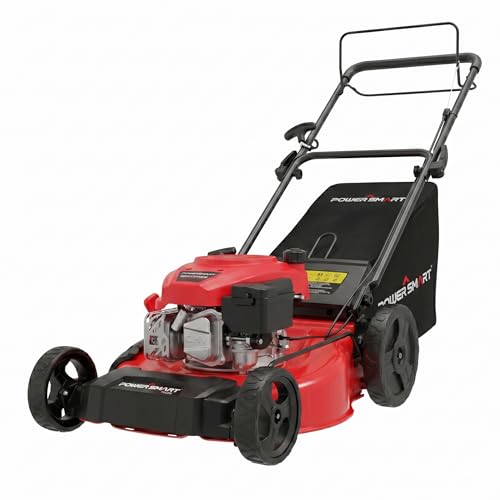
For buyers who want a wider-than-average cutting path without the premium price tag, this PowerSmart delivers a 22-inch steel deck driven by a 170cc four-cycle OHV engine. The three-in-one system covers mulching, bagging, and rear discharge, and six height settings provide adequate adjustment for most cool-season grasses. Owners appreciate the reasonable power-to-weight ratio and the straightforward starting process. The con most frequently cited is that the self-propulsion drive engages at a fixed speed with no dial-in control, which can feel either too fast on flat terrain or slightly underpowered on thick stands of summer fescue.
- Pro: Widest deck in this group at 22 inches for faster coverage
- Pro: Three-mode versatility handles bagging and mulching without tool changes
- Con: Single fixed drive speed offers no pace adjustment
Look elsewhere if you want to match your walking pace exactly or if your terrain varies steeply between mows.
BILT HARD 21″ Self Propelled Gas Lawn Mower
The 201cc engine here is the largest displacement among the sub-$300 gas mowers in this comparison, and that extra cubic centimeter shows up in torque when cutting through damp, tall growth. Eight adjustable cutting heights exceed what most competitors offer, giving you finer control over turf health across seasons. Owners repeatedly highlight the smooth easy-start system, which removes the frustrating choke-pull-pull cycle common on budget engines. The trade-off is a slightly heavier deck weight that makes manual turning in tight garden beds more of a two-handed affair.
- Pro: Eight cutting-height settings for precise seasonal adjustments
- Pro: Reliable easy-start system minimizes pull-cord frustration
- Con: Heavier deck complicates tight maneuvering around obstacles
Skip this one if you mow a small, obstacle-dense yard where a lighter push model reduces fatigue.
PowerSmart 21″ Self-Propelled Gas Lawn Mower with Rear-Wheel Drive
Rear-wheel drive is the defining feature here, and it changes how the mower behaves on inclined ground. The 170cc engine pairs with a steel deck and six height positions, mirroring its sibling’s spec sheet, but the traction delivery gives you noticeably more control when the terrain tilts. Owners with sloped medium-size yards report that the rear-drive configuration prevents the front-wheel lift and steering wander that plague FWD machines on grades. The 21-inch deck is narrower than the 22-inch model above, trading a few seconds of pass time for a more nimble turning radius.
- Pro: Rear-wheel drive provides superior traction on slopes
- Pro: Durable steel deck resists flex and vibration noise
- Con: Narrower 21-inch deck means more passes on wide open lawns
If your property is flat and expansive, the 22-inch PowerSmart above covers ground faster for a nearly identical price.
YARDMAX 22 in. 201cc Select PACE 6 Speed CVT FWD Lawn Mower
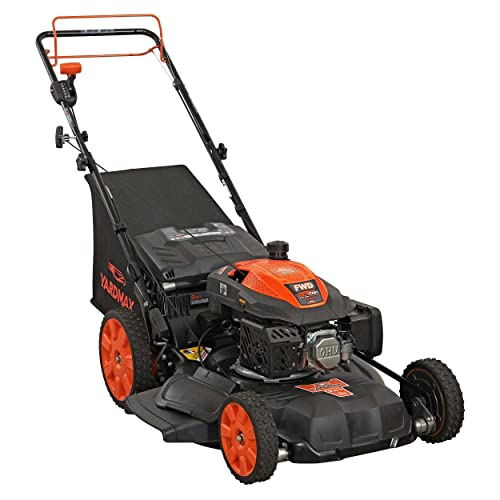
This mower targets buyers who want continuous drive-speed control without a clutch-based system that jerks or hesitates. The CVT transmission offers six selectable pace settings, letting you dial the engine and ground speed to whatever your grass density and slope demand. The 22-inch deck and 201cc engine match the BILT HARD in displacement while adding front-wheel drive and a high-wheel configuration that rolls over bumps and uneven terrain more gracefully. Owners praise the smooth, silent transmission shift. The con: this is the most expensive gas mower in the group, and the FWD layout can lose grip on wet slopes where RWD models maintain traction.
- Pro: CVT six-speed pace control adapts to terrain and grass thickness
- Pro: High-wheel design clears uneven ground and small obstacles
- Con: Front-wheel drive struggles for grip on wet or steep inclines
Rear-wheel or all-wheel configurations suit hilly properties better; consider the RWD PowerSmart first if slopes dominate your yard.
Toro 60V MAX* 30 in. eTimeMaster Personal Pace Lawn Mower
At 30 inches of cutting width, this commercial-grade electric walk-behind is in a different category from everything else here. The Personal Pace system responds to the pressure of your hands on the drive control, adjusting speed in real time without shifting or dialing. The eTimeMaster is built for property managers, large-lot homeowners, and anyone who mows more than half an acre and wants zero emissions with the runtime to match. Battery and charger are not included, so expect a substantial added cost, and the price tag puts it firmly in an investment purchase territory.
- Pro: 30-inch deck dramatically reduces mowing time on large properties
- Pro: Personal Pace delivers intuitive, fatigue-free speed control
- Con: High price plus separate battery cost creates a steep entry
Overkill for any lawn under half an acre, where the narrower decks above finish faster once you account for turning in tight spaces.
Greenworks 80V 21in Push Lawn Mower
The 80V platform is Greenworks’ answer to homeowners who need serious runtime without returning to gas. With the included 4.0 Ah battery, owners report completing a full quarter-acre mow without a mid-session recharge, and the 80V motor maintains blade speed under load better than lower-voltage equivalents. The push design keeps weight manageable and the price reasonable, though the lack of self-propulsion demands more leg effort on grades. Build quality on the deck and drive housing receives consistently positive marks for materials that would be expected on machines costing more.
- Pro: 80V platform sustains power under dense or wet grass conditions
- Pro: Battery and charger included at this price point
- Con: Push-only design increases physical effort on uneven terrain
Self-propelled electric mowers with Personal Pace-style drive systems are the upgrade path if fatigue or terrain concerns dominate your shopping list.
Greenworks 60V 21in Push Lawn Mower
Sitting $9 below the 80V model with a larger 5.0 Ah battery included, the 60V variant offers competitive runtime at a marginally lower entry cost. The 60V motor provides adequate cutting power for well-maintained lawns on flat to gently rolling terrain. Owners note slightly more blade-speed sag on thick, late-season growth compared to the 80V sibling, but day-to-day mowing on established turf shows minimal difference. The 5.0 Ah cell pairs with other 60V Greenworks tools, making this a sensible anchor for someone expanding into an electric tool ecosystem.
- Pro: 5.0 Ah battery supports extended mowing sessions without interruption
- Pro: Shares platform with Greenworks’ full 60V tool lineup
- Con: Noticeable power drop on dense or tall wet grass
If your lawn routinely sees overgrown stretches or heavy morning dew, the 80V model’s extra voltage headroom is worth the small premium.
Buying Guide
Engine Displacement vs. Deck Width: Finding the Balance
A 170cc engine behind a 21-inch deck is a comfortable pairing that maintains blade speed through moderate growth. Push that same displacement to 22 inches and you shave headroom, which manifests as bogging on damp or tall grass. If you choose a wider deck, step up to 200cc or more to keep cut quality consistent. For electric mowers, the equivalent metric is voltage: 21-inch decks run acceptably on 60V platforms, while anything beyond that benefits from 80V or higher to prevent the motor from dropping RPM under load.
Drive System: Push, Self-Propelled, and Personal Pace
Push mowers work on flat, small yards and save you both money and weight. Self-propelled models add a transmission that drives the wheels at a fixed or adjustable rate, reducing physical strain on medium and sloped terrain. Personal Pace and CVT systems go further, letting you modulate ground speed continuously with hand pressure or a dial, which matters most when your mowing conditions shift within a single pass from bare earth to dense growth. Match the drive system to your yard’s topography, not just its size.
Electric vs. Gas: Total Cost of Ownership Over Five Years
A gas mower costs less upfront but demands annual oil changes, spark-plug replacements, fuel, and occasional carburetor cleaning. Over five years, those consumables and the time spent performing them can equal the price gap between a comparable gas and electric model. Electric mowers add their own long-term consideration: battery replacement after several hundred charge cycles. Check whether the manufacturer publishes a battery price before buying, and whether the voltage platform you choose connects to other tools you already own, which effectively amortizes the cell cost across your whole equipment set.
Our Verdict
The top pick for most homeowners is the BILT HARD 21″ Self Propelled Gas at $299.99. Its 201cc engine provides a genuine power margin over the 170cc competitors, eight height positions give seasonal flexibility, and the easy-start system removes the single most common daily annoyance. If your budget is the hard ceiling, the PowerSmart 21″ RWD at $275.49 is the most capable self-propelled option under $280, especially on slopes where its rear-drive traction justifies the slightly smaller deck. The condition that shifts the winner: if you already own Greenworks 60V or 80V tools, the bundled battery on either Greenworks push model drops its effective cost below any gas competitor and eliminates engine maintenance entirely.
FAQ
Is a Toro lawn mower still a good choice when non-Toro brands undercut it on price?
Toro retains an edge in deck geometry and cut quality, particularly on their mulching designs, but the gap has narrowed significantly as newer brands improve blade engineering. You are paying a premium for brand-specific refinements rather than a fundamental capability difference on most small-to-medium residential lawns.
How many batteries do I need for a full quarter-acre mow?
On flat, regularly maintained turf, a single 4.0 Ah 80V battery or 5.0 Ah 60V battery typically completes a quarter-acre pass without stopping. Heavier, taller, or wet grass consumes more energy, so keeping a spare charged is practical advice for anyone mowing beyond half an acre.
Do self-propelled mowers last longer than push mowers?
The drive system adds components that can wear, so a self-propelled model has more potential failure points than a pure push design. However, the reduced physical strain means owners tend to maintain the deck, blade, and engine more diligently, which often results in the self-propelled machine outliving a neglected push mower regardless of mechanical complexity.
Can I use a single mulching pass instead of bagging clippings?
Yes, provided you mow on a schedule that prevents clippings from exceeding one-third of the blade height. A well-tuned mulching deck returns fine clippings that decompose quickly and feed nitrogen back into the soil, but forcing too much uncut grass through the deck at once causes clogging regardless of brand.