Key takeaways
- Choosing by height alone: A 7.8-foot arch may look tall in a listing photo but still have a narrow 24- to 30-inch opening.
- Ignoring mature vine weight: A frame suitable for sweet peas may bend under grapevines or established roses.
- Leaving no maintenance clearance: Tight placement makes pruning and tying difficult and can trap moisture against wood or metal.
- Forgetting installation depth: Burying legs can reduce the final height by 6 to 12 inches.
- Skipping wind protection: A leafy arbor has much more wind resistance than an empty frame. Anchor it before the vine fills in.
- Making the opening too narrow: Measure the actual clear passage between posts, not the advertised outside width.
- Overlooking door and equipment clearance: Wheelbarrows, lawn mowers, and garden carts often need at least 48 to 60 inches of clearance.
The right arbor size depends on three things: the mature spread of your vines, the path or seating area beneath the structure, and how much clearance you want around people and garden equipment. For most climbing vines, a garden arbor measuring 6 to 8 feet wide, 7 to 8 feet tall, and 18 to 30 inches deep provides a practical starting point.
The Short Answer
For a single walkway or garden entrance, choose an arbor at least 36 inches wide and 84 inches tall. A 48-inch width is more comfortable for two people, wheelbarrows, and garden carts. If you want a leafy tunnel effect, look for a structure 60 to 72 inches wide and 24 to 36 inches deep.
Our top picks
 Adorox 7.8ft Garden Arch Trellis for Climbing
- Transform your backyard into a beautiful garden retreat…
- Give climbing roses, clematis, flowering vines, and other…
- Perfect for backyard gardens, walkways, garden entrances, and…
 RUBFAC 7.8ft Garden Arch
- Versatile garden arch, perfect for event, wedding, and…
- Approximately 55 inches Width x 94 inches Height,…
- Easy assembly and disassembly, praised by customers
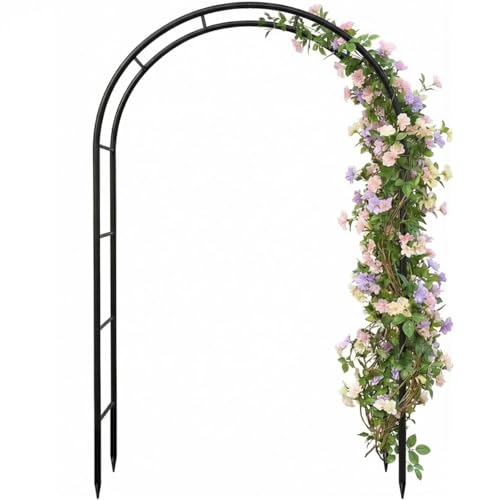 Garden Arch Galvanized Metal Rust-Proof Heavy Duty
- Superior Rust Resistance with Galvanized Metal: Forged from…
- Thicker & heavier for extra strength: We have…
- Effortless One-Person Assembly: Engineered for user-friendly setup, this…
| Product | Key specs | |
|---|---|---|
| Adorox 7.8ft Garden Arch Trellis for Climbing | Transform your backyard into a beautiful garden retreat… Give climbing roses, clematis, flowering vines, and other… Perfect for backyard gardens, walkways, garden entrances, and… | Check price |
| RUBFAC 7.8ft Garden Arch | Versatile garden arch, perfect for event, wedding, and… Approximately 55 inches Width x 94 inches Height,… Easy assembly and disassembly, praised by customers | Check price |
| Garden Arch Galvanized Metal Rust-Proof Heavy Duty | Superior Rust Resistance with Galvanized Metal: Forged from… Thicker & heavier for extra strength: We have… Effortless One-Person Assembly: Engineered for user-friendly setup, this… | Check price |
 Outvita 7Ft Dark Brown Wooden Garden Arbor Outvita 7Ft Dark Brown Wooden Garden Arbor | Check price |
As an Amazon Associate we earn from qualifying purchases at no extra cost to you.
Vines need room beyond the frame itself. Allow at least 12 inches of growing space on each side for light, air circulation, and pruning access. Vigorous plants such as wisteria, grapevines, trumpet vine, and climbing roses may need 18 to 24 inches of extra lateral room once mature. Lightweight annuals, including morning glory and sweet peas, can work on a smaller arch.
As a general 2026 buying guide, an arbor around 7 to 8 feet tall and 4 to 6 feet wide is the most versatile choice for a residential garden. Check the installed height, not just the frame height: buried legs, uneven ground, and raised beds can reduce usable clearance by several inches.
Standard Sizes
Arbor dimensions are usually listed as width × height × depth. Width is the side-to-side opening, height is the ground-to-top measurement, and depth describes how far the arbor extends along the path. The opening beneath the crossbar is smaller than the outside dimensions because of the frame thickness and side panels.
| Arbor type | Typical outside dimensions | Approximate metric size | Best for |
|---|---|---|---|
| Compact entry arch | 30–36 in W × 72–84 in H × 12–18 in D | 76–91 cm W × 183–213 cm H × 30–46 cm D | Small beds, narrow paths, annual vines |
| Standard garden arbor | 42–48 in W × 84–96 in H × 18–24 in D | 107–122 cm W × 213–244 cm H × 46–61 cm D | Most entrances and climbing roses |
| Wide walkway arbor | 60–72 in W × 84–96 in H × 24–36 in D | 152–183 cm W × 213–244 cm H × 61–91 cm D | Two people, carts, dense foliage |
| Deep vine tunnel | 72–96 in W × 84–108 in H × 36–48 in D | 183–244 cm W × 213–274 cm H × 91–122 cm D | Grapes, wisteria, long paths, seating zones |
| Seated arbor | 60–72 in W × 84–96 in H × 30–36 in D | 152–183 cm W × 213–244 cm H × 76–91 cm D | Bench seating and shade-forming vines |
A 7.8-foot arbor is approximately 93.6 inches or 238 centimeters tall. That height is common among lightweight metal arch trellises and leaves enough room for most adults to walk beneath the top, although the usable opening may be lower. Compact metal arches such as the Adorox and RUBFAC-style 7.8-foot models are generally suited to decorative vines and lighter plant loads. Prices for simple metal arches commonly range from about $18 to $25.
Heavier galvanized metal arches designed for roses and climbing vines often cost roughly $20 to $40, depending on width, coating, anchors, and frame thickness. Wooden arbors are typically more substantial and may cost about $90 to $180 or more. A 7-foot wooden model, such as an Outvita-style arbor, can be a better visual match for a cottage garden, but it needs more careful anchoring and periodic sealing.
How to Measure Your Space
- Measure the path width. Measure the finished walking surface at its narrowest point. Add at least 6 inches of clearance to each side for a comfortable opening. For a 36-inch path, an arbor with an outside width near 48 inches may be appropriate, provided its legs do not sit directly in the walking lane.
- Check the required headroom. Measure from the ground to the lowest overhead obstruction, such as a fence rail, branch, light, or roof edge. Choose an arbor at least 6 to 12 inches shorter than that obstruction. For frequent passage, aim for a clear opening of 78 to 84 inches.
- Account for the legs. Some frames are installed by pushing or burying legs 6 to 12 inches into soil. Others use ground stakes or base plates. Confirm how much height and width remain after installation.
- Measure the planting zone. Mark the arbor footprint with stakes or painter’s tape. Include the mature root and stem area, not only the current plant size. Leave at least 12 inches between the vine’s planting location and a walkway edge where possible.
- Allow for growth and maintenance. Add 12 to 24 inches outside the frame for pruning, tying, spraying, and air movement. Do not place a vigorous vine directly against siding, gutters, or utility lines.
- Check the ground. Measure on level ground and inspect for buried irrigation lines, drainage problems, and frost heave. A sloped path can make one side of a tall arbor appear lower and may require extra anchoring.
- Plan the support system. A vine-covered frame catches wind like a sail. For an arbor taller than 7 feet, or one supporting a heavy perennial vine, plan for stakes, screw-in anchors, concrete-set posts, or a crossbar secured to a fence or other stable structure.
By Room or Use Case
Garden entrance
A 36- to 48-inch opening works well for a single-person entrance. Select an arbor about 84 to 96 inches tall and 18 to 24 inches deep. This size looks proportional beside most flower beds without overwhelming a small yard. Climbing roses, clematis, jasmine, and moderate-growing annuals are suitable choices.
Walkway for two people
Choose at least a 48-inch clear opening, with 60 inches providing noticeably easier passage. An outside width of 60 to 72 inches is often appropriate. Use a depth of 24 to 36 inches if you want foliage overhead rather than only on the side panels. For a public-facing or frequently used route, leave an unobstructed height of approximately 84 inches.
Grapevines and edible vines
Grapevines produce heavy trunks and woody growth, so a narrow decorative arch may not be enough over time. Choose a frame at least 60 inches wide, 84 to 96 inches tall, and 24 to 36 inches deep. A deeper tunnel can support several horizontal canes, but it also increases wind load. Use a rigid, well-anchored structure and provide wire or cross supports designed for the vine’s weight.
Wisteria and vigorous perennial vines
Wisteria can become too heavy for thin tubular metal arches. Look for a heavy-duty frame at least 72 inches wide and 96 inches tall, or use posts and beams rated for permanent outdoor loads. Leave 18 to 24 inches of growing room on the sides and prune regularly. The plant’s mature size matters more than its container size when choosing an arbor.
Small patio or balcony garden
For a compact container display, use a 24- to 36-inch-wide arch that is 60 to 84 inches tall. Confirm that the planter, feet, or base will not block a door or reduce the required exit path. Lightweight metal is easier to move, but it may need ballast or a fixed planter to resist wind.
Seating or shade arbor
If the arbor will cover a bench, allow at least 60 inches of interior width and 30 inches of depth. For a 48-inch bench, an outside width of 72 inches is more comfortable because vines and side supports take up space. Use a frame at least 84 inches tall, with strong overhead members and secure footings. Avoid placing dense vines directly above seating unless you can inspect them for insects, dropped fruit, and dead growth.
Common Sizing Mistakes
- Choosing by height alone: A 7.8-foot arch may look tall in a listing photo but still have a narrow 24- to 30-inch opening.
- Ignoring mature vine weight: A frame suitable for sweet peas may bend under grapevines or established roses.
- Leaving no maintenance clearance: Tight placement makes pruning and tying difficult and can trap moisture against wood or metal.
- Forgetting installation depth: Burying legs can reduce the final height by 6 to 12 inches.
- Skipping wind protection: A leafy arbor has much more wind resistance than an empty frame. Anchor it before the vine fills in.
- Making the opening too narrow: Measure the actual clear passage between posts, not the advertised outside width.
- Overlooking door and equipment clearance: Wheelbarrows, lawn mowers, and garden carts often need at least 48 to 60 inches of clearance.
FAQ
What is the best size garden arbor for most vines?
A 48-inch-wide, 84- to 96-inch-tall arbor with an 18- to 24-inch depth is a dependable choice for clematis, climbing roses, jasmine, and moderate annual vines. Increase the width and structural strength for grapes or wisteria.
How wide should a garden arbor be for two people?
Choose at least a 48-inch clear opening. A 60-inch opening is more comfortable when the arbor is covered with foliage or when people will carry baskets, tools, or bags through it.
Is a 7-foot arbor tall enough for vines?
Yes, for many decorative vines and garden entrances. A 7-foot arbor may have only 78 to 82 inches of usable clearance after installation and frame thickness, so it is less forgiving than an 8-foot model. Vigorous vines may also grow above and beyond the top.
How much extra room should I leave for a vine?
Allow at least 12 inches beyond the frame for ordinary climbers and 18 to 24 inches for vigorous woody vines. Keep the planting area accessible so you can prune, tie, inspect, and replace the plant without moving the arbor.