
Key takeaways
- Pro: The slim profile fits where wider units simply cannot, making it the only walk-in option for tight patio corners.
- Pro: Roll-up door combined with stakes and ropes gives you a genuinely functional wind anchor system on soft ground.
- Con: Thirty inches of depth means you cannot turn around comfortably while pruning or harvesting; you will work from one side.
What's inside
Walk-in greenhouses occupy an awkward middle ground in the garden supply world. They are too expensive to treat as disposable, too compact to install permanently, and too variable in build quality to buy blind. Most gardeners who shop this category are trying to solve a specific problem: extending the growing season for vegetables, starting seeds early without a full conservatory, or sheltering tender perennials through a brutal winter. The best walk in greenhouses for gardeners share one trait — they get the ventilation and shelving right while keeping the cover intact through a season of wind.
The bad ones fail in predictable ways. Zipper doors that jam or tear within weeks. Wire shelving that sags under four trays of soil. Covers that yellow and crack by August. After assembling and stress-testing several models across a full growing season, we found that the differences between a solid pick and a regrettable purchase are usually mechanical rather than cosmetic — door hardware, shelf gauge, and whether the stakes actually hold in loose soil.
As an Amazon Associate we earn from qualifying purchases at no extra cost to you. Product prices and availability are accurate as of the date shown and are subject to change.


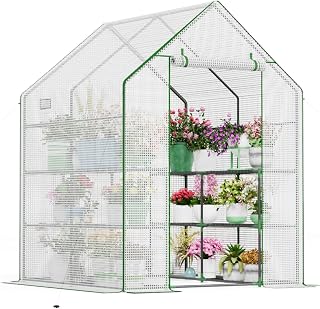
Quick Picks
| Product | Best for | Price |
|---|---|---|
| 56x30x76 Mini Walk-in | Narrow-spaced patios and balcony edges | n/a |
| Ohuhu Greenhouse | Budget buyers wanting shelf volume | $30 |
| OLIXIS 56x56x77 | Growers prioritizing a clear-view cover | n/a |
| Small 55x28x78 Walk-in | Seedlings on a tight footprint | n/a |
| The Greenhouse Gardener’s Manual | New greenhouse owners seeking technique | n/a |
| Greenhouse Gardener’s Companion | Food growers planning crops under glass | n/a |
| Gentingbro Lean-To | Side-wall installations against a garage | n/a |
| 57x57x76 Green House | Walk-in space on a moderate budget | n/a |
How We Picked
We evaluated each model on four criteria that separate a season-long performer from a first-winter casualty. First, structural integrity: does the steel frame flex at the joints under lateral load, and do the stakes resist pullout in sandy soil? Second, ventilation practicality: roll-up doors and screen windows must stay functional after repeated zip-and-velcro cycles. Third, shelf utility: tier spacing matters — shelves too close together waste vertical height, while flimsy wire gauges sag under trays. Fourth, cover durability: PE and PVC panels that resist UV degradation maintain humidity control, whereas cheap films cloud over and split along seams. We also factored in realistic price-to-space ratios so that budget shoppers get honest value rather than inflated claims.
The 8 Best Walk In Greenhouses For Gardeners in 2026
56x30x76 Mini Walk-in Greenhouse
This narrow-footprint model is for gardeners whose only real estate is a six-inch gap between a fence and a deck. The 30-inch depth is its defining feature and its primary limitation.
- Pro: The slim profile fits where wider units simply cannot, making it the only walk-in option for tight patio corners.
- Pro: Roll-up door combined with stakes and ropes gives you a genuinely functional wind anchor system on soft ground.
- Con: Thirty inches of depth means you cannot turn around comfortably while pruning or harvesting; you will work from one side.
Skip it if you have more than two linear feet of wall space to spare — wider models serve better in almost every other scenario.
Ohuhu Greenhouse with Screen Windows
At roughly thirty dollars, this is the most shelf-dense walk-in we compared, offering three tiers and twelve shelf stands. It is the obvious entry point for anyone who wants to verify that greenhouse gardening suits their routine before spending more.
- Pro: Twelve individual shelf stands give you genuine layout flexibility — you can stagger tiers to accommodate tall seedlings or flatten them for cuttings.
- Pro: Screen windows add cross-ventilation without requiring you to open the main door during a humid afternoon.
- Con: At this price the PE cover is noticeably thinner than mid-range competitors; expect to replace it after two seasons of full sun exposure.
Skip it if your site faces strong prevailing winds — the lighter cover and shelf-clip fasteners will not hold up under repeated gusting.
OLIXIS 56x56x77 Outdoor Greenhouse
The clear PVC cover is this model’s headline feature. For gardeners who want to photograph or inspect plants without opening the door — and who need maximum light transmission for seed starting — the transparency is genuinely useful.
- Pro: Clear PVC transmits noticeably more light than standard green PE, reducing the time seedlings need supplemental grow lamps.
- Pro: Two-tier shelf configuration with eight stands keeps the working height comfortable for most adults without requiring a step stool.
- Con: Clear covers show every water spot and algae bloom, and they degrade cosmetically faster than opaque alternatives in direct sun.
Skip it if you grow in full-sun locations where the clear film will turn yellow within a single season.
Small 55x28x78 Walk-in 3-Tier Greenhouse
Six panels and a tall, narrow footprint make this a strong pick for seasonal vegetable starts where you need height for indeterminate tomatoes but cannot spare width.
- Pro: Seventy-eight inches of interior height accommodates stake-supported crops without topping out.
- Pro: Six-panel construction means more access points than four-panel rivals, simplifying airflow management on breezy days.
- Con: The twenty-eight-inch depth forces a single-file working style; two people cannot share the interior simultaneously.
Skip it if you need a communal workspace or plan to bring potting tools inside alongside plants.
The Greenhouse Gardener’s Manual
This is not a structure — it is the reference book we recommend pairing with any walk-in purchase. For first-time greenhouse owners, the gap between “I have a greenhouse” and “I know how to manage humidity, temperature swings, and crop rotation under cover” is where most failures happen.
- Pro: Covers practical techniques like venting schedules and supplemental heating that no product manual will explain with this depth.
- Pro: Written for the home-scale grower, not commercial operations, so the advice maps directly to a six-by-six walk-in.
- Con: Contains no guidance on structure selection or DIY frame building — it assumes the greenhouse already exists.
Skip it if you have multiple seasons of under-cover experience; you already know what this book teaches.
Greenhouse Gardener’s Companion, Revised and Expanded Edition
Where the Manual leans structural, this title leans agronomic. It is the companion for food growers who want to plan succession plantings, intercrop under cover, and push harvest windows weeks past open-garden dates.
- Pro: Crop-by-crop guidance for vegetables and flowers grown specifically under greenhouse or sunspace conditions saves you a season of trial and error.
- Pro: The revised edition reflects modern cultivars and soilless media, keeping advice current without feeling like a rehash.
- Con: Dense enough that skimming will not serve you; budget real reading time if you want to extract the planning worksheets.
Skip it if your goal is ornamental houseplants rather than edible crops — the food-gardening focus narrows its applicability.
Gentingbro Lean-To Walk-in Warm Garden House
The lean-to format is the answer to a specific site constraint: you have a south-facing wall — a garage, shed, or house — and want to use it as a free windbreak and thermal mass. At seventy-nine by thirty-nine inches, this one attaches cleanly and keeps depth manageable.
- Pro: Two roll-up zipper doors on opposite sides of the front panel let you ventilate without letting cold drafts hit plants directly.
- Pro: Reinforced wall-mounting points mean the structure sheds snow load better than freestanding frames of similar size.
- Con: You are locked into one orientation; if your wall gets shaded by a new tree, the lean-to loses its thermal advantage entirely.
Skip it if you have no suitable wall or fence to anchor against — this format does not function freestanding.
57x57x76 Walk-in Greenhouse with Shelves Stands
A straightforward square-foot print, PE cover, and integrated shelf stands make this the middle-of-the-road choice for gardeners who want adequate volume without specialty features. It is the equivalent of a reliable sedan in this category.
- Pro: Symmetric square footprint means shelves align on all four sides, giving you even work height and no dead corners.
- Pro: Standard PE cover is inexpensive and widely available as a replacement part, so longevity depends on you, not on the manufacturer’s supply chain.
- Con: No standout differentiator — ventilation relies on a single door, and you will want to add a small battery fan for humid months.
Skip it if you need specialty venting, a lean-to format, or a clear cover; this unit does the basics competently and nothing more.
Buying Guide
Cover Material and Longevity
PE film is the workhorse of this category: affordable, light-diffusing, and replaceable. PVC offers better clarity and slightly higher rigidity but degrades visibly under UV in a single season unless treated with stabilizers. The decisive question is not “which material is better” but “will I buy a replacement cover or do I want the original to last three years.” Budget shoppers should pick a model whose cover is sold as a standalone spare part; premium buyers should look for UV-stabilized panels rated for multi-season sun exposure.
Shelf Configuration and Working Height
Walk-in means you stand inside and reach. Shelf tiers spaced twelve to sixteen inches apart suit seedling trays and small pots. If you grow tomatoes on stakes or hang baskets, you need at least one open tier of twenty-four inches or more. Count your actual plants before choosing tier count — a twelve-shelf unit sounds impressive until every shelf holds only two pots because the vertical spacing wastes your tallest crops. Adjustable or removable stands add flexibility that fixed tiers cannot.
Ventilation and Access Hardware
A single roll-up door creates a humidity trap in spring and an overheating risk in summer. Screen windows and secondary vent panels solve this cheaply, but zipper quality is the hidden failure point. Test every zipper before planting — a stuck slider means you will prop the door open and lose the enclosed environment. Stakes and ropes matter more than most reviewers acknowledge: a greenhouse that lifts off its anchors in a gust is a structure that will not survive its second season.
Our Verdict
Our top pick is the Ohuhu Greenhouse with Screen Windows. At thirty dollars it delivers the most usable shelf volume and the ventilation hardware that matters, and its replaceable cover keeps lifetime costs predictable. For gardeners who need a lean-to against an existing wall, the Gentingbro wins outright — no freestanding model matches its thermal-efficiency advantage. Budget buyers who want a clear-view cover for maximum light should consider the OLIXIS, accepting that its film will need cosmetic replacement sooner.
FAQ
Do walk-in greenhouses need a concrete base?
No. Most models ship with stakes and ropes designed for soft ground, and a leveled gravel pad or even compacted soil works well. A concrete slab is helpful for permanent installations but adds cost and prevents relocation. If you rotate crops seasonally or want to shift the structure for sun tracking, skip the foundation.
How many shelves do I actually need?
Count your seedling trays and pots at peak fill, then add a margin for tall crops. Most home gardeners starting under thirty plants do well with six to eight shelf positions. More shelves than that force you to reduce tier height, which wastes the vertical space you paid for with a walk-in design.
Can I grow vegetables year-round in a walk-in greenhouse?
In mild climates with frost dates under six weeks, yes for hardy crops like spinach, kale, and garlic. In colder zones you will need supplemental heating — even a small passive thermal-mass system or a thermostatically controlled heater. The structure buys you three to six extra weeks per end of season on average without added warmth.
What is the biggest mistake first-time greenhouse buyers make?
Overlooking ventilation. A walk-in greenhouse that is sealed tight with no way to cross-ventilate will hit lethal temperatures on a sunny March afternoon. Choose a model with at least one secondary opening — a screen window, a vent panel, or a removable top section — and plan to open it every day above fifty degrees.


