
Key takeaways
- Pros: Polymer jacket stays flexible in freezing temperatures where rubber turns board-stiff; leak-free couplings rated highly by owners after multiple seasons
- Con: Noticeably heavier than the lightest non-expanding rivals, making full-length storage harder for one person
What's inside
A 100 foot garden hose is the one piece of yard equipment that turns a two-minute watering job into a ten-minute wrestling match when it fails. Kinks that strangle flow, couplings that weep at every connection, rubber that goes stiff and cracked after one cold season — these are the real complaints that surface in owner reviews far more often than buyers expect when they first shop.
What separates the best 100 foot garden hose options from the forgettable ones comes down to three things: jacket construction that resists kinking under gravity, fitting quality that seals without thread tape on the first attempt, and a weight-to-flexibility balance that lets one person coil the hose without back strain. We compared published specs and aggregated owner feedback across these eight models to find which ones deliver on all three fronts.
As an Amazon Associate we earn from qualifying purchases at no extra cost to you. Product prices and availability are accurate as of the date shown and are subject to change.


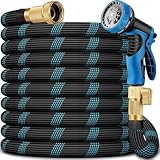


Quick Picks
| Product | Best for | Price |
|---|---|---|
| Flexzilla 5/8″ x 100 ft. | All-weather reliability | $69 |
| 100ft Non-Expandable with 8-Function Nozzle | Best value non-expanding | $49.97 |
| Garden Hose 100FT Ultra Lightweight | Lowest weight pickup | $37.99 |
| 2026 Upgraded 100 FT Non-Expandable | Feature-rich mid-range | $43.58 |
| Pocket Hose Ballistic 100 FT | Storage in tight spaces | $99.99 |
| BIONIC STEEL 100 Ft Metal Hose | Puncture and chew resistance | $47.99 |
| 100 FT High-Pressure Non-Expanding | Budget all-weather flexibility | $29.99 |
| 100ft Lightweight with Metal Fittings | Cheapest with brass couplings | $29.99 |
How We Picked
We narrowed this category using four criteria drawn from spec sheets and recurring themes in owner feedback: jacket material and wall thickness as indicators of kink resistance, fitting type (metal versus polymer) and coupling design for leak prevention, weight and flexibility for real-world handling, and nozzle or sprayer compatibility where included. Price-to-feature balance anchored every comparison.
The 8 Best 100 Foot Garden Hose in 2026
Flexzilla Garden Hose 5/8″ x 100 ft.
- Pros: Polymer jacket stays flexible in freezing temperatures where rubber turns board-stiff; leak-free couplings rated highly by owners after multiple seasons
- Con: Noticeably heavier than the lightest non-expanding rivals, making full-length storage harder for one person
Flexzilla has earned a reputation among long-time gardeners as the go-to replacement when cheaper hoses fail in winter. The all-weather polymer construction is its defining advantage — owners in northern states consistently report it coils without cracking at temperatures where vinyl hoses shatter. At $69 it carries a premium, but the durability narrative in reviews justifies the gap for anyone who leaves the hose outdoors year-round. Skip it if your primary concern is weight and you store the hose indoors during cold months, or if budget caps you below $50.
100ft Non-Expandable Garden Hose with 8 Function Spray Nozzle
- Pros: Three-quarter inch bore delivers noticeably higher flow than half-inch competitors at the same price; burst-resistant construction rated for high pressure
- Con: The included 8-function nozzle feels plasticky compared to standalone upgrades, and some owners report the pattern dial loosens over time
This model targets buyers who want maximum flow without paying the Flexzilla premium. The three-quarter inch diameter is a genuine spec advantage for filling pools or running sprinklers across large lawns. At $49.97 it sits in the mid-value bracket where you get real capacity plus an included nozzle. Skip it if you already own a quality spray wand you prefer, or if a narrower half-inch profile and lighter weight matter more than volume.
Garden Hose 100FT Non-Expanding Ultra Lightweight
- Pros: Lightest option in this group, making full-length dragging and coiling genuinely easy; compact enough to fit small storage sheds
- Con: Ultra-thin walls sacrifice burst resistance — owners on high municipal pressure report premature coupling separation
For anyone who has struggled with back strain after lugging a heavy hose across a backyard, this $37.99 option removes that friction entirely. The ultra-light construction means a smaller-framed gardener or a child can manage the full hundred feet without assistance. It is the right call for casual watering of flower beds and container gardens. Skip it if you run a booster pump, operate above sixty PSI, or need a hose that survives being dragged over gravel and rough concrete.
2026 Upgraded 100 FT Non-Expandable Garden Hose with 10 Function Sprayer
- Pros: Ten-function sprayer covers jet, mist, cone, and flat patterns in one unit; upgraded jacket resists kinking under its own length
- Con: The $43.58 price puts it just above simpler models that lack the included nozzle, making the value proposition narrower
This is the upgrade play in the mid-range tier, adding a more versatile sprayer and a reinforced jacket over base models. The ten-function head eliminates the need to buy a separate wand for most yard tasks, which effectively closes the price gap against bare-hose competitors. Owners praise the pressure-resistant design for holding seal at connections. Skip it if you already have a favorite nozzle or prefer a half-inch diameter for lighter weight, since the added features do not reduce overall mass significantly.
Pocket Hose Ballistic 100 FT Expandable Garden Hose
- Pros: Contracts to a fraction of its working length for storage in a drawer or hanging hook; ballistic fabric sleeve resists abrasion far better than plain latex expandables
- Con: Highest price in this group at $99.99, and expandable designs inherently deliver lower flow than rigid-jacket non-expandables of comparable bore
Pocket Hose solves the storage problem that plagues every other option here. A hundred feet of traditional hose demands a reel or a dedicated shelf; this model collapses to roughly a quarter of its extended length. The Ballistic tier adds a woven outer shell that addresses the number one complaint owners have had with earlier Pocket Hose generations: premature outer-layer fraying. Skip it if your priority is maximum flow rate or if you dislike the variable-diameter feel that expandables produce under pressure.
BIONIC STEEL 100 Ft Metal Garden Hose with Sprayer Nozzle
- Pros: Steel-braided exterior is virtually immune to punctures from dog teeth, garden shears, and gravel; cools quickly after sun exposure
- Con: Metal construction adds substantial weight and can scratch painted surfaces or siding if dragged carelessly
This is the hose for households where previous hoses died from causes other than normal wear. If you have a dog that chews garden equipment, a cat that sleeps on the lawn, or a property bordering gravel, the steel braid eliminates those failure modes at $47.99. The included sprayer nozzle handles common patterns without a separate purchase. Skip it if you live in a region with freeze cycles where moisture trapped in the metal weave can expand and compromise fittings, or if weight is your primary handling concern.
100 FT High-Pressure Non-Expanding Garden Hose
- Pros: Lowest price in this group at $29.99 while still claiming burst resistance and all-weather flexibility; kink-free jacket rated for higher PSI than budget vinyl competitors
- Con: Minimal brand presence and no bundled accessories, so replacement fittings or nozzles may require separate purchases with uncertain compatibility
For buyers who simply need a functioning hundred-foot hose at the absolute lowest entry price, this model delivers the core requirements — length, flexibility, kink resistance, and pressure tolerance — without extras. Owner reviews highlight that it punches above its price in daily use for lawn and garden watering. Skip it if you want a hose that survives being left outdoors through a full freeze-thaw cycle, or if you value a bundled nozzle and brand support infrastructure.
100ft Lightweight Garden Hose with 3/4″ Metal Fittings and 10-Function Nozzle
- Pros: Three-quarter inch metal fittings provide a secure, threaded seal that resists stripping far better than polymer couplings; ten-function nozzle adds spray versatility at no extra cost
- Con: Jacket material is thinner than premium competitors to hit the $29.99 price point, limiting lifespan under heavy daily use or UV exposure
The metal fittings are the headline feature here. At the same $29.99 price as the previous entry, this model upgrades the weakest link in budget hoses — the couplings — to solid metal that holds thread integrity through repeated connections. The ten-function nozzle further increases out-of-box utility. Skip it if you expect the hose to last more than two or three seasons of regular use, since the jacket will degrade before the fittings do.
Buying Guide
Wall Thickness and Bore Diameter
The half-inch versus three-quarter-inch distinction is the most consequential spec choice. A three-quarter inch bore moves significantly more water per minute, which matters when filling a wading pool, running a soaker line across a full lawn, or feeding a pressure washer. The tradeoff is weight and cost. Wall thickness determines burst resistance — thin walls on ultra-light hoses save pounds but fail under sustained pressure above fifty PSI. Match bore to your highest-flow task, then select the thickest wall your budget and handling tolerance allow.
Jacket Material and Weather Tolerance
Polymer jackets (like Flexzilla’s) maintain flexibility from deep freeze through summer heat but cost more. Vinyl and rubber compounds are cheaper but stiffen in cold and degrade faster under UV. Metal braided sleeves offer unmatched puncture resistance but add weight and can scratch surfaces. Expandable hoses use a latex inner tube with a fabric outer sleeve that collapses for storage — convenient for tight garages but a common source of burst failures at higher pressures. Choose based on your climate and storage constraints, not marketing adjectives.
Fittings, Couplings, and Leak Prevention
Metal couplings hold threads longer and seal tighter than polymer ones, especially under repeated attachment and detachment cycles. Look for gasketed or O-ring sealed connections rather than relying on thread compression alone. A leaking coupling wastes water and frustrates the user within weeks. If a product does not specify fitting material, assume polymer and budget for replacement gaskets or plan to swap to universal metal connectors.
Our Verdict
The Flexzilla is the best 100 foot garden hose for most buyers seeking a one-purchase solution that survives full-year outdoor exposure without drama. The 100 FT High-Pressure Non-Expanding at $29.99 is the clear budget pick for warm-climate gardeners who store the hose seasonally. However, if your storage space cannot accommodate a full-length coiled hose, the Pocket Hose Ballistic wins decisively despite its higher price, because no other option here collapses to a fraction of its working length.
FAQ
Do expandable hoses lose pressure over time?
Yes. The latex or TPU inner tube in expandable hoses gradually loses elasticity, resulting in reduced expansion ratio and slower contraction. Owners of budget expandables commonly report flow degradation within two seasons of regular use, which is why fabric-sleeved premium models like the Pocket Hose Ballistic attempt to slow the process.
Is a half-inch or three-quarter inch hose better for a large lawn?
Three-quarter inch delivers meaningfully higher volume, which reduces the time needed to water expansive areas. For lawns over roughly five thousand square feet or for running in-ground sprinkler zones, the larger bore is the practical choice. Half-inch hoses suffice for beds, borders, and container watering.
Why do garden hoses leak at the faucet connection?
The most common cause is a worn or compressed rubber washer inside the female coupling. Hard water accelerates washer degradation, and repeated tightening crushes the seal. A small tube of plumber’s tape on the male threads or a washer replacement resolves most cases without needing a new hose.
Can I leave a garden hose connected to the spigot in winter?
No. Even at moderate cold, trapped water inside the hose expands as it freezes and can split the jacket or push couplings apart. Disconnect, drain by elevating one end, and store indoors before the first frost. All-weather polymer jackets resist cold cracking while stored empty but still cannot survive being full of frozen water.


