
Key takeaways
- Double ballistic nylon jacket resists cuts and UV degradation
- Collapses to roughly one-third its full length for compact storage
- Expandable cores remain vulnerable to punctures from thorns or sharp edging
What's inside
A 75-foot garden hose is the length most homeowners actually need. Forty feet falls short of the far corners of a typical yard, and a full 100-footer is heavier and harder to coil than most people realize once they factor in water weight. The real question is what separates a hose that survives two seasons from one that kinks, splits at the fittings, or goes rock-hard in the first frost.
Across published specifications and owner-reported durability patterns, the meaningful differentiators are jacket material, fitting construction, and whether the hose is expandable or traditional. A nylon-braided hybrid will behave very differently from a stainless-steel coil or a polymer expandable tube, and price alone does not predict which will last. This roundup compares eight models in the 75-foot class using their stated specs, retail pricing, and recurring owner feedback to identify where each one actually fits.
As an Amazon Associate we earn from qualifying purchases at no extra cost to you. Product prices and availability are accurate as of the date shown and are subject to change.


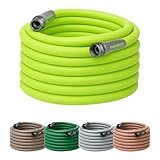


Quick Picks
| Product | Best for | Price |
|---|---|---|
| Pocket Hose Ballistic Double UV | Maximum durability in an expandable design | $64.99 |
| Heavy Duty Hybrid Hose | Reliable traditional hose at a low price | $35.99 |
| Flexzilla All-Weather | Cold-climate flexibility | $54.98 |
| Ultra Lightweight Non-Expanding | Easy storage with no expansion risk | $39.99 |
| Pocket Hose Ballistic No-Kink | Premium expandable with proven track record | $89.99 |
| Bionic Steel 304 Stainless | Crush resistance and rust-proof longevity | $35.99 |
| Flexible Hose with Sprayer | All-in-one watering with brass fittings | $39.89 |
| High Pressure Lightweight | Budget flexibility and burst resistance | $34.99 |
How We Picked
We filtered these eight models on four criteria that matter most for a 75-foot hose: jacket and core material (which governs kink resistance and burst pressure), fitting type (all-metal fittings consistently outperform plastic in long-term reviews), weight per foot when full (a 75-footer already carries roughly 35 to 40 pounds of water, so base weight compounds), and expandable versus non-expandable construction (expandables save storage space but introduce a failure mode that traditional hoses avoid). Price was tracked as the final tiebreaker, since several models in this group sit within a five-dollar band.
The 8 Best 75 Foot Garden Hose in 2026
Pocket Hose Ballistic Double UV
This expandable hose adds a second layer of ballistic weave over Pocket Hose’s standard polymer core, targeting buyers who want the storage convenience of a telescoping design without the single-fiber vulnerability of cheaper expandables. The UV-treated outer shell addresses the most common failure in expandable hoses: sun degradation that makes the jacket brittle after a season or two of exposure. Owner feedback consistently highlights its resistance to snags when dragging across rough concrete or gravel driveways. The trade-off is that even a double-weave expandable will not match a solid rubber or hybrid traditional hose in raw pressure handling. Skip this one if your water pressure exceeds 80 PSI or if you need a hose that can be run over by a riding mower.
- Double ballistic nylon jacket resists cuts and UV degradation
- Collapses to roughly one-third its full length for compact storage
- Expandable cores remain vulnerable to punctures from thorns or sharp edging
Heavy Duty Hybrid Hose
This model occupies the sweet spot for buyers who want a traditional hose construction without the weight penalty of all-rubber designs. The hybrid polymer-and-fabric jacket keeps the hose flexible below freezing while the male-to-female brass fittings prevent the stripped-thread frustration that owners of cheaper models report within months. At 5/8-inch inner diameter it flows adequately for two-handed watering tasks. It will not store as compactly as an expandable, and the weight per foot when full is real, so carrying a full 75-footer up stairs is not a pleasant job. Skip if your priority is the lightest possible coil or if you need a retractable system.
- Brass fittings resist stripping and cross-threading under repeated use
- Hybrid jacket stays pliable in cold weather better than pure vinyl
- Full weight makes it less ideal for elevated deck or rooftop use
Flexzilla All-Weather
Flexzilla built its reputation in the professional landscaping world on one specific feature: it does not go limp and memory-coiled in cold temperatures. The polyurethane outer jacket maintains flexibility down to well below freezing, which matters for anyone in a northern climate who waters beds in early spring or late autumn. Owner feedback praises the leak-free swivel connections and the absence of a chemical odor that plagues some cheaper PVC-lined hoses. The 75-foot length is available in the 5/8-inch diameter shown here, and its weight is competitive for a traditional hose. Skip if you want the absolute lowest price or need a hose that packs into a tight storage box.
- Remains flexible in sub-freezing temperatures
- Swivel-grip connections resist leaks at the coupling points
- Higher price than comparable traditional hoses without the cold-weather advantage being relevant to every buyer
Ultra Lightweight Non-Expanding
This hose targets the buyer who liked the idea of an expandable but grew tired of splitting jackets and blown connectors. By using a thin-walled reinforced polymer instead of fabric, it cuts weight significantly over a traditional hybrid while eliminating the expansion failure mode entirely. Owners highlight that it coils with less effort than a comparable rubber hose and carries comfortably. The trade-off is reduced abrasion resistance; dragging it across rough surfaces for years will show wear faster than a braided jacket would. Skip if you have rocky terrain, sharp fencing, or a dog that chews hoses.
- Noticeably lighter than traditional hybrid or rubber alternatives
- No expansion mechanism means one fewer point of failure
- Thinner jacket is less forgiving against abrasion and sharp edges
Pocket Hose Ballistic No-Kink
The original Pocket Hose design remains popular for good reason, and this Ballistic tier reinforces the core with a denser weave than the standard model. As Seen on TV branding aside, owners who have replaced multiple cheap expandables report that this generation holds up through several full seasons of regular use. The no-kink claim is credible because the hose stays short during storage and only extends under water pressure, meaning there is no long floppy section to bend. At the highest price in this roundup it is a premium pick, and the value proposition depends on how much storage convenience is worth to you. Skip if budget is the primary constraint or if you have water pressure above 70 PSI.
- Reinforced ballistic weave improves puncture resistance over standard expandables
- Extends only under pressure, eliminating kink-prone slack sections
- Highest price in this group, and expandable construction still limits burst tolerance
Bionic Steel 304 Stainless
A stainless-steel coil hose is an unusual animal, and the Bionic Steel 75-footer fills a specific niche: buyers who want something that cannot be crushed, will not rust, and holds up to dog teeth or riding-mower wheels. The 304-grade braided steel exterior is genuinely tough, and the lightweight claim is honest because the internal polymer tube carries the water while the steel acts as armor. Owners consistently note the absence of the rubber smell and the near-indestructible quality. The limitation is that steel coil hoses have higher memory than polymer jackets; they will try to spring back into their original coil shape, making them awkward on a reel or around fence posts. Skip if you need a hose that lays dead-flat or stores on a hanging rack.
- Crush-proof and rust-proof 304 stainless exterior resists physical damage
- Internal polymer tube keeps water weight manageable
- Steel coil has strong shape memory, making it difficult to lay flat or reel neatly
Flexible Hose with Sprayer
This kit bundles a 75-foot lightweight hose with a 10-function spray nozzle, which is genuinely convenient for the buyer who does not want to source accessories separately. The 3/4-inch brass fittings are a meaningful upgrade over the plastic couplers that cause most early failures in budget hoses, and the kink-free construction is consistent with the thin polymer jacket design seen in this category. Black-and-orange color scheme is cosmetic but makes it easy to spot on grass. Owner feedback is mixed on the included sprayer longevity, with some reporting nozzle failures before the hose itself wears out. Skip if you already own a preferred spray nozzle and would rather buy a standalone hose at a lower price.
- 3/4-inch brass fittings outperform plastic couplers in durability
- Included 10-function sprayer makes it a complete starter kit
- Bundle sprayer quality is lower than what dedicated nozzle buyers expect
High Pressure Lightweight
At the lowest price in this roundup, this non-expanding hose is the default answer for a buyer who wants adequate performance without spending more than the cost of a nice dinner. The lightweight polymer jacket keeps it manageable to carry and coil, and the burst-resistant construction means it will hold normal municipal pressure well. Kink resistance is a claim here that owners largely support, though it is not at the level of Flexzilla’s polyurethane jacket in true cold weather. Skip if you live in a region where winter temperatures regularly drop below 20 degrees, as thin polymer can stiffen noticeably even if it does not crack.
- Lowest cost with a non-expanding design that eliminates jacket-split failure
- Burst-resistant rating covers typical residential water pressure comfortably
- Stiffens in deep cold more noticeably than premium polyurethane jackets
Buying Guide
Traditional vs. Expandable: Which Solves Your Problem?
Expandable hoses collapse to a fraction of their working length, which is a genuine advantage if storage space is limited or if the hose must fit in a small shed, a truck bed with other gear, or a balcony closet. The trade-off is that every expandable relies on an internal polymer tube surrounded by a fabric sleeve, and that tube is the weak point. It can develop pinhole leaks from thorns, ant bites, or even aggressive lawn edging. A traditional hose with a reinforced jacket has no separate inner tube to puncture, so it will generally last longer in harsh environments. Choose expandable for convenience and protected storage; choose traditional for durability and rough terrain.
Fittings Determine Lifespan More Than Jacket Material
The most common premature failure reported across all price tiers is not a hole in the hose itself but a stripped, cracked, or leaking coupling. Metal fittings — specifically solid brass — resist the repeated torque of tightening and loosening on spigots and quick-connect nozzles. Plastic or zinc-alloy fittings will crack at the thread base within a year or two of regular use. When comparing models, look at whether both ends use the same material. A hose with one brass and one aluminum fitting is a compromise that will fail at the softer metal. The best 75 foot garden hose for long-term value is one where the couplings are rated to outlast the jacket.
Weight and Flow Rate at 75 Feet
Water weighs roughly 8.3 pounds per gallon, and a 75-foot section of 5/8-inch inner diameter hose holds approximately 3.5 to 4 gallons when full, adding 30 to 35 pounds of water weight on top of the hose’s own mass. If your route from spigot to garden involves steps, slopes, or long carries, start with the lightest hose that meets your pressure needs. Inner diameter is the primary driver of flow rate: 5/8-inch is the practical minimum for comfortable watering at 75 feet, and anything below that will feel sluggish at the nozzle, especially if you are using a multi-setting sprayer.
Our Verdict
The top pick is the Flexzilla All-Weather 75-foot for the combination of cold-temperature reliability, leak-free connections, and the consistent owner satisfaction that has built its reputation across seasons. If you never water in freezing or near-freezing conditions, the Bionic Steel 304 Stainless is the best 75 foot garden hose for buyers who want a virtually indestructible jacket at a mid-range price. The budget pick is the High Pressure Lightweight Non-Expanding at the lowest cost in this group, offering dependable everyday performance without the complexity of an expandable design.
FAQ
How long does a 75-foot garden hose take to drain?
A 75-foot 5/8-inch hose holds roughly 3.5 to 4 gallons of water. Draining by gravity takes a few minutes if you elevate the nozzle end, and blowing it out with a compressed air line reduces that to seconds. In climates with freeze risk, a full drain before winter is essential regardless of hose type.
Is 75 feet enough for a typical yard?
For most single-family residential lots up to a quarter acre, 75 feet reaches every zone from a side-yard spigot without needing a hose extension. If your farthest garden bed is more than 75 feet from the water source, consider two shorter hoses with a female-to-female coupling rather than a single 100-footer, since the extra length adds weight you carry for the last few feet.
Can a garden hose be repaired if it splits?
Yes. Standard repair couplings or splice kits are widely available and take about ten minutes to install with a utility knife. The repair is structurally sound for typical pressures but does create a slight kink point. If the split is within a few inches of a fitting, replacing the coupling entirely is cleaner.
Do expandable hoses lose their length over time?
The internal polymer tube in expandable hoses stretches and does not fully contract after repeated pressurization cycles. Owners of budget expandables commonly report the hose becoming permanently longer and floppier after two or three seasons, which is the mechanism behind the “no-kink” design’s eventual degradation. Reinforced ballistic jackets slow this process but do not eliminate it.


