
Key takeaways
- Pro: Ten spray functions included, no separate nozzle purchase needed
- Pro: Leak-proof and pressure-resistant construction rated for daily use
- Con: Full weight can be awkward for elderly or younger users
What's inside
A hundred-foot garden hose is a specific kind of commitment. You are dragging a long, heavy rubber tube across a yard, hoping it reaches the far flower bed without kinking, leaking at the couplings, or collapsing into a tangle the first time you set it down. The problem is that most shoppers compare hoses by length and price alone, then discover that burst rating, fitting quality, and weight per foot matter far more once you are two weeks into the growing season.
What separates a good 100-foot hose from a mediocre one comes down to construction: the core material (vinyl, hybrid polymer, or coated steel), whether the hose is expandable or non-expandable, how many layers protect against abrasion, and whether the crimped or swaged fittings actually stay watertight under pressure. Owner feedback consistently shows that the cheapest hoses fail first at the couplings, not along the body. This roundup compares published specifications, current prices, and aggregated owner reviews to help you find the right balance of durability, flexibility, and value.
As an Amazon Associate we earn from qualifying purchases at no extra cost to you. Product prices and availability are accurate as of the date shown and are subject to change.


Quick Picks
| Product | Best for | Price |
|---|---|---|
| 100 FT Non-Expandable (2026 Upgraded) | Best overall value | $43.58 |
| 100ft Non-Expandable (8 Function) | Car washing and yard cleanup | $49.97 |
| Flexzilla 5/8 in. x 100 ft. | All-season durability | $69 |
| Garden Hose 100FT (Ultra Lightweight) | Minimal cost without expandables | $37.99 |
| 100 FT Non-Expanding (Burst-Resistant) | Lowest price entry | $29.99 |
| Pocket Hose Ballistic | Maximum reach per stored inch | $99.99 |
| BIONIC STEEL 100 Ft | Rodent and puncture resistance | $47.99 |
| Garden Hose Water Hose (10-Function) | Budget flexibility | $29.99 |
How We Picked
We evaluated each hose on four criteria that owner reviews repeatedly flag as deal-breakers: construction integrity (layer count and core material), fitting quality (metal versus plastic couplings and whether they corrode or strip over time), manageability (weight per foot and kink resistance in practice), and accessory value (number and quality of included spray nozzle patterns). Price is weighed relative to the durability tier rather than treated in isolation.
The 8 Best Garden Hose 100 Ft in 2026
100 FT Non-Expandable (2026 Upgraded)
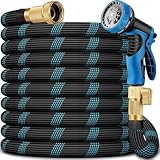
This hose sits in a strong middle ground: it avoids the durability questions that plague expandable hoses while staying light enough for a single person to coil without a cart. Owners praise the 10-function sprayer for offering genuinely useful patterns without extra hardware. The non-expandable design means no water pressure loss at the far end, which matters on sloped yards. The trade-off is weight: at a full hundred feet it is noticeably heavier than the ultra-light options above it. Skip this if you have mobility concerns or need to store the hose in a small box.
- Pro: Ten spray functions included, no separate nozzle purchase needed
- Pro: Leak-proof and pressure-resistant construction rated for daily use
- Con: Full weight can be awkward for elderly or younger users
100ft Non-Expandable (8 Function)
Designed around hard-surface tasks like car washing and patio rinsing, this hose pairs a kink-free body with an eight-function nozzle that covers the most common spray patterns. The three-quarter-inch diameter delivers solid volume at the end of a long run. Owners note it stays flexible in cooler mornings without the stiffness that plagues cheaper vinyl. The con is that eight functions means fewer specialty options like shower or cone compared to ten-function competitors. Skip it if you water delicate seedlings that need a gentle mist pattern.
- Pro: Burst-resistant wall construction with three-quarter-inch flow diameter
- Pro: Stays flexible in cool weather without kinking
- Con: Eight-function nozzle lacks fine-mist settings for seedlings
Flexzilla 5/8 in. x 100 ft.
Flexzilla has built a reputation among professional landscapers, and this model continues that trend. The hybrid polymer core resists memory kinks and stays supple from deep winter into summer heat without a heated storage garage. Leak-free connections at both ends address the most common failure point in budget hoses. The cost is the obvious drawback: at nearly double the price of the cheapest options, you are paying for a brand and a polymer blend that outlasts vinyl. Skip it if your budget tops out below fifty dollars and you replace hoses seasonally anyway.
- Pro: All-weather flexibility without kink memory
- Pro: Leak-free connection system reduces coupling failures
- Con: Highest non-premium price in this group
Garden Hose 100FT (Ultra Lightweight)
For anyone who has struggled with a coiled rubber hose digging into the shoulder, this model prioritizes minimum weight above nearly every other attribute. Owners with small yards and light-duty watering needs report that it is easy to drag and store in tight spaces. The simplicity is also its weakness: with no listed spray nozzle or function count, you will likely buy one separately, eroding the savings. Skip it if you need a ready-to-use kit or plan to wash vehicles.
- Pro: Among the lightest 100-foot non-expandable options available
- Pro: Easy to coil and store in compact spaces
- Con: No spray nozzle included, increasing real-world cost
100 FT Non-Expanding (Burst-Resistant)
At under thirty dollars this is the floor price for a non-expandable hundred-footer, and owners confirm it performs adequately for routine lawn watering. The burst-resistant and kink-free claims hold up under normal household pressure, and the high-pressure rating gives some margin for users on elevated or long-driveway properties. The limitation is long-term durability: reviewers note that the vinyl body stiffens after one full season of UV exposure. Skip it if you need a multi-season hose or store it outdoors year-round.
- Pro: Lowest entry price for a non-expandable 100-foot hose
- Pro: Kink-free and burst-resistant for standard household pressure
- Con: Vinyl body tends to stiffen after one season outdoors
Pocket Hose Ballistic
The Pocket Hose concept is unique: a fabric-encased expandable core that shrinks to a fraction of its deployed length when water is off, making storage trivial even in a closet or shed corner. The Ballistic edition adds a tougher outer weave to resist abrasion from gravel and concrete. Owners with zero storage space call it a genuine problem solver. The drawbacks are price and the inherent trade-offs of any expandable hose, including reduced flow volume and longer fill time at the far end. Skip it if you need high-volume flow for filling pools or running sprinklers.
- Pro: Collapses to a fraction of deployed length for easy storage
- Pro: Ballistic weave resists punctures better than standard expandables
- Con: Highest price in this group and reduced flow volume
BIONIC STEEL 100 Ft
A stainless steel braided body sets this apart from every vinyl or polymer option here. Owners specifically buy it for one reason: rodent resistance. In rural or suburban yards where squirrels or rats chew through rubber hoses, the steel casing is essentially chew-proof. It is also weather-resistant without the UV degradation of vinyl. The downside is weight and handling: a steel-braided hundred-footer is rigid compared to polymer hoses and can scratch painted surfaces or delicate flowers if dragged carelessly. Skip it if you water in tight garden beds or need soft, easy-to-coil storage.
- Pro: Stainless steel casing resists rodent chewing and punctures
- Pro: No UV degradation, suitable for year-round outdoor storage
- Con: Rigid and heavy, can scratch surfaces or damage plants when dragged
Garden Hose Water Hose (10-Function)
This model mirrors the value proposition of the top pick at the lowest possible price point. Ten included spray functions, three-quarter-inch metal fittings, and a kink-free body make it a complete kit under thirty dollars. Owners who bought it for occasional yard use report solid first-season performance. The concern raised in repeated reviews is fitting longevity: metal couplings at this price tier sometimes develop slow seepage after heavy use. Skip it if you run the hose daily through a full season and cannot tolerate a small leak at the tap end.
- Pro: Ten-function nozzle and metal fittings included at bottom-tier price
- Pro: Kink-free and weather resistant for standard yard tasks
- Con: Metal couplings may develop seepage with frequent heavy use
Buying Guide
Expandable Versus Non-Expandable
Non-expandable hoses deliver full water pressure to the nozzle regardless of length, making them the right choice for sprinklers, pressure washers, or sloped terrain where pressure loss matters. Expandable hoses trade flow volume for storage convenience. If you have no shed or garage and must hang the hose in a small space, the collapse benefit can justify the lower flow. Otherwise, stick with non-expandable.
Fitting Material and Connection Method
Plastic fittings cost less but strip and crack within a season, especially when the hose is under pressure or dragged across concrete. Metal fittings (brass or zinc-alloy) resist stripping but can corrode or seep if the crimp is poor. When comparing hoses in the same price band, a model with swaged metal couplings and rubber gaskets at both ends will last noticeably longer than one with molded plastic ends. Check owner reviews specifically for the word “leak” to catch this before buying.
Weight Per Foot and Manageability
A hundred feet of hose weighs between fifteen and thirty-five pounds depending on core material and wall thickness. For reference, lightweight polymer hoses fall near the bottom of that range, while steel-braided or multi-layer vinyl options reach the top. If you will drag the hose across an acre of property or coil it daily without a reel, every extra pound per foot compounds over the season. Match the weight class to your physical routine rather than defaulting to the thickest wall you can find.
Our Verdict
Our top pick is the 100 FT Non-Expandable (2026 Upgraded) at $43.58. It combines a ten-function sprayer, pressure resistance, and a flexible non-expandable body at a price that undercuts Flexzilla while delivering comparable daily usefulness. Our budget pick is the Garden Hose Water Hose (10-Function) at $29.99, which offers a complete kit at the floor price, provided you accept potential coupling wear over multiple seasons. If rodents are your primary concern, the BIONIC STEEL wins outright despite its weight, because no polymer construction in this group matches chew resistance.
FAQ
What diameter hose delivers the best flow at 100 feet?
A three-quarter-inch inner diameter delivers the highest volume per minute, but it adds noticeable weight over a full hundred feet. The five-eighths-inch diameter used by Flexzilla offers a practical compromise, providing adequate volume for most garden tasks while keeping the hose light enough to drag easily. Choose three-quarter-inch only if you run multiple sprinklers or need to fill a pool or tank at speed.
Is an expandable hose worth the extra cost?
Only if storage space is your binding constraint. Expandables collapse when the water is off, shrinking from a bulky coil to a soft fabric sleeve, which solves the storage problem in apartments, sheds with limited floor area, or tight garage corners. For anyone with even modest storage space, a non-expandable hose is simpler, cheaper, and delivers better flow.
How long should a 100-foot garden hose last?
With indoor or shaded storage, a quality non-expandable hose lasts three to five seasons before the outer layer shows significant cracking or the fittings begin to seep. Hoses left outdoors in direct sun year-round degrade faster, typically showing UV brittleness within one to two seasons regardless of price tier. A cover, reel box, or short extension of shaded storage time adds measurable lifespan.
Do spray nozzle function counts actually matter?
Yes, but only after the core three patterns (jet, mist, and cone) are covered. Most owners use two or three settings routinely, so a ten-function nozzle matters mainly if you have specific tasks like watering at seedling depth or rinsing siding at a narrow cone. Beyond ten functions, extra settings tend to be rarely used novelty patterns that add cost without real benefit.


