
Key takeaways
- Pro: Truly wire-free — no boundary wire to install or maintain on uneven ground
- Pro: Lowest price of any wire-free model here
- Con: No published slope rating; brush traction is limited on anything beyond a gentle grade
What's inside
Every homeowner with a sloped yard knows the same frustrating truth: most robot mowers are designed for manicured, flat suburban lawns and simply cannot handle the physics of a hillside. They slip, they spin out, they leave uncut strips along steep banks, and they abandon the job when the incline exceeds their traction limits. Finding the best robot mower for hills means prioritizing drive systems, navigation accuracy, and grade ratings over marketing buzzwords about app interfaces or blade design.
The eight models we compared for this 2026 roundup represent the current range of solutions, from budget-friendly wire-free units that handle gentle slopes to all-wheel-drive machines rated for 84% grades and a hybrid crawler track unit designed for terrain most mowers would refuse outright. What separates the winners from the failures in this category is not price — it is whether the drive system, navigation method, and slope rating match the actual terrain on your property.
As an Amazon Associate we earn from qualifying purchases at no extra cost to you. Product prices and availability are accurate as of the date shown and are subject to change.

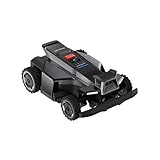
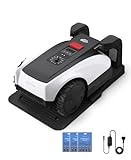
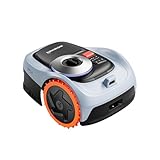


Quick Picks
| Product | Best for | Price |
|---|---|---|
| WORX Wire-Free 1/4 Acre | Small lawns with gentle slopes | $799.99 |
| Segway Navimow X430 | Large properties with steep terrain | $2249 |
| ECOVACS Goat O1000 RTK | Best value RTK navigation | $664 |
| Segway Navimow i206 | Small yards with moderate slopes | $899 |
| AIWEIYA Hybrid Crawler Track | Extreme inclines and professional estates | $1748 |
| ECOVACS Goat A2000 LiDAR PRO | LiDAR precision at a mid-range price | $1399 |
| Sunseeker X5 AWD | Medium properties with mixed terrain | $1384 |
| ECOVACS Goat O1000 LiDAR PRO | Premium features on a quarter-acre lot | $999 |
How We Picked
We focused on four criteria that directly determine hill performance: slope rating (how steep a grade the unit is actually engineered to climb), drive type (all-wheel drive, tracked, or standard rear-wheel with brushes), navigation system (RTK, LiDAR, or vision-based — which dictates path reliability on uneven ground), and cutting height range (because steep banks often need taller blade settings to avoid scalping). Owner feedback on real-world slip recovery and boundary handling on slopes rounded out the evaluation.
The 8 Best Robot Mower For Hills in 2026
WORX Wire-Free 1/4 Acre
This is the entry-level option for anyone whose “hill” is a gentle crown in the yard rather than a true grade. Wire-free setup eliminates boundary wire headaches on sloped terrain where burying a wire is impractical, and the brush-based traction system handles mild undulations without issue.
- Pro: Truly wire-free — no boundary wire to install or maintain on uneven ground
- Pro: Lowest price of any wire-free model here
- Con: No published slope rating; brush traction is limited on anything beyond a gentle grade
Skip it if your yard has a sustained incline above roughly 15%. Owners on steeper terrain report frequent wheel spin and incomplete coverage.
Segway Navimow X430
The X430 is the most capable robotic unit on this list for genuine hillside work. Its 4WD system is rated for 84% slopes — roughly 40 degrees — and the zero-turn capability means it can reposition on steep banks without dragging its rear end and tearing turf. The dual 180W motors provide consistent torque under load, and the 0.75-to-4-inch cutting range lets you raise the deck on inclines to prevent scalping.
- Pro: 84% slope rating with 4WD and zero-turn for damage-free mowing on grades
- Pro: Covers up to 1 acre, handling large sloped properties in fewer cycles
- Con: $2249 is the steepest price tag among the robot mowers listed
Skip it if your property is small or your slope is mild — you are paying for capability you will not use.
ECOVACS Goat O1000 RTK
At $664, this is the least expensive way to get RTK satellite navigation on a sloped quarter-acre. RTK matters on hills because GPS-only guidance drifts more when the mower tilts, and RTK correction keeps the path tight. The coverage area matches the WORX and the Goat LiDAR model, but the navigation method is more suited to terrain that shifts the unit’s angle frequently.
- Pro: RTK navigation at the lowest price point in this group
- Pro: Compact coverage area suits smaller sloped gardens without wasted runtime
- Con: No published slope rating, so you are inferring performance from the navigation system alone
Skip it if you need confirmed grade capability numbers for a property with a documented steep pitch — look to the Segway or AIWEIYA instead.
Segway Navimow i206
AWD at $899 makes this a strong middle option for smaller sloped yards. The 45% slope rating (approximately 24 degrees) covers most residential backyard hills that frustrate two-wheel-drive mowers, and the 0.15-acre coverage area keeps it focused on compact properties where a larger unit would over-engineer the job.
- Pro: All-wheel drive with a published 45% slope rating at under $900
- Pro: Right-sized for small yards, meaning shorter charge cycles and less runtime waste
- Con: Only covers 0.15 acre — too small for most properties where a serious hill is an issue
Skip it if your yard exceeds roughly a quarter-acre or if the slope is steeper than 24 degrees.
AIWEIYA Hybrid Crawler Track
This is not a robot mower in the conventional sense — it is a remote-controlled crawler track unit with an oil-electric hybrid drive. That distinction makes it the only option here rated for 100% slope (45°), which is a near-vertical bank. The crawler tracks distribute weight far more evenly than wheels, eliminating the spin-out problem that defeats even the best 4WD robot. The 1.1-to-5.9-inch cutting range handles thick brush and tall grass that would choke a standard mower.
- Pro: Crawler tracks rated for 100% slope — the only unit here for truly extreme terrain
- Pro: Hybrid power delivers sustained torque on demanding banks without battery anxiety
- Con: Requires remote operation — it is not a hands-free “set and forget” machine
Skip it if you want full autonomy. This is a professional-grade tool for estate owners who need a specific bank mowed and will accept walking behind a remote to do it.
ECOVACS Goat A2000 LiDAR PRO
Dual LiDAR navigation at $1399 positions this as the mid-range choice for owners with larger properties and moderate slopes. LiDAR builds a real-time map of the terrain surface, which helps the mower adjust its path to avoid depressions and crowned sections that confuse wheel-based units. It is a sensible step up from RTK-only models when your budget allows but the Navimow X430 feels excessive.
- Pro: Dual LiDAR navigation adapts path planning to uneven surface geometry
- Pro: Strong balance of navigation sophistication and price between the RTK and 4WD extremes
- Con: No published slope rating or coverage area in the listed specs, leaving hill performance to inference
Skip it if you need a hard grade number to justify the purchase for insurance or property-management requirements.
Sunseeker X5 AWD
The Sunseeker combines RTK with a Vision AI camera system and all-wheel drive for 0.5 acres of coverage. That dual navigation approach — satellite positioning reinforced by visual cues — addresses a specific hillside weakness: RTK signal quality can degrade when the mower tilts away from sky view, and the camera fills that gap by reading the ground directly. At $1384, it sits in the same price tier as the Goat A2000 but trades LiDAR for vision-plus-RTK.
- Pro: RTK plus Vision AI gives redundancy on slopes where either system alone might struggle
- Pro: 0.5-acre coverage handles most suburban hillside properties without oversizing
- Con: Limited owner feedback compared to the more established ECOVACS and Segway platforms
Skip it if you prioritize community support, long-term app reliability, or established parts availability over the newest hardware combination.
ECOVACS Goat O1000 LiDAR PRO
The premium small-lawn model in the Goat lineup adds dual LiDAR, built-in edge trimming, and AI obstacle avoidance at $999 for a quarter-acre. The edge trimming feature is genuinely useful on sloped lawns where the mower boundary meets a bank and the last two inches of grass remain uncut by the main blade. App control rounds out a package designed for owners who want maximum features on a manageable area.
- Pro: Built-in edge trimming eliminates the uncut border strip that hills often create
- Pro: Dual LiDAR plus AI obstacle avoidance gives a refined navigation layer for the size class
- Con: Coverage capped at 1/4 acre despite a price that approaches mid-range 0.5-acre units
Skip it if your lawn is larger than a quarter-acre — the Sunseeker X5 covers double the area for a similar price.
Buying Guide
Slope Rating and Drive Type
The slope rating tells you the maximum grade the manufacturer guarantees the mower can handle without slipping or leaving uncut strips. Anything rated below 30% is suitable only for gentle yard crowns. For true hills — the kind where you lose your footing — look for 45% or higher, which is where the Segway i206 and X430 operate. Drive type is the mechanism behind that rating: rear-wheel-drive mowers with brushes rely on friction and fail early; all-wheel-drive units distribute traction across four contact patches; and crawler tracks spread weight over the largest surface area, which is why the AIWEIYA can claim a 100% rating that no wheel-based machine can match.
Navigation System Reliability on Uneven Ground
Wheel position determines whether your mower follows its intended path or drifts. GPS alone is sufficient on flat lawns but introduces errors when the unit tilts on a slope because the antenna angle shifts relative to satellites. RTK corrects that drift with a base-station signal, making it the minimum standard for sloped terrain. LiDAR and vision systems go further by reading the ground surface in real time, adjusting the path to account for dips, ridges, and crowned sections. If your hill has irregular geometry rather than a uniform angle, dual-sensor navigation (LiDAR plus RTK, or RTK plus vision) is worth the premium.
Cutting Height Range and Scalping Prevention
Hills create a specific cutting problem: the mower deck sits at a different height on the uphill side than the downhill side, and the blade can dig into the ground on crowned sections. A narrow cutting height range forces you into a compromise — too low means scalping on slopes, too high means ragged appearance on flat areas. The Segway X430’s 0.75-to-4-inch range and the AIWEIYA’s 1.1-to-5.9-inch range both give you headroom to set a taller cut on banks and a lower cut on flat sections without changing equipment. Anything under two inches of adjustment is a real limitation on varied terrain.
Our Verdict
The top pick is the Segway Navimow X430: it is the only robot mower here with a published 84% slope rating, 4WD, zero-turn, and enough power reserve for a full acre of demanding terrain. The budget pick is the ECOVACS Goat O1000 RTK at $664, which delivers the most important hill-specific feature — RTK navigation — for less than any comparable option. If your property includes a near-vertical bank that no wheeled machine will conquer, the AIWEIYA Hybrid Crawler Track wins outright, provided you accept remote operation instead of full autonomy.
FAQ
Can a robot mower handle a 45-degree slope?
A 45-degree slope equals roughly a 100% grade, which is beyond any wheel-based robot mower on this list. The AIWEIYA crawler track unit is rated for that angle, but it operates as a remote-controlled machine rather than a fully autonomous robot. Standard robot mowers with wheel-based traction top out around 84% (approximately 40 degrees) in the case of the Segway X430.
Is wire-free setup important on a hill?
Yes, significantly. Burying a boundary wire along a sloped edge means digging into a grade where soil shifts with rain and erosion, causing the wire to break or surface over time. Wire-free navigation via RTK or LiDAR eliminates that maintenance burden and reduces the risk of the mower crossing a broken wire and wandering off the property.
Do I need all-wheel drive for a small hill?
For a mild slope under 15 degrees, rear-wheel-drive units with traction brushes often manage fine. The Segway i206 demonstrates that even compact lawns benefit from AWD when the grade reaches 45%, because two-wheel-drive units on that angle will spin the rear wheels and leave rut marks. If your “hill” is a gentle crown, a two-wheel-drive wire-free option saves you several hundred dollars.
Which navigation system works best when the mower is tilted?
RTK maintains positional accuracy better than plain GPS when the unit tilts because its correction signal is less dependent on a single antenna angle. LiDAR and vision cameras read the ground directly, so they adapt to tilt without a satellite link at all. The strongest approach on uneven terrain is a combination — the Sunseeker X5 pairs RTK with vision, and the ECOVACS A2000 uses dual LiDAR to build a surface-aware path that corrects for angle changes in real time.


