Key takeaways
- 4WD and 84% slope rating handle genuinely steep terrain
- Wire-free setup with ORV-tuned suspension reduces marking damage
- $2249 price excludes most homeowners with small yards
Sloped lawns break robot mowers. Flat-yard units that coast through a quarter-acre lawn on level ground will stall, slip, or wander off a hillside before they finish half the work. The best robot lawnmower for hills solves a specific problem: keeping traction, cutting consistency, and navigation accuracy intact when the ground tilts ten, twenty, or even forty degrees beneath the wheels or tracks.
What separates a hill-capable model from one that merely survives a gentle grade comes down to drive system, slope rating in published specs, and how the navigation handles the shifting reference frame a hillside creates. This roundup compares eight robots ranging from budget wire-free units to all-terrain crawlers, drawing on published specifications, owner feedback, and price positioning across the 2026 market.
Our top picks




As an Amazon Associate we earn from qualifying purchases at no extra cost to you.
Quick Picks
| Product | Best for | Price |
|---|---|---|
| Segway Navimow X430 | Large sloped lawns over 1 acre | $2249 |
| WORX Wire-Free Robot | Small yards with mild slopes | $799.99 |
| YARDCARE V100 | Tight budgets, compact flat lots | $399.99 |
| Segway Navimow i206 AWD | Modest slopes under 0.2 acre | $899 |
| Sunseeker X5 AWD | Half-acre slopes with no wiring | $1384 |
| AIWEIYA Crawler Track | Extreme terrain and tall grass | $1748 |
| LOPKIN L2500-NEO | Large multi-zone sloped properties | $1139.05 |
| ECOVACS Goat A2000 | Precision LiDAR navigation on slopes | $1399 |
How We Picked
We filtered this category on four criteria: published slope tolerance (the single most important number), drive system (AWD, 4WD, or tracked versus two-wheel drive), coverage area matched to real hillside geometry rather than flat-lawn marketing figures, and navigation method (RTK, LiDAR, vision, or boundary wire). Owner reports on slippage behavior and edge coverage on grades informed tiebreakers where two products shared similar specs.
The 8 Best Robot Lawnmower For Hills in 2026
Segway Navimow X430
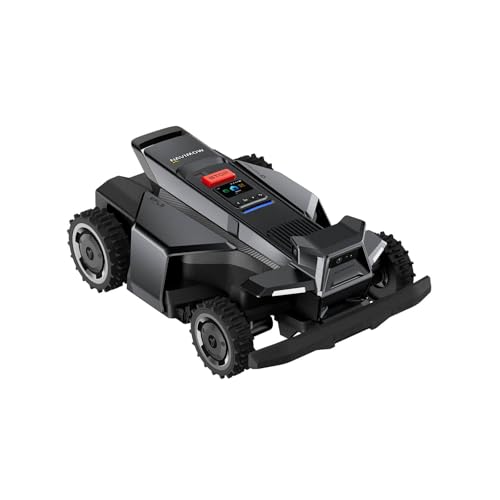
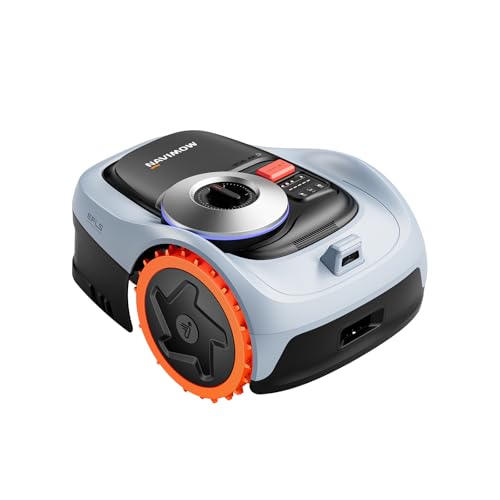
The X430 is the clear answer for owners with large, aggressively sloped properties. Its 4WD system and two 180W motors give it published capability on 84% slopes, a rating that places it well above most consumer robots. The zero-turn design reduces turf damage on turns across uneven ground, and the 0.75 to 4 inch cutting-height range lets you raise blades over bumpier sections without swapping machines. Owners on sloped half-acre-plus lawns report consistent coverage where two-wheel-drive units left streaks.
- 4WD and 84% slope rating handle genuinely steep terrain
- Wire-free setup with ORV-tuned suspension reduces marking damage
- $2249 price excludes most homeowners with small yards
Skip this if your lawn is under half an acre or the grade stays below twenty percent; you are paying for capability you will not use.
WORX Wire-Free Robot
WORX targets the buyer who wants simplicity on a quarter-acre lot with gentle undulation. Wire-free operation means no boundary loop to bury, and the brush system handles light debris without jamming. For mild slopes, owners report acceptable coverage without the wandering that plagues cheaper navigation units.
- Wire-free installation removes the most common hillside failure point
- Brush design handles small sticks and grass clippings on grades
- No published slope tolerance means uncertain behavior above 15%
Pass on this if your property has any section steeper than a walkable grade; WORX does not publish a slope rating and the drive system lacks all-wheel traction.
YARDCARE V100
At $399.99, the V100 is the cheapest way to automate a small, mostly flat yard. The HD Vision camera helps it identify boundaries, but the coverage cap of 1600 square feet and two-wheel drive mean this machine belongs on level ground only.
- Lowest entry price in this roundup
- Vision-based navigation avoids boundary wire installation
- Not designed for any meaningful slope
Skip immediately if hills are the reason you are reading this guide. The V100 is a flat-lawn budget option.
Segway Navimow i206 AWD
The i206 brings Segway’s AWD platform down to 0.15 acres with a published 45% slope rating. For homeowners with a modest yard that includes one steep section, it delivers the core navigation and traction technology of the larger X430 at a fraction of the cost.
- AWD with 45% slope rating covers most residential grades
- Compact footprint suits tight yards without wasted coverage
- 0.15-acre limit means no room for expansion
Skip if your total lawn exceeds a tenth of an acre; the coverage area will force frequent returns to base and extend mow cycles unacceptably.
Sunseeker X5 AWD
The X5 combines RTK positioning with Vision AI on a half-acre platform, making it a strong mid-range pick for sloped lawns where you want wire-free reliability. AWD drive handles grades without the stalling seen in two-wheel units, and the vision system adds obstacle detection that pure RTK models lack.
- RTK plus Vision AI gives layered navigation redundancy on uneven ground
- Half-acre coverage suits most suburban hillside lots
- Wire-free setup at $1384 is competitive but not cheap
Consider skipping only if your slope exceeds 50% or your lawn pushes past half an acre, where the X430 or LOPKIN would serve better.
AIWEIYA Crawler Track Mower
This is not a typical robot. The AIWEIYA uses crawler tracks and an oil-electric hybrid drivetrain, rated for a 100% slope (45 degrees). The remote-control option and 1.1 to 5.9 inch cutting range make it suited to large, wild terrain that no wheeled robot can safely manage.
- Tracks eliminate the traction problem entirely at any grade up to 45 degrees
- Oil-electric hybrid provides runtime on large areas without battery anxiety
- Remote-control operation removes full autonomy and adds physical presence on the lawn
Skip if you want a set-and-forget robot; the AIWEIYA is better understood as a tracked utility mower with remote convenience rather than a true autonomous robot.
LOPKIN L2500-NEO
The L2500-NEO covers 0.9 acres with NetRTK and AI Vision, making it the wire-free workhorse for large sloped properties below the X430’s price tier. Wi-Fi HaLow connectivity extends reliable range without a hub, and 60dB operation means neighbors will not hear it running early on a hillside where the base sits close to the house.
- Multi-zone management handles properties with varying slope sections
- Wi-Fi HaLow extends connectivity range without extra hubs
- NetRTK performance in dense tree canopy can degrade on some hillside layouts
Skip if your property has more than ten trees over the mowing zone; RTK signal loss under canopy is the most common owner complaint on wooded slopes.
ECOVACS Goat A2000
The Goat A2000 leans on dual LiDAR navigation, which gives it a positioning method independent of satellite signals. On hillside lawns where tree cover or building geometry blocks RTK, this becomes a genuine advantage. At $1399 it sits between the Sunseeker and the LOPKIN in price while offering a different navigation philosophy.
- Dual LiDAR avoids satellite-signal dropout common on wooded slopes
- Compact design fits through narrower garden paths between terraced sections
- Published slope tolerance is less aggressive than the X430 or AIWEIYA
Skip if your grade exceeds 35%; the LiDAR advantage only matters if you also stay within the machine’s traction limits.
Buying Guide
Slope Rating: The Number That Matters Most
Every hill-capable robot should publish a slope tolerance. Treat this as the primary filter. Anything rated below 30% will struggle on grades where a person leans noticeably. The X430 at 84% and the AIWEIYA at 100% (45 degrees) represent the extreme end. Most residential drivable grades fall between 15% and 35%, making the i206, Sunseeker, and LOPKIN the sweet spot for real-world hillside lawns. If a product does not publish a slope figure, assume it handles only gentle undulation.
Drive System: Wheels, All-Wheel Drive, or Tracks
Two-wheel drive robots rely on friction and will slip sideways on any grade above roughly 15%. AWD systems distribute torque to all four wheels, improving traction and reducing the risk of the robot parking itself mid-slope. Tracked units eliminate wheel-spin entirely but add weight and complexity. For lawns under 0.5 acres with slopes up to 40%, AWD with wire-free navigation is the practical standard. For anything steeper or rougher, tracks or the X430’s 4WD with ORV-tuned suspension become necessary.
Navigation on Uneven Ground
Hills shift the reference frame that navigation systems depend on. RTK units use satellite positioning and can lose signal under canopy, which is common on sloped yards bordered by tree lines. Vision-based systems read the ground plane and handle this better but can be confused by shadows cast across a hillside at low sun angles. LiDAR maps the environment from the robot’s own sensors and is weather-agnostic but adds cost. Dual systems, like the Sunseeker’s RTK plus Vision AI or the LOPKIN’s NetRTK plus AI Vision, provide redundancy that single-method navigation cannot match on complex terrain.
Our Verdict
The Segway Navimow X430 is the top pick for anyone whose lawn genuinely demands slope capability above forty percent. Its 4WD system, 84% published rating, and zero-turn platform leave nothing unresolved on steep ground. The best budget pick is the Segway i206 AWD at $899, which delivers all-wheel traction and a 45% slope rating on smaller lots where the X430’s coverage range is wasted. If your hillside is heavily wooded and satellite signals drop out, the ECOVACS Goat A2000 with its dual LiDAR navigation wins on reliability despite a lower absolute slope rating, because the best traction in the world means nothing if the robot gets lost.
FAQ
Can a robot lawnmower handle a 45-degree slope?
Very few can. The AIWEIYA crawler track mower is the only product in this list rated at 100% slope (45 degrees), and it achieves that through tracks rather than wheels. Standard wheeled robots should be kept to grades where the published slope rating has at least ten percent of headroom above your actual terrain.
Do I need boundary wire for a hillside lawn?
No. Every model in this roundup except the YARDCARE and WORX operates without a buried wire, and even those two use alternative methods. On slopes, wire-free navigation is often preferable because the boundary line can shift or the wire can surface after frost heaves and erosion.
Will a robot mower slip and damage the lawn surface on a hill?
Two-wheel-drive units will mark and tear turf during turns on grades. AWD and 4WD systems with zero-turn geometry, like the Segway X430, distribute weight and rotate in place, which reduces surface damage. Tracked mowers virtually eliminate the problem but are not autonomous in the same sense.
How does tree cover affect navigation on sloped properties?
RTK and satellite-based systems degrade under dense canopy, which is common on wooded hillside lots. Vision and LiDAR systems work independently of sky visibility, so models like the ECOVACS Goat A2000 or the Sunseeker’s dual RTK-plus-Vision approach provide more consistent coverage where trees are present.