
Key takeaways
- Pro: Battery and charger included at a price that still undercuts many corded alternatives once you factor in extension cords.
- Pro: Compact deck width makes it easy to store in a small shed or against a fence line.
- Con: Owners on uneven terrain report the push-only design demands real arm effort on slopes.
Choosing a cordless push or self-propelled mower used to mean guessing which battery platform would survive a full season and whether the cut quality justified dropping gas entirely. In 2026 the market has matured enough that price, voltage, and deck width tell you almost everything you need to know before you ever open a box.
What separates a smart purchase from a regrettable one comes down to three questions: Is the deck wide enough for your yard without making the unit unmanageable around flower beds and fencing? Does the battery platform have enough power to handle your grass density through a full cut? And does the price include both battery and charger, or are those sold separately? We compared the published specifications, current prices, and aggregated owner feedback across eight models that keep surfacing in searches for a Ryobi lawn mower and its closest competitors, so you can skip the spec-sheet rabbit hole and get straight to a shortlist.
As an Amazon Associate we earn from qualifying purchases at no extra cost to you. Product prices and availability are accurate as of the date shown and are subject to change.




Quick Picks
| Product | Best for | Price |
|---|---|---|
| Greenworks 40V 16″ Push | Small yards on a modest budget | $258.99 |
| Cordless 17″ Walk Behind | Tightest budgets | $139.98 |
| Greenworks 60V 21″ Push | Medium-to-large flat lawns | $389.99 |
| Ryobi 20″ 40V Whisper-Quiet | Noise-sensitive neighborhoods | $519.95 |
| Greenworks 48V 17″ Push | Cutting versatility on two batteries | $259.99 |
| Greenworks 80V 21″ Self-Propelled | Hills and thick, damp grass | $479.99 |
| MZK 40V 16″ 2-in-1 | Small yards that need mulching | $159.98 |
| Greenworks 60V 21″ Self-Propelled | Larger lawns with gentle inclines | $538 |
How We Picked
We narrowed this list by weighting four criteria that consistently drive owner satisfaction or complaints: battery inclusion (a mower priced without a battery is misleadingly cheap), deck width relative to yard size, voltage output as a proxy for torque in dense or wet grass, and whether the unit is push-driven or self-propelled. We also factored in noise design where the manufacturer claims it, because a Ryobi lawn mower with a whisper-quiet motor or any similarly marketed unit changes where and when you can mow. Price was the final filter — every model here lands under $540, and most sit well below that.
The 8 Best Ryobi Lawn Mower in 2026
Greenworks 40V 16″ Push Lawn Mower
At $258.99, this Greenworks bundles a 4.0 Ah battery and charger, making it the sensible entry point for anyone with a quarter-acre lot or less. The 16-inch deck keeps it light enough to maneuver around tight garden beds, and the 40V platform handles standard fescue and bluegrass without stalling.
- Pro: Battery and charger included at a price that still undercuts many corded alternatives once you factor in extension cords.
- Pro: Compact deck width makes it easy to store in a small shed or against a fence line.
- Con: Owners on uneven terrain report the push-only design demands real arm effort on slopes.
Skip this if your yard exceeds a half-acre or has noticeable grade changes; you will want a wider deck and self-propulsion.
Cordless 17″ Walk Behind Lawn Mower
The $139.98 price tag makes this the least expensive cordless mower in our lineup, and for small, flat patches of yard it delivers adequate cut quality without any battery platform commitment. The 17-inch deck sits between the narrow Greenworks 16-inch and the wider Ryobi lawn mower alternatives, giving it decent coverage for the price.
- Pro: Lowest cost of entry in the entire roundup — ideal as a backup mower for a side lot or rental property.
- Pro: Light enough that owners with limited strength handle it comfortably.
- Con: No brand ecosystem; replacement batteries and parts can be harder to source than with Greenworks or Ryobi.
Pass on this if you need a mower that doubles as your primary unit or if you value a wide dealer network for support.
Greenworks 60V 21″ Push Lawn Mower
Priced at $389.99 with a 5.0 Ah battery and charger, this model is the workhorse for half-acre to three-quarter-acre lawns that are mostly flat. The 21-inch deck is the widest you can get in a push configuration here, matching the coverage of a self-propelled unit without the motor-drive cost.
- Pro: The 60V platform gives noticeably more torque through damp or thick grass than 40V competitors.
- Pro: 5.0 Ah battery included means fewer mid-season charges during peak growth.
- Con: Push-only at 21 inches becomes tiring on anything beyond a gentle slope.
If your yard has hills, spend a little more and get the self-propelled version below.
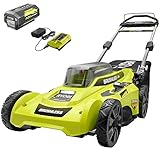
Ryobi 20″ 40V Whisper-Quiet Cordless Push Mower
At $519.95, this is the priciest push mower in the group, and the Ryobi lawn mower earns that premium by targeting a specific buyer: someone who mows early mornings or evenings and lives close to neighbors. The whisper-quiet design is the headline feature, and owners consistently flag it in reviews as the reason they chose this over louder alternatives.
- Pro: Genuinely quieter than comparable 40V mowers, reducing disturbance in dense subdivisions.
- Pro: Ryobi’s ONE+ battery ecosystem means you can share packs across dozens of other tools.
- Con: The 40V platform here produces less torque than Greenworks’ 60V or 80V options in the same price bracket.
Choose a Greenworks 60V or 80V instead if your grass is thick or you frequently mow in less-than-dry conditions.
Greenworks 48V (24V x 2) 17″ Push Lawn Mower
This $259.99 kit uses two 4.0 Ah 24V batteries to reach 48V output, and the clever part is flexibility: run both for full power, or split them across other Greenworks 24V tools. The 17-inch deck is a solid middle ground for small-to-medium yards.
- Pro: Two-battery system lets you spread usage across an entire tool collection.
- Pro: Price sits nearly identical to the single-battery 40V 16-inch model but with more total energy on board.
- Con: Managing two batteries adds a step to the mowing routine — swapping, balancing, and storing.
Skip this if you want a one-battery-and-go simplicity; the 40V single-pack models are easier to live with.
Greenworks 80V 21″ Self-Propelled Lawn Mower
For $479.99 with a 4.0 Ah battery and charger, this is the best value in self-propelled mowers under $500. The 80V platform delivers the most torque in the lineup, and owners with clay-heavy soil or damp fescue specifically praise its ability to power through conditions that stall lesser units.
- Pro: Highest voltage and most pulling power — handles thick, wet grass without bogging.
- Pro: Self-propelled drive at 21 inches removes nearly all physical effort from a medium-to-large mow.
- Con: The 4.0 Ah battery included may require a mid-mow swap on lawns above three-quarters of an acre.
If your yard is large and flat, you can save by going push with a bigger battery; the self-propelled premium matters most on slopes.
MZK 40V 16″ 2-in-1 Brushless Cordless Push Mower
At $159.98, the MZK is the runner-up in budget and the only 2-in-1 mulch-and-side-discharge model in this group. The brushless motor is a meaningful upgrade over cheaper brushed units, and for quarter-acre or smaller lawns it cuts cleanly.
- Pro: Brushless motor means longer lifespan and less maintenance than brushed competitors in this price range.
- Pro: True 2-in-1 operation with mulch plug and side-discharge bag options.
- Con: 16-inch deck limits coverage on anything above a small suburban lot.
Move up to a 17-inch or wider model if you mow more than about a quarter-acre.
Greenworks 60V 21″ Self-Propelled Lawn Mower (2-Battery Kit)
The $538 2-battery kit is the most expensive option here, but it solves the runtime anxiety that plagues single-battery self-propelled mowers. With two 4.0 Ah packs you can mow a full acre before either needs recharging, and the 60V platform handles most grass densities without complaint.
- Pro: Two included batteries nearly guarantee a full mow without interruption.
- Pro: Self-propelled 60V drive strikes a balance between the raw power of the 80V and the lower cost of 40V platforms.
- Con: Highest price in the roundup; budget-conscious buyers will find similar capability for less.
If you do not regularly exceed half an acre, the 80V single-battery model offers more torque per dollar.
Buying Guide
Voltage and Torque: Matching Power to Grass Density
Voltage is the clearest spec for predicting whether a mower will bog down in your conditions. A 40V or 24V x 2 platform handles thin, dry turf on flat ground. A 60V system absorbs moderate dampness and thicker blades. An 80V unit powers through the worst conditions without noticeable slowdown. If you have heavy soil, shaded patches that stay wet, or tall growth between mows, buy more voltage than you think you need.
Deck Width and Yard Size
Deck width directly determines how many passes you will make per mow. A 16- or 17-inch deck is manageable around obstacles but takes longer on open stretches. A 20- or 21-inch deck cuts total time by roughly a quarter, but you will struggle in tight spaces. For most residential lawns under half an acre, 17 inches is the sweet spot. Above that, go wide and accept that you will need a slightly different path around your garden beds.
Push vs. Self-Propelled vs. Battery Inclusion
Self-propelled drive is worth the premium if your yard has any grade at all or if you mow more than half an acre. For flat, small lawns, a push mower with a larger battery beats a self-propelled with a small one. Always verify whether price includes battery and charger before comparing numbers — a $140 mower that needs a $80 battery is actually a $220 mower, which changes the value equation entirely.
Our Verdict
Our top pick is the Greenworks 80V 21″ Self-Propelled. At $479.99 with battery and charger included, it delivers the most torque, the most convenience, and the broadest yard-size coverage of anything on this list. The budget pick is the MZK 40V 16″ Brushless at $159.98 — the brushless motor and 2-in-1 design make it the most capable mower you can get under $160. If noise is your primary concern and you already own Ryobi ONE+ batteries, the Ryobi 20″ 40V Whisper-Quiet wins on a condition no spec sheet captures: being able to mow at seven in the morning without a neighbor knocking.
FAQ
Is a Ryobi lawn mower better than Greenworks?
Neither brand dominates outright. Ryobi excels in battery-platform breadth and noise-reduction design, while Greenworks tends to offer higher voltage and more torque at comparable or lower prices. The right choice depends on whether you already own tools in either ecosystem.
Can I use a Ryobi ONE+ battery in a Greenworks mower?
No. Battery platforms are proprietary and not cross-compatible. Before purchasing, check which batteries you already own and factor the cost of a new pack into the total price.
How wide of a deck do I need for a half-acre lawn?
A 21-inch deck reduces mow time meaningfully on a half-acre compared to 16 or 17 inches. If your yard is flat and obstacle-free, go wide. If it has mature trees, garden beds, or tight turns, a 17-inch deck is easier to maneuver despite the extra passes.
Do cordless mowers last as long as gas mowers?
Cordless mowers with brushless motors have fewer moving parts and typically need less maintenance than gas units. The battery is the wear item — most last several hundred charge cycles, after which replacement costs should be factored in over the mower’s lifetime.


