Key takeaways
- Included balancer helps you verify blade symmetry after sharpening
- Lowest per-unit cost in this roundup at under two dollars per disc
- Requires a drill and a steady hand; angle control depends entirely on your technique
A dull lawn mower blade tears grass instead of cutting it cleanly, leaving your lawn brown-tipped and vulnerable to disease. Knowing how to sharpen a lawn mower blade is one of the most practical skills a homeowner can develop, yet the market is flooded with tools that range from genuinely effective to barely functional.
We compared published specifications, current pricing, and recurring owner feedback across eight sharpeners sold in 2026 to separate the reliable options from the disappointing ones. What separates a worthwhile sharpener from a waste of money comes down to grit quality, angle control, and whether the tool actually removes material fast enough to justify the time spent. Some budget options perform well for occasional users, while others leave you struggling with a blade that still looks factory-dull after twenty minutes of effort.
Our top picks




As an Amazon Associate we earn from qualifying purchases at no extra cost to you.
Quick Picks
| Product | Best for | Price |
|---|---|---|
| cenoz Drill Sharpener (5-Pack) | Buyers wanting backup discs for a power drill | $9.99 |
| SHARPAL 103N | Multi-tool households that sharpen several items | $22.99 |
| SporGain Adjustable Frame | Users who need precise angle control without a drill | $49.99 |
| UF-SHARP Diamond | A single durable disc for drill-based sharpening | $18.99 |
| 7-Inch Ceramic Wheel Grinder | High-volume or professional use | $169.99 |
| SporGain Brushless Motor | Long-term ownership with motor warranty coverage | $179.99 |
| Sharp Pebble Cordless | Portability and quick touch-ups anywhere in the yard | $61.99 |
| Calsoling 3-Piece Rotary | Minimum-cost entry with a balancer included | $8.99 |
How We Picked
We evaluated every product against four criteria that consistently drive owner satisfaction or frustration in this category. First, material removal rate: a sharpener that takes multiple passes to restore a factory edge fails the basic task. Second, angle stability: tools that let you drift off the correct bevel produce an uneven cutting edge that dulls faster. Third, durability under real conditions, meaning whether the abrasive holds up after several seasons of use rather than clogging or wearing smooth quickly. Fourth, practicality of the form factor, including whether the tool requires a specific drill, generates hazardous metal dust, or demands a bench setup that limits how often you will actually use it.
The 8 Best How To Sharpen A Lawn Mower Blade in 2026
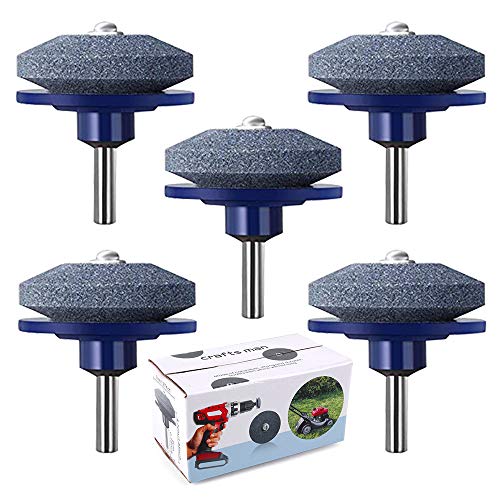
cenoz Drill Sharpener (5-Pack)
Best for the homeowner who already owns a cordless drill and wants a no-commitment way to maintain a handful of blades each season. The five-pack format means you can retire a worn disc without buying another kit, and the blue abrasive coating is designed for quick stock removal on steel mower blades.
- Included balancer helps you verify blade symmetry after sharpening
- Lowest per-unit cost in this roundup at under two dollars per disc
- Requires a drill and a steady hand; angle control depends entirely on your technique
Skip this if you need repeatable accuracy on a mulching blade or if you work without a power drill nearby.
SHARPAL 103N
This is the right choice for someone whose shed contains pruners, shears, a hatchet, and a mower blade, and who wants one tool to cover all of them. The multi-stage carbide and ceramic slots let you start with aggressive stock removal and finish with a polishing pass.
- Handles several edge geometries beyond mower blades
- Compact and easy to hang on a pegboard for frequent access
- Not purpose-built for the flat profile of a mower blade, so it requires more passes than a dedicated disc
Skip it if your sole priority is mower blades and you want the fastest single-blade turnaround.
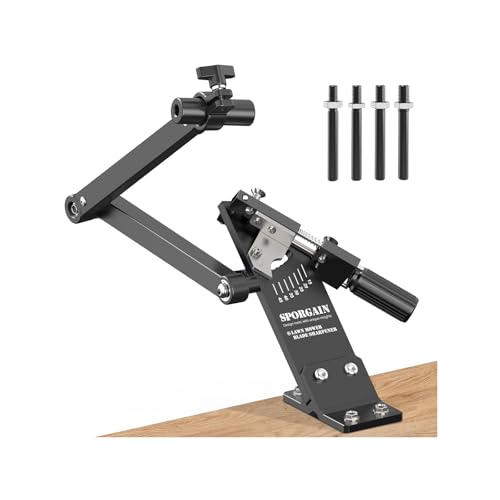
SporGain Adjustable Frame
Owner of a push mower who dislikes the vibration and dust of drill-mounted discs will find the 15°-45° adjustable frame appealing. You pull the file across the blade edge in a guided track, which locks your angle regardless of skill level.
- Angle is mechanically fixed once set, removing user error
- No power source needed, so it works anywhere without setup
- Slower than abrasive discs on heavily nicked or pitted blades
Skip it if your blade has significant damage below the edge, where a file cannot reach.
UF-SHARP Diamond
A single diamond-coated disc at 120 grit for drill users who want one high-quality replacement rather than a pack of budget options. The all-metal construction resists the flex that cheaper resin-bonded discs show under pressure, keeping the cutting surface consistent.
- Diamond abrasive lasts noticeably longer than aluminum oxide on hardened steel
- Mounts to standard drill chucks without adapters
- Only one disc included, so replacement means reordering sooner than the five-pack option
Skip it if you sharpen blades for several properties and go through discs quickly.
7-Inch Ceramic Wheel Grinder
This benchtop machine is built for people who sharpen a dozen or more blades per season, whether for a small landscaping crew or a household with multiple mower decks. The ceramic wheel at seven inches provides generous surface area, and the 30°/40° angle brackets let you match manufacturer specifications without estimating by eye.
- Powered grinding removes nicks and corrosion in a single session
- Includes extra sandpapers for surface finishing and rust spots
- Footprint and price put it out of reach for casual single-mower owners
Skip it if you sharpen fewer than three blades per year and store tools in a small shed.
SporGain Brushless Motor
For the buyer who wants a complete powered system with long-term protection, this brushless motor sharpener offers a lifetime motor warranty that signals manufacturer confidence. The sealed housing keeps metal dust out of the bearings, which is the primary failure mode on cheaper corded units.
- Brushless design runs cooler and lasts longer than brushed competitors
- Lifetime motor warranty reduces replacement risk over many seasons
- Requires a power outlet and an extension cord for most yard setups
Skip it if portability matters more than raw grinding power.
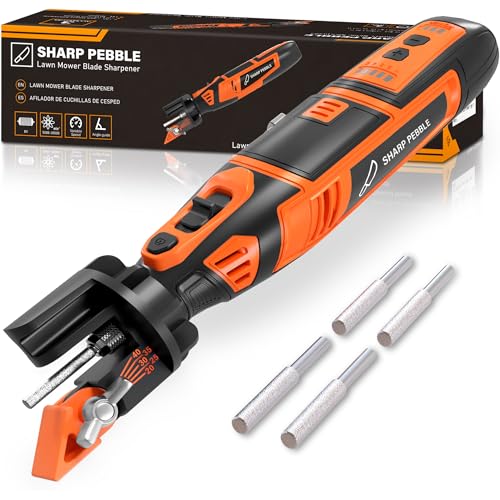
Sharp Pebble Cordless
The cordless design means you can sharpen a blade wherever it happens to be, without dragging an extension cord across flower beds or a driveway. The kit includes what owners describe as a satisfying grip and trigger feel that reduces hand fatigue during longer sessions.
- No cord, so you are not limited by outlet distance or extension cord length
- Balanced weight keeps the tool steady along the blade edge
- Battery runtime limits how many blades you can finish on a single charge
Skip it if you are sharpening for a team or fleet and need continuous operation.
Calsoling 3-Piece Rotary
At the lowest total price in this comparison, the Calsoling set pairs three rotary abrasive discs with a blade balancer for drill-based sharpening on a tight budget. The discs are rated for high-temperature resistance, which matters when a drill spins them faster than the abrasive is designed to handle.
- Three discs plus a balancer in one purchase covers an entire season
- Universal fit works with standard cordless drills
- Abrasive life is shorter than diamond-coated alternatives, so plan on more frequent replacement
Skip it if you want a set-and-forget tool that lasts several years without reordering.
Buying Guide
Abrasive Type and Grit
Aluminum oxide discs cut fast but dull quickly on hardened mower steel. Diamond coatings at 120 grit last multiple seasons longer and handle nicked edges without clogging. Ceramic wheels sit between the two in cost and longevity. Match the abrasive to how damaged your blades typically are: routine maintenance needs less aggressive material than restoring a blade that hit a sprinkler head.
Angle Control and Consistency
A mower blade typically uses a 30° to 45° bevel depending on the manufacturer. Guided frames lock this angle mechanically, while freehand drill discs place the burden on your wrist. If you are new to blade maintenance, prioritize a tool that constrains angle drift over one that simply cuts faster.
Power Source and Workflow
Corded grinders deliver consistent RPM and never run out of juice, but require an outlet nearby. Cordless and drill-mounted options trade some runtime for portability. Consider where your mower sits: a blade in a garage with a nearby outlet suits a bench grinder, while a blade pulled off in a backyard works better with a battery tool or hand-guided file.
Our Verdict
Top pick: the SporGain Adjustable Frame at $49.99 offers the best balance of accuracy, durability, and ease of use for the average homeowner sharpening one or two blades per season. Budget pick: the cenoz 5-Pack at $9.99 delivers the lowest entry cost for drill owners who want a simple abrasive disc with backups included. One condition where another product wins: if you sharpen blades for multiple properties or a landscaping crew, the 7-Inch Ceramic Wheel Grinder at $169.99 replaces all hand methods with a powered, repeatable process that saves hours across dozens of blades per season.
FAQ
How often should I sharpen a lawn mower blade?
A typical push-mower blade benefits from sharpening every 20 to 25 hours of cutting, which works out to roughly once per mowing season for most residential lawns. Inspect the edge monthly: if you see nicks, rounded corners, or grass that looks torn rather than cleanly sliced, it is time to touch up.
Can I sharpen a blade without removing it from the mower?
Several products in this list, including drill-mounted discs and corded grinders, can work on a blade still attached to the deck. However, removing the blade lets you access both bevels evenly and check for bending with a balancer, which produces a more balanced result.
Is a diamond sharpener worth the extra cost over aluminum oxide?
For occasional homeowners, aluminum oxide discs at the low end of this price range perform adequately for one or two seasons. If you sharpen three or more blades per year or work on commercial-grade hardened steel, a diamond-coated option pays for itself by lasting significantly longer before replacement.
What safety gear should I use while sharpening?
Always wear eye protection because metal filings and abrasive particles fly at high speed, and use hearing protection with powered grinders or drill-mounted discs. A respirator or dust mask is advisable when working in an enclosed space where metal dust accumulates in the air.