
Key takeaways
- The moment your mower starts leaving streaks of uncut grass, dragging through the lawn instead of slicing it, or vibrating so badly that your hands go numb mid-pass, you already know the answer: the blades are done. Replacing them is…
The moment your mower starts leaving streaks of uncut grass, dragging through the lawn instead of slicing it, or vibrating so badly that your hands go numb mid-pass, you already know the answer: the blades are done. Replacing them is one of the cheapest and most impactful maintenance tasks a homeowner can do, yet the parts market is surprisingly uneven. A well-matched set of lawn mower blades can restore a clean cut in under twenty minutes and save you a service call costing several times the part price.
What separates a worthwhile replacement from a frustrating one comes down to fit precision, steel quality, and blade geometry matched to your deck size and discharge style. A mulching blade sold for bagging will clog; a commercial-grade heavy-duty set bolted onto a residential deck can overload the spindle. This roundup compares eight options across three price tiers, drawing on published specifications, owner-reported longevity, and OEM cross-reference data available in 2026.
As an Amazon Associate we earn from qualifying purchases at no extra cost to you. Product prices and availability are accurate as of the date shown and are subject to change.



Quick Picks
| Product | Best for | Price |
|---|---|---|
| MaxPower 561713B | 42″ Poulan, Husqvarna, Craftsman decks | $27.98 |
| MaxPower 561139B | 60″ Exmark rides | $44.98 |
| MaxPower 331528B | Small 21″ mulching decks | $17.68 |
| Oregon 91-626 | 61″ Scag, Ferris, Simplicity fleets | $59.99 |
| MaxPower 561557B | General 3-blade residential decks | $32.21 |
| Grasscool 942-0741A | Troy-Bilt TB130 walk-mowers | $18.88 |
| Grasscool 138971 | 42″ Craftsman bagging setups | $23.88 |
| Grasscool 942-04308 | Troy-Bilt and Cub Cadet 42″ decks | $23.88 |
How We Picked
We narrowed the field using four criteria that consistently predict satisfaction. First, OEM cross-reference accuracy: a replacement listing the same part numbers as your originals will physically fit without modification. Second, build origin and steel grade, because USA-made MaxPower and Oregon blades tend to hold an edge longer than unbranded imports at similar prices. Third, deck-size and function alignment—mulching, bagging, or high-lift—since geometry matters as much as length. Fourth, value per blade, which revealed a wide spread between single-blade options and multi-pack fleet purchases.
The 8 Best Lawn Mower Blades in 2026
MaxPower 561713B 2-Blade Set (42″ Cut)
Owner feedback repeatedly praises the precise fit on Poulan, Husqvarna, and Craftsman 42-inch decks, citing the five OEM numbers (138498, 138971, 127843, and their 532-prefixed variants plus CMXGZAM110136) that this pair directly replaces. Both blades arrive fresh, preventing the imbalance that causes vibration when only one is swapped. A recurring complaint is a factory coating that some owners report as thicker than the original, requiring a brief wire-brush pass before first use. Skip this set if your deck accepts three blades; the two-blade configuration will underperform on a spindle designed for a third.
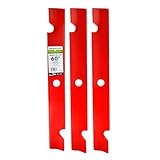
MaxPower 561139B Heavy-Duty 3-Blade Set (60″ Cut)
This USA-made set targets commercial and prosumer owners running 60-inch Exmark decks, replacing OEM 103-6403, 103-6403-S, and 140-1240. Owners note that the heavy-duty gauge holds up well on properties with thick thatch and occasional gravel contact. A recurring con in long-term feedback is that the aggressive lift curve can leave a slightly visible stripe if the deck height sits below the mid-range setting. This is not the right choice for walk-behinds or smaller decks, where the mass and power demand would strain a lighter engine.
MaxPower 331528B 21″ Mulching Blade
At under eighteen dollars, this USA-made single blade is one of the most affordable entry points to fresh mulching performance on a 21-inch deck. Owners report noticeably finer clippings after swapping a worn original, particularly on flat residential lawns. The curved mulching geometry recirculates material effectively without the clogging issues generic replacements introduce. The limitation is straightforward: it is a single blade, so two-blade decks need a second unit, and the price advantage erodes quickly. Skip this if your deck exceeds 21 inches or if you primarily bag rather than mulch.
Oregon 91-626 6-Pack (61″ Scag, Ferris, Simplicity)
Oregon’s reputation among fleet operators is well earned, and this six-pack for 61-inch decks serves contractors who rotate blades across multiple machines. Cross-references cover Scag 48111 and 481708, Ferris 5020842 and 5101755, and Simplicity 5022808ASM, making it a practical inventory purchase for shops servicing mixed brands. The consistent steel quality means uniform cutting without sorting through out-of-spec units. The obvious barrier is commitment: a single homeowner with one mower has no use for six blades, and the $59.99 price reflects bulk economics that do not translate to individual buyers.
MaxPower 561557B USA-Made 3-Blade Set
This set fills the gap for homeowners with three-blade residential decks who want USA-made construction without commercial-tier pricing. At just over thirty-two dollars, the per-blade cost is competitive, and the balanced triple configuration cuts vibration noticeably on flat terrain. Reviewers highlight the clean factory edge and the absence of rough burrs that plague budget imports. The trade-off is that MaxPower does not publish a detailed hardness rating for this SKU, so owners in rocky soil report edge nicks slightly sooner than Oregon equivalents would sustain. Skip if your deck takes two blades.
Grasscool 942-0741A Mulching Blade (Troy-Bilt TB130)
Walk-mower owners with the Troy-Bilt TB130 appreciate that Grasscool numbers this replacement after the OEM 942-0741A, eliminating guesswork at checkout. Under nineteen dollars, it restores proper mulching action on a 21-inch deck, and the curved profile chops clippings fine enough to feed back into the soil. The narrow application range is the main limitation: this fits essentially one mower platform, so cross-utility is minimal. A secondary complaint from a handful of reviewers concerns the bolt-hole tolerance, which is slightly snug and occasionally requires a reamer for smooth installation.
Grasscool 138971 Bagging Blade (42″ Craftsman)
Priced identically to its sister product but designed for a different task, this Craftsman 42-inch blade replaces OEM 138971 and excels at lifting clippings into a bag rather than re-cutting them. Owners switching from a worn mulching blade to this bagging profile report cleaner collection and less deck buildup. The geometry is straightforward but not aggressive enough to double as a mulching blade in a pinch. It is worth noting this number overlaps with an OEM reference the MaxPower 561713B covers, giving buyers a single-blade versus pair choice at similar per-unit cost.
Grasscool 942-04308 Bagging Blade (Troy-Bilt / Cub Cadet 42″)
This blade serves the popular Troy-Bilt and Cub Cadet XT1 and ZT1 42-inch platforms, replacing OEM 942-04308. At $23.88 per blade, it is fairly priced for a specific-fit residential part, and owners report that the straight-edge design channels grass cleanly into bagging systems without the recirculation lag that mulching profiles introduce. The con is brand lock-in: it fits decks sharing that OEM number but not the broader aftermarket cross-references that MaxPower or Oregon typically publish. If you own a different brand with a 42-inch deck, look elsewhere.
Buying Guide
Match the Blade Function to Your Deck Purpose
The single most expensive mistake in this category is installing a blade profile that fights your deck’s airflow. Mulching blades have curved wings that keep clippings under the deck for repeated slicing; bagging blades have a lifted end that tosses material upward into a collector. Using the wrong profile causes either buildup and streaky cuts or poor collection and clumps on the lawn. Confirm your manufacturer’s original blade marking—mulching, bagging, or high-lift—and replace it in kind unless you have upgraded a deck attachment.
Use OEM Cross-References as Your Primary Filter
Part numbers are not marketing labels; they are dimensional contracts. When a replacement lists the same numbers as your originals, bolt-hole spacing, blade length, center-bore diameter, and curvature have been matched to spec. Owners who buy by deck size alone report warped mounting surfaces and spindle wobble. Write down every number stamped on your existing blade before shopping, and verify the replacement lists at least one of them. A cross-reference match is a stronger fit predictor than a length measurement alone.
Weigh Build Origin and Steel Hardness Against Your Terrain
USA-made MaxPower and Oregon blades generally use hardened steel that holds an edge through normal residential use, but terrain changes the calculus. Lawns with hidden rocks or compacted soil will nick and dull any blade faster. Commercial-tier sets carry heavier gauge steel that resists bending under load but demands more engine power to maintain tip speed. For flat, clean residential lawns, mid-price sets deliver adequate life without the weight penalty. For rough properties, a heavy-duty or high-quality import often costs less over a season than repeatedly replacing budget blades.
Our Verdict
For most homeowners on a mid-size residential deck, the MaxPower 561713B 2-Blade Set is the best overall pick. Its five-OEM cross-reference covers the widest range of common 42-inch platforms, and paired delivery eliminates imbalance risk at $27.98. For budget-conscious owners on a 21-inch mulching deck, the MaxPower 331528B at $17.68 is hard to beat. One condition overrides both: if your 42-inch Craftsman relies on bagging rather than mulching, the Grasscool 138971 single blade delivers the correct lift geometry, and buying two brings cost into the same range while matching your task.
FAQ
How often should I replace my lawn mower blades?
Most residential users should sharpen every twenty to twenty-five hours of mowing and replace outright by the start of the third season or whenever the edge is visibly nicked or bent. Owners with rocky or sandy lawns often find blades lose their edge within a single season and should budget for annual replacement.
Can I use a mulching blade on a bagging deck?
Technically the bolt pattern may match, but the airflow geometry will not. Mulching blades lack the lifting end that directs clippings upward into a bag, so expect reduced collection and deck buildup. Always match the blade profile to the deck’s primary discharge mode unless the manufacturer explicitly rates it for both.
Do I have to replace both blades at the same time?
On multi-blade decks, yes. Installing one fresh blade beside a worn, shorter one creates imbalance that stresses the spindle and vibrates the deck. On a two-blade 42-inch deck, the cutting-height difference between old and new produces visible uncut strips, which is why sets like the MaxPower 561713B are sold as pairs.
What is the difference between high-lift, mulching, and standard blades?
Standard blades have a flat cutting edge with minimal lift, suited for basic side-discharge mowing. Mulching blades feature curved wings that recirculate clippings beneath the deck for finer chopping. High-lift blades have dramatically angled tips that generate strong suction to carry material into a bag or trailer, common on commercial riders but potentially overloading residential engines that lack the horsepower to sustain the extra drag.


