Key takeaways
- Choosing between solar spotlights and pathway lights for gardens is less about which product is “better” and more about what you want your outdoor lighting to do. Spotlights direct a concentrated beam toward a wall, tree, sign, porch feature, or…
What's inside
Choosing between solar spotlights and pathway lights for gardens is less about which product is “better” and more about what you want your outdoor lighting to do. Spotlights direct a concentrated beam toward a wall, tree, sign, porch feature, or dark corner. Pathway lights spread softer pools of light along walkways, planting beds, and borders.
The real decision is whether your priority is focused illumination or consistent guidance and atmosphere. A few spotlights can make a small yard feel more architectural, while a line of pathway lights can make a longer route easier to navigate after dark. Budget, available sunlight, pets and children, rental restrictions, and how permanent you want the installation to be all matter too.
As an Amazon Associate we earn from qualifying purchases at no extra cost to you. Product prices and availability are accurate as of the date shown and are subject to change.


Quick Verdict
Choose solar spotlights if you need brighter, adjustable light in specific locations. They are usually the better choice for highlighting trees, house numbers, steps, fences, flags, and architectural details. Their adjustable heads and panels can also help you aim light where it is most useful.
Choose solar pathway lights if you want an inviting border along a walkway, driveway, garden bed, or patio. They are simpler to distribute evenly and generally create less glare. For many homes, a combination works best: spotlights for focal points and pathway lights for low-level orientation.
Side by Side
| Factor | Solar Spotlights | Solar Pathway Lights |
|---|---|---|
| Comfort and visibility | Brighter, more directional light; can cause glare if aimed toward eye level | Softer, lower light that is usually more comfortable for walking and entertaining |
| Typical light output | Often about 0.5–2 watts per fixture, with a narrow or adjustable beam | Often about 0.06–0.2 watts per fixture, with a broad, decorative glow |
| Durability | Typically sturdy when the stake, head, and solar panel are well sealed; fewer fixtures mean fewer ground-level impacts | More exposed fixtures in the soil; lightweight models may be vulnerable to lawn equipment, pets, and frost heave |
| Price range | About $6–$15 per light, or roughly $24–$60 for a four-pack | About $3–$10 per light, or roughly $24–$80 for an eight- to ten-pack |
| Maintenance | Wipe panels, check aiming, and replace batteries as needed | Wipe panels, straighten stakes, clear leaves, and replace batteries as needed |
| Space needed | About 6–12 inches of ground space per stake, plus room for beam clearance | Usually 4–8 inches of ground space per fixture; allow about 4–8 feet between lights |
| Look | Architectural, dramatic, and useful for layered lighting | Decorative, welcoming, and effective for defining edges |
| Resale appeal | Can emphasize landscaping and exterior features without permanent wiring | Can make paths and entry areas feel finished and cared for |
| Best for | Trees, façades, signs, steps, address plaques, and security-minded accent lighting | Walkways, driveways, garden borders, patios, and general evening ambiance |
Where Solar Spotlights Wins
Solar spotlights are the stronger option when one part of the yard deserves attention. A fixture aimed at a tree trunk or textured stone wall can add depth without flooding the entire property with light. Models with adjustable heads are especially useful because you can change the beam as plants grow or furniture moves.
They also provide more practical illumination than most decorative pathway fixtures. A spotlight positioned near a step, gate, house-number plaque, or shed can make that feature easier to see. For a modest installation, two to four lights may be enough. A four-pack such as the AUDERWIN Solar Spot Lights Outdoor Waterproof, 4 Packs, Cool White, listed at $24.99, or the JEJOT Solar Spot Lights Outdoor Waterproof, 4 Pack, listed at $23.99, fits the typical entry-level budget for this approach.
Spotlights can be easier to place strategically. Instead of lining an entire walkway, you can position one at each end of a patio or direct two toward the front elevation. Many have separate or adjustable solar panels, which is valuable when the light needs to face one direction but the best sunlight comes from another.
There are tradeoffs. A narrow beam can create bright spots and dark gaps, and cool-white LEDs may look stark against warm landscaping. Avoid aiming fixtures at windows, neighboring homes, or directly at approaching guests. For a more comfortable result, point the beam at a surface rather than into the line of sight.
Where Pathway Lights Gardens Wins
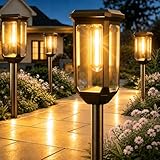
Pathway lights are the natural choice when you want a clear visual route through a garden. Their repeated, low-level glow helps define the edge of a walkway without making the area feel overlit. They are also forgiving: slight differences in placement are usually less noticeable than a poorly aimed spotlight.
They work well around curves, planting beds, driveways, and outdoor dining areas. Place them in a staggered pattern rather than a rigid straight line for a more relaxed appearance. For a path approximately 30 feet long, six to eight fixtures may provide a balanced rhythm, depending on the width of the path and the brightness of the lights.
Pathway lights are often the economical way to cover more ground. The DenicMic Solar Lights Outdoor Waterproof 10 Pack Pathway Lights Cool White is listed at $22.99, while the Tenmiro Solar Pathway Lights Outdoor 8 Pack, Bright Solar Garden Lights, is listed at $37.99. Those prices illustrate the broad range: basic multi-packs can cover a border inexpensively, while larger or brighter sets cost more per fixture.
The main weakness is that every fixture is close to the ground. Stakes can loosen in soft soil, get nudged by dogs, or be damaged by a mower or string trimmer. Keep lights a few inches outside the cutting path, and use a narrow trowel or hand tool to create starter holes instead of forcing stakes into hard ground.
Cost Over 5 Years
Up-front price is only part of the calculation. For a small display, assume four spotlights at $6–$15 each, for an initial cost of approximately $24–$60. A pathway installation using eight lights at $3–$10 each costs approximately $24–$80. The actual pack prices above show that multi-packs can sit near the low end or rise above it when brightness, construction, or styling improves.
Most solar lights use rechargeable batteries that gradually lose capacity. Depending on the battery type, climate, charging conditions, and use, a replacement may be needed during a five-year period. Budget roughly $2–$6 per replaceable battery, although some sealed designs require replacing the entire fixture instead.
Using a simple ownership estimate, four spotlights might cost $24–$60 initially, plus $8–$24 for one battery replacement per light, for a five-year total of about $32–$84. Eight pathway lights might cost $24–$80 initially, plus $16–$48 for batteries, for an estimated total of $40–$128. These figures exclude tools, shipping, and full-fixture replacement.
Spotlights often win on cost when you only need a few fixtures. Pathway lights can deliver more coverage per dollar, but an entire border requires more batteries, more cleaning, and more opportunities for damage. The cheapest option is therefore the one that matches the area you actually want to light—not necessarily the pack with the lowest sticker price.
Which One for Your Home
Small Apartment
Start with one or two solar spotlights if your outdoor space is a balcony, small patio, or compact entry. They take up less ground space and can highlight a planter, doorway, or house number. If your lease prohibits stakes or exterior attachments, use only products designed for approved freestanding placement and avoid drilling or permanent wiring. For a tiny ground-level garden, four pathway lights may be enough to define the edge without crowding it.
Family With Kids or Pets
Pathway lights can make routes easier to recognize, but their stakes need protection. Place them outside running and mowing lanes, avoid fragile decorative tops, and check them after landscaping work. Spotlights are useful near steps, gates, and play-area entrances because fewer fixtures mean fewer objects at ground level. Aim bright beams away from children’s eye level and avoid creating sharp glare near seating areas.
Rental
Solar lighting is particularly renter-friendly because it requires no trenching, electrician, or permanent fixture. Pathway lights are easy to reposition when a landlord changes the landscaping, while spotlights can add curb appeal around an entry without altering the property. Keep packaging and spare stakes if you expect to move, and choose lightweight sets that can be removed without leaving holes or marks.
Long-Term Home
A layered plan makes the most sense for a permanent residence. Use spotlights at the front door, façade, mature trees, or address marker, then add pathway lights along the route people actually use. Warm white light, often around 2700–3000K, tends to blend with planting and outdoor seating better than cool white. Leave enough open space around fixtures so future pruning and garden expansion do not block their panels.
FAQ
Are solar spotlights brighter than pathway lights?
Usually, yes. Spotlights concentrate light into a narrower beam and commonly use a higher-power LED. Pathway lights are designed for low-level orientation and decoration, so their light is broader and less intense. Brightness still varies by model, battery condition, panel exposure, and the number of hours of direct sun.
How far apart should solar pathway lights be?
Begin with about 4–8 feet between fixtures. Use closer spacing on steps, tight curves, or dark sections, and wider spacing along a broad, lightly used border. Stand back after placing the first few lights and adjust the pattern before installing the entire set.
Can solar spotlights replace security lighting?
They can improve visibility around a home, but most small garden spotlights are not a complete replacement for hardwired or motion-activated security lighting. Their output and run time can decline after cloudy weather. Use them as accent or supplemental lighting, especially near an entry, gate, or address plaque.
Which color temperature is best for gardens?
Warm white is generally the most comfortable choice for patios, seating areas, and natural planting. Cool white can make paths and architectural details look crisp, but it may feel harsher and produce more noticeable glare. If you mix types, keep the color temperatures similar so the yard looks intentional.