Key takeaways
- Making the bed too wide: A 5- or 6-foot-wide bed may look efficient, but the center becomes difficult to weed and harvest. Keep the planting area within reach.
- Ignoring the path: Measuring only the box can leave no room to walk, move a wheelbarrow or repair the bed. Include access space in the layout.
- Choosing depth without calculating soil: A 4-by-8-by-2-foot bed needs about 64 cubic feet of fill. That can be expensive and difficult to move.
- Using too little depth for vegetables: A 6-inch bed may support lettuce and herbs but can restrict tomatoes, peppers and root crops.
- Assuming every vegetable belongs in one bed: Mint, sprawling squash and vigorous pumpkins can quickly overwhelm a small footprint. Give them dedicated containers or ample ground space.
- Forgetting mature plant size: Check the spacing on seed packets and plant labels. A bed that fits seedlings may become crowded once tomatoes, cucumbers or zucchini reach full size.
- Putting a heavy bed on an unverified balcony: Soil, water and the frame create a much greater load than the empty planter. Confirm structural limits before filling it.
What's inside
The Short Answer
For most vegetables, the best raised bed size is 4 feet wide by 8 feet long and 12 inches deep (122 by 244 by 30 cm). This footprint provides enough growing space for a useful harvest while keeping the center within reach from either side. If you can access the bed from only one side, limit the width to 2 to 3 feet (61 to 91 cm).
Choose a bed at least 6 to 12 inches deep (15 to 30 cm) for lettuce, herbs, radishes, onions and other shallow-rooted crops. Tomatoes, carrots, peppers, cucumbers and most root vegetables perform better with 12 to 18 inches (30 to 46 cm) of soil. Large crops, including indeterminate tomatoes and some perennial vegetables, may need 18 to 24 inches (46 to 61 cm).
As an Amazon Associate we earn from qualifying purchases at no extra cost to you. Product prices and availability are accurate as of the date shown and are subject to change.



There is no single perfect dimension. The right size depends on your available space, the vegetables you want to grow, how far you can reach and how much soil you want to buy. For a first garden in 2026, a 4-by-4-foot bed is an especially manageable starting point.
Standard Sizes
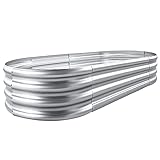
Raised beds are commonly sold in rectangular, oval and modular shapes. The measurements below refer to the approximate outside dimensions; the usable planting area may be slightly smaller because of the frame or curved sides.
| Bed size | Metric size | Best for | Approximate soil volume at listed depth |
|---|---|---|---|
| 2 x 4 x 1 ft | 61 x 122 x 30 cm | Balconies, patios and compact herb gardens | 8 cubic feet (227 L) |
| 3 x 6 x 1 ft | 91 x 183 x 30 cm | Small yards and mixed vegetables | 18 cubic feet (510 L) |
| 4 x 4 x 1 ft | 122 x 122 x 30 cm | Beginners and square-foot gardening | 16 cubic feet (453 L) |
| 4 x 8 x 1 ft | 122 x 244 x 30 cm | Full-size family vegetable gardens | 32 cubic feet (906 L) |
| 4 x 8 x 2 ft | 122 x 244 x 61 cm | Deep-rooted crops and easier access | 64 cubic feet (1,812 L) |
| 5 ft oval x 1 ft | 152 cm oval x 30 cm | Patios, flowers, herbs and compact vegetables | Varies by oval width |
A 12-inch-high bed does not always require 12 inches of premium garden soil. If the bed sits on open ground, you can fill the lower portion with clean native soil and add a quality top layer. For a bed placed on concrete or a patio, plan to fill the entire container with a suitable raised-bed mix. Soil is heavy, so check that a deck, balcony or roof terrace can support the finished weight before installation.
Common metal kits range from about $20 to $80, depending on size, height, shape and included hardware. Small galvanized models such as 4-by-2-by-1-foot kits are often near the lower end, while larger 8-by-4-by-2-foot beds cost more and require substantially more soil. The example products in this category range from approximately $19.99 to $77.89, but prices can change.
How to Measure Your Space
- Measure the usable area. Record the length and width of the level surface, excluding gates, steps, downspouts and areas that flood. Leave room for the bed frame and a walkway.
- Mark the footprint. Use stakes, string, cardboard or painter’s tape to outline the proposed bed. Walk around it before ordering. This quickly reveals whether a 4-foot width is comfortable.
- Allow access space. Leave at least 18 inches (46 cm) between beds for a narrow path. For a wheelbarrow, lawn mower or comfortable two-person access, use 24 to 36 inches (61 to 91 cm).
- Check reach distance. Most people can comfortably reach about 24 inches (61 cm) into a bed without stepping inside. A freestanding bed can therefore be up to 4 feet wide when accessible from both sides. Against a wall, keep it closer to 2 feet wide.
- Confirm sunlight. Most fruiting vegetables need at least six to eight hours of direct sun daily. Place taller plants where they will not shade shorter crops, and remember that a seasonal change in sun angle can alter the usable area.
- Plan water access. Measure the distance to the faucet and make sure a hose can reach every bed. A long, narrow arrangement may be easier to water than one oversized bed.
- Calculate soil. Multiply length in feet by width by depth to get cubic feet. For example, a 4-by-8-by-1-foot bed needs 32 cubic feet. Add roughly 10 percent for settling, or buy enough bags to meet the manufacturer’s stated volume.
- Inspect the surface. Set the bed on stable, well-drained ground. On a slope, level the site rather than forcing the frame to sit unevenly. For patios and balconies, confirm load capacity and protect the surface from standing water.
By Room or Use Case
Small patio or balcony
Choose a 2-by-4-foot bed that is 10 to 12 inches high, or use several narrow planters instead of one wide box. Keep the total soil volume and finished weight in mind: a fully filled 2-by-4-by-1-foot bed holds about 227 liters of soil before watering. Grow herbs, salad greens, bush beans, radishes, peppers and compact tomatoes. Avoid placing a deep metal bed where it blocks a door, railing or drainage outlet.
Small backyard
A 3-by-6-foot or 4-by-4-foot bed offers a useful harvest without taking over the yard. The square format works well for intensive planting, while the rectangular option is easier to divide into crop rows. A 12-inch depth is sufficient for many vegetables, with deeper containers or extra soil mounded above the frame for carrots and other long roots.
Large backyard or family garden
Start with one or two 4-by-8-foot beds rather than a single enormous bed. Separate beds make crop rotation, watering and maintenance simpler. A 4-by-8-foot footprint provides 32 square feet of growing area and can hold a mixture of greens, herbs, peppers and compact vining crops. Use trellises along the north side so climbing plants do not shade the rest of the bed.
Limited mobility or accessible gardening
Raised beds between 24 and 32 inches high (61 to 81 cm) reduce bending, but they need sturdy construction because taller walls hold more soil pressure. Keep the width at 2 to 3 feet (61 to 91 cm) so every area is reachable. A 2-by-4-foot bed at countertop height is easier to manage than a deep 4-by-8-foot bed. Leave paths at least 36 inches wide for mobility equipment where necessary.
Vegetables with deep roots
For carrots, parsnips, long beets and large tomato root systems, select a bed at least 18 inches deep. A 2-foot-deep bed gives roots more room but requires twice the soil of a 1-foot bed at the same length and width. If you only want a few deep-rooted crops, use a deep section or separate container rather than filling every bed to 24 inches.
Common Sizing Mistakes
- Making the bed too wide: A 5- or 6-foot-wide bed may look efficient, but the center becomes difficult to weed and harvest. Keep the planting area within reach.
- Ignoring the path: Measuring only the box can leave no room to walk, move a wheelbarrow or repair the bed. Include access space in the layout.
- Choosing depth without calculating soil: A 4-by-8-by-2-foot bed needs about 64 cubic feet of fill. That can be expensive and difficult to move.
- Using too little depth for vegetables: A 6-inch bed may support lettuce and herbs but can restrict tomatoes, peppers and root crops.
- Assuming every vegetable belongs in one bed: Mint, sprawling squash and vigorous pumpkins can quickly overwhelm a small footprint. Give them dedicated containers or ample ground space.
- Forgetting mature plant size: Check the spacing on seed packets and plant labels. A bed that fits seedlings may become crowded once tomatoes, cucumbers or zucchini reach full size.
- Putting a heavy bed on an unverified balcony: Soil, water and the frame create a much greater load than the empty planter. Confirm structural limits before filling it.
FAQ
What is the best raised-bed size for beginners?
A 4-by-4-foot bed that is 12 inches deep is a practical beginner size. It provides 16 square feet of planting area, is reachable from all sides and requires about 16 cubic feet of soil. If space is tight, choose a 2-by-4-foot bed instead.
Is a 2-foot-wide raised bed big enough for vegetables?
Yes. A 2-foot width is ideal when the bed sits against a wall or fence, because you can reach the entire surface from one side. It is suitable for greens, herbs, peppers, bush beans and many compact tomatoes. Use a trellis for cucumbers or other climbers.
How deep should a raised bed be for tomatoes?
Use at least 12 inches of soil for most tomatoes, with 18 inches preferred for larger varieties or beds placed on hard surfaces. Also allow adequate horizontal spacing: many tomato plants need 18 to 24 inches between plants, depending on the variety and pruning method.
How many raised beds do I need for a family?
There is no fixed number, but two 4-by-8-foot beds provide 64 square feet of growing area and are a useful starting point for a household that eats vegetables regularly. Add beds gradually after observing how much sunlight, watering time and harvest your garden can support.