Key takeaways
- Choosing lumens without considering beam angle: A narrow beam can look intense in one spot but leave the surrounding ground dark.
- Using too few very bright fixtures: This creates harsh pools of light and deep shadows. More fixtures at lower output usually look more natural.
- Ignoring fixture height: A light mounted 10 feet high covers more area than one mounted 2 feet high, but it may require a wider beam and better glare control.
- Overlooking mature plant size: Measure the feature as it is expected to look, not only as it appears on installation day.
- Assuming watts equal brightness: Watts measure energy use; lumens measure visible light. Compare lumen ratings when evaluating LED products.
- Forgetting color temperature: Warm white light around 2,700K to 3,000K generally suits gardens. Cooler light can appear brighter and more stark, even at the same lumen rating.
- Placing lights at eye level: Aim beams toward the subject and use hoods, shields, or frosted lenses where glare is a problem.
What's inside
The Short Answer
For most garden lighting, plan on 50 to 150 lumens per light for paths, 100 to 300 lumens for steps and entrances, and 300 to 1,000 lumens for trees, walls, fences, and architectural features. The right number depends on the fixture’s beam angle, distance from the subject, surrounding darkness, and whether you want a soft glow or a strong security effect.
A useful starting point is to treat lumens as the brightness of one fixture, not the brightness of the entire garden. A small solar marker may produce 10 to 50 lumens, while an adjustable solar spotlight advertised at 1,000 lumens can illuminate a tree or wall from several feet away. Low-voltage landscape spotlights commonly range from 300 to 1,000 lumens per fixture. For a balanced design, use several lower-output lights rather than a few extremely bright ones.
As an Amazon Associate we earn from qualifying purchases at no extra cost to you. Product prices and availability are accurate as of the date shown and are subject to change.

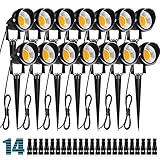


For a typical 20-foot path, install lights every 6 to 10 feet and choose 50 to 100 lumens per fixture. A 30-foot planting bed may need three to five spotlights rated at 200 to 500 lumens each. Always check whether the stated output is for the LED itself or the finished fixture; advertised brightness can vary considerably between products.
Standard Sizes
Use the following guide when selecting garden-light brightness and physical dimensions. Measurements are typical fixture sizes rather than mandatory standards, so check the product listing before planning post spacing or cable runs.
| Garden lighting type | Typical lumens | Typical dimensions | Typical weight | Best use |
|---|---|---|---|---|
| Solar path light | 10–100 lm | 4–6 in. W × 4–6 in. D × 16–24 in. H (10–15 × 10–15 × 41–61 cm) |
0.5–2 lb (0.2–0.9 kg) |
Walkways, borders, and low planting beds |
| Compact solar spotlight | 100–300 lm | 4–6 in. W × 5–8 in. D × 10–14 in. H (10–15 × 13–20 × 25–36 cm) |
1–3 lb (0.5–1.4 kg) |
Small shrubs, pots, and garden ornaments |
| Landscape spotlight | 300–1,000 lm | 3–5 in. W × 4–7 in. D × 8–14 in. H (8–13 × 10–18 × 20–36 cm) |
1–4 lb (0.5–1.8 kg) |
Trees, walls, fences, and focal features |
| Low-voltage path or area light | 100–500 lm | 5–8 in. W × 5–8 in. D × 18–30 in. H (13–20 × 13–20 × 46–76 cm) |
1–5 lb (0.5–2.3 kg) |
Steps, entrances, paths, and entertaining areas |
| Wall or security floodlight | 700–2,000 lm | 5–10 in. W × 4–8 in. D × 5–10 in. H (13–25 × 10–20 × 13–25 cm) |
2–6 lb (0.9–2.7 kg) |
Driveways, large patios, and security coverage |
Physical size matters as much as lumen output. A fixture around 3 inches wide can disappear into a planting bed, while a 6-inch floodlight may look oversized beside a narrow path. Solar units also need an unobstructed panel, usually about 4 to 8 inches wide, and should not be hidden beneath dense foliage.
How to Measure Your Space
- Measure the length of the area. Record the path, fence, wall, or planting bed in feet and inches. Convert to centimeters if you are comparing products listed in metric measurements.
- Measure the subject’s height. Note the height of a tree trunk, shrub, retaining wall, or architectural feature. A 4-foot shrub generally needs less output than a 12-foot tree.
- Mark viewing points. Stand where people will see the garden most often, such as the patio, front door, or driveway. This helps you aim fixtures without shining light directly into eye level.
- Choose fixture spacing. Space path lights 6 to 10 feet apart. For overlapping illumination, reduce the spacing to 4 to 6 feet. For decorative pools of light, 10 to 12 feet may work better.
- Estimate total lumens. Multiply the number of fixtures by each fixture’s lumen rating. For example, six 100-lumen path lights provide 600 stated lumens across a walkway, but they will not appear as one 600-lumen beam.
- Account for the beam angle. A narrow 15- to 30-degree beam concentrates light on a tree trunk or statue. A 60- to 120-degree beam spreads light across paths, beds, and patios.
- Check the power layout. A 12-volt system may require a transformer, outdoor-rated cable, connectors, and enough capacity for the total wattage. Solar fixtures avoid cable runs but depend on daily sunlight and battery capacity.
By Room or Use Case
Paths and Walkways
Choose 50 to 100 lumens per fixture for a path that is already easy to see. Place fixtures 6 to 10 feet apart and alternate sides where possible. For a 20-foot walkway, four 75-lumen lights are usually more comfortable than two 300-lumen spotlights. Keep the light source below eye level or use a shielded cap to reduce glare.
Steps and Entrances
Stairs need more consistent light than a flat path. Use 100 to 300 lumens per step area, landing, or entrance fixture, depending on the width and surrounding darkness. A 3-foot-wide stair may need one centered light, while a 5-foot-wide stair is often better served by two lower-output fixtures. Avoid placing a bright light directly at the top of the stairs, where it can create silhouettes.
Patios and Outdoor Dining
For general patio illumination, aim for 10 to 20 lumens per square foot when using several fixtures or string-style sources. A 100-square-foot patio therefore needs roughly 1,000 to 2,000 total lumens, distributed around the perimeter rather than concentrated overhead. For a softer dining setting, use 20- to 60-lumen accent lights and add brighter task lighting only near a grill, serving table, or steps.
Trees, Shrubs, and Garden Features
Use 100 to 300 lumens for small shrubs and ornamental grasses, 300 to 600 lumens for medium trees, and 600 to 1,000 lumens for larger trees or textured walls. Aim the beam from the side or from the base of the feature. Two 300-lumen fixtures aimed from different angles can create more depth than one 600-lumen light pointed straight ahead.
Driveways, Gates, and Security Areas
Use 700 to 2,000 lumens for broad coverage around a driveway, gate, or side entrance. Motion-activated floodlights can use higher output because they are not operating continuously. For a decorative driveway, 100 to 300 lumens per path light may be enough. Select weather-resistant fixtures and direct them downward to avoid glare into neighboring windows.
Solar Versus Low-Voltage Lighting
Solar spotlights are convenient for small areas and locations where trenching cable is impractical. Example products range from roughly $20 to $60 for compact or adjustable solar spotlights, with some listings advertising outputs up to 1,000 lumens. Performance depends on panel placement, season, battery condition, and the length of the nightly run.
Low-voltage kits are generally more consistent for larger gardens. A 12-volt, 10-watt landscape fixture may provide several hundred to about 1,000 stated lumens, while multi-light kits commonly cost about $40 to $100 or more depending on the number of fixtures, connectors, transformer, and cable. Plug-in 120-volt spotlights can cost about $40 to $80 for a small multipack, but they require a suitable outdoor outlet and weather-rated connections.
Common Sizing Mistakes
- Choosing lumens without considering beam angle: A narrow beam can look intense in one spot but leave the surrounding ground dark.
- Using too few very bright fixtures: This creates harsh pools of light and deep shadows. More fixtures at lower output usually look more natural.
- Ignoring fixture height: A light mounted 10 feet high covers more area than one mounted 2 feet high, but it may require a wider beam and better glare control.
- Overlooking mature plant size: Measure the feature as it is expected to look, not only as it appears on installation day.
- Assuming watts equal brightness: Watts measure energy use; lumens measure visible light. Compare lumen ratings when evaluating LED products.
- Forgetting color temperature: Warm white light around 2,700K to 3,000K generally suits gardens. Cooler light can appear brighter and more stark, even at the same lumen rating.
- Placing lights at eye level: Aim beams toward the subject and use hoods, shields, or frosted lenses where glare is a problem.
FAQ
How many lumens are good for garden path lights?
Use about 50 to 100 lumens per path light for ordinary walkways, spaced 6 to 10 feet apart. Choose closer spacing rather than dramatically higher brightness when the path has steps, curves, or uneven paving.
Is 1,000 lumens too bright for a garden?
Not necessarily. A 1,000-lumen spotlight can be appropriate for a tall tree, large wall, or security area. It may be excessive for a small flower bed, especially with a narrow beam. Use adjustable aiming, a shield, or a dimmer when available.
How many lumens do I need for a small backyard?
A small backyard often needs 500 to 1,500 total decorative lumens, distributed among paths, plants, and seating areas. Add more only where visibility or security requires it.
What is the best lumen range for warm garden lighting?
For a comfortable layered scheme, use 50 to 150 lumens for paths, 100 to 300 lumens for steps and shrubs, and 300 to 600 lumens for trees and feature walls. Warm white LEDs around 2,700K to 3,000K help keep the result inviting rather than overly harsh.