Key takeaways
- Choosing by height alone: A tall fountain with a broad base may use more space than expected. Always compare width and depth as well as height.
- Ignoring the filled weight: Water weighs about 8.34 pounds per gallon. A fountain holding 5 gallons adds more than 40 pounds before the basin, pump, and decorative material are included.
- Placing it too close to walls: Splash and evaporation can stain masonry, damage finishes, or leave mineral deposits. Follow the manufacturer’s clearance recommendations.
- Blocking circulation: A fountain positioned in the center may look attractive but can force people to walk around it. Keep the main route clear.
- Using an undersized pump: A fountain designed for a particular pump flow may not produce the advertised cascade with a weaker replacement. Pump wattage commonly falls around 10 to 50 watts for residential fountains, but use the specified replacement whenever possible.
- Forgetting maintenance access: Leave room to remove the pump, clean the basin, and refill the reservoir. A fountain that fits perfectly against a wall may be difficult to service.
- Overlooking noise: Taller tiers often create more noticeable water sound, but pump noise and splash depend on design and water level. Position louder models away from dining and conversation areas.
What's inside
The Short Answer
For most courtyards, the best fountain size is 30 to 40 inches tall with a 20- to 30-inch-wide footprint. This range creates a visible focal point without overwhelming a compact seating area or blocking circulation. In a very small courtyard, choose a tabletop or wall fountain measuring 12 to 24 inches high. In a spacious courtyard, a 40- to 52-inch floor fountain can provide enough height and sound to anchor the space.
As a practical rule, leave at least 24 inches of clear walking space around the fountain, and allow 36 inches where people will regularly pass. The basin or base should occupy no more than about one-quarter of the open floor area. A fountain that is too small may disappear among furniture and plants, while one that is too large can make the courtyard feel crowded and difficult to maintain.
As an Amazon Associate we earn from qualifying purchases at no extra cost to you. Product prices and availability are accurate as of the date shown and are subject to change.
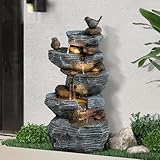

Standard Sizes
Fountain dimensions are usually described by overall height, width, and depth. Height determines how strongly the feature reads from across the courtyard; width and depth determine how much floor space it uses. The measurements below are useful starting points rather than strict rules.
| Fountain type | Typical dimensions | Metric dimensions | Best for |
|---|---|---|---|
| Tabletop | 12–24 in. high × 8–16 in. wide × 8–16 in. deep | 30–61 cm high × 20–41 cm wide × 20–41 cm deep | Small patios, bistro tables, entry ledges |
| Wall-mounted | 18–36 in. high × 12–24 in. wide × 6–12 in. deep | 46–91 cm high × 30–61 cm wide × 15–30 cm deep | Narrow courtyards and vertical surfaces |
| Compact floor fountain | 24–32 in. high × 14–22 in. wide × 14–22 in. deep | 61–81 cm high × 36–56 cm wide × 36–56 cm deep | Small seating areas and apartment courtyards |
| Medium floor fountain | 32–42 in. high × 18–30 in. wide × 18–30 in. deep | 81–107 cm high × 46–76 cm wide × 46–76 cm deep | Most residential courtyards |
| Tall floor fountain | 42–55 in. high × 22–36 in. wide × 22–36 in. deep | 107–140 cm high × 56–91 cm wide × 56–91 cm deep | Large courtyards and long sight lines |
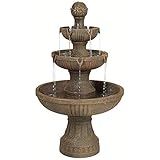
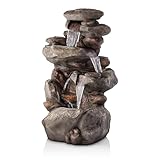
A 30- to 40-inch fountain is often the safest choice for a typical courtyard because its upper tiers are visible over low chairs and planters. For comparison, commonly sold outdoor models include a 40-inch, four-tier rock-style fountain priced around $229, a 43-inch tiered Italian-style fountain priced around $284.95, and a 50.5-inch solar cascading fountain priced around $169.99. Smaller multi-tier options may cost about $79.99, though price varies with materials, lighting, pump capacity, and seasonal availability.
Check the listed base dimensions before buying. Two fountains with the same height can have very different footprints. Also check shipping weight and assembled weight. Resin and fiberglass models may weigh roughly 15 to 40 pounds, while concrete, stone, and ceramic fountains can exceed 75 pounds. A heavy fountain is more stable but harder to reposition and may require a structurally sound surface.
How to Measure Your Space
- Measure the open floor area. Record the courtyard’s usable length and width, excluding stairs, doors, gates, built-in planters, and furniture that will remain in place.
- Mark the proposed footprint. Use painter’s tape or cardboard to outline the fountain’s advertised width and depth. Include any rear housing, basin lip, feet, or solar panel that extends beyond the main body.
- Protect the walkway. Leave at least 24 inches between the fountain and nearby obstacles. Increase this to 36 inches on the main route between the house, gate, and seating area.
- Check sight lines. Sit in the main chairs and stand at the courtyard entrance. The fountain should be visible without blocking a window, door swing, grill, or important architectural feature.
- Measure vertical clearance. Confirm that the fountain will not interfere with a roof overhang, low tree branch, pergola, outdoor fan, or window view. Leave several inches above the fountain for safe clearance and easy cleaning.
- Plan for splash. Keep the fountain several feet from delicate furniture, painted walls, electrical outlets, and fabric cushions. Wind can carry spray farther than the listed basin width.
- Locate power before purchasing. A plug-in fountain needs a weather-rated outdoor receptacle and a safe cord route. Measure the distance to the outlet rather than assuming an extension cord will be suitable.
- Check the surface and load. Set the fountain on a level, stable surface. Confirm that a balcony, raised deck, or rooftop courtyard can support the filled fountain, especially with stone or concrete construction.
By Room or Use Case
Small courtyard or narrow side yard
Choose a 12- to 28-inch fountain, or use a wall-mounted design that is 18 to 30 inches tall and no more than 12 inches deep. A narrow vertical fountain preserves walking space while adding the sound of moving water. For a floor model, target a footprint under 20 by 20 inches. Avoid wide bowls and large lower basins, which can make a narrow courtyard feel like a passageway obstacle.
Courtyard with a bistro table
A 24- to 36-inch fountain usually works well beside a small dining set. Place it at least 24 inches from chair edges so people can pull chairs out without striking the basin. A compact fountain can sit near a corner or against a wall, while a tabletop model works when floor space is especially limited. Choose a quieter pump if the fountain will be close to conversation seating.
Large entertaining courtyard
Use a 36- to 50-inch fountain with a footprint of approximately 24 to 32 inches. This scale is easier to see behind lounge chairs and can serve as a visual anchor at the end of a seating arrangement. For a courtyard larger than about 200 square feet, a fountain below 24 inches may look undersized unless it is grouped with tall planters, lighting, or a raised plinth.
Entry courtyard
For an entry, select a 30- to 44-inch fountain that can be seen from the front door or gate. Keep at least 36 inches of clear passage, and avoid placing the fountain where it narrows the route or obstructs door hardware. A tiered design offers strong vertical emphasis, while a low bubbling bowl may be better where guests need an unobstructed view.
Solar-powered courtyard
Solar fountains are useful where running a power cable is difficult. Allow extra space for the solar panel, which may need direct sunlight and a clear angle. A 30- to 50-inch solar fountain can be suitable, but water flow may be weaker in shade or cloudy conditions. Confirm whether the panel is attached to the fountain or connected by a separate cable before measuring the installation area.
Common Sizing Mistakes
- Choosing by height alone: A tall fountain with a broad base may use more space than expected. Always compare width and depth as well as height.
- Ignoring the filled weight: Water weighs about 8.34 pounds per gallon. A fountain holding 5 gallons adds more than 40 pounds before the basin, pump, and decorative material are included.
- Placing it too close to walls: Splash and evaporation can stain masonry, damage finishes, or leave mineral deposits. Follow the manufacturer’s clearance recommendations.
- Blocking circulation: A fountain positioned in the center may look attractive but can force people to walk around it. Keep the main route clear.
- Using an undersized pump: A fountain designed for a particular pump flow may not produce the advertised cascade with a weaker replacement. Pump wattage commonly falls around 10 to 50 watts for residential fountains, but use the specified replacement whenever possible.
- Forgetting maintenance access: Leave room to remove the pump, clean the basin, and refill the reservoir. A fountain that fits perfectly against a wall may be difficult to service.
- Overlooking noise: Taller tiers often create more noticeable water sound, but pump noise and splash depend on design and water level. Position louder models away from dining and conversation areas.
FAQ
What is the best fountain size for a small courtyard?
A fountain 24 to 32 inches tall with a footprint no larger than about 20 by 20 inches is a reliable choice. For very narrow spaces, select a wall fountain 6 to 12 inches deep or a tabletop model 12 to 24 inches high.
How far should a courtyard fountain be from a wall?
Leave enough room to prevent splash and to access the pump. In many installations, 12 to 24 inches of clearance is practical, but follow the product instructions. A wall-mounted fountain may require less floor depth but still needs service access.
Is a 40-inch fountain too big for a courtyard?
Not necessarily. A 40-inch fountain suits many medium and large courtyards, especially when its base is 30 inches wide or less. It may be too large for a narrow walkway or a compact courtyard with less than 100 square feet of open floor area.
How much water does a courtyard fountain need?
Many residential fountains use roughly 2 to 10 gallons in the visible reservoir, but capacity varies substantially. Buy according to the manufacturer’s fill line, not appearance. Keep the water level high enough to protect the pump, and expect to refill more often in hot, dry, or windy conditions.