Key takeaways
- Best all-round deer crossbow: TenPoint Flatline 460 — compact, fast, and supplied with a crank-cocking system on many packages.
- Best high-speed option: Ravin R500 — approximately 500 feet per second, with a narrow reverse-draw design and integrated cocking mechanism.
- Best recurve choice: Excalibur Assassin Extreme — simpler limb architecture, good field serviceability, and a built-in crank aid.
- Best budget-oriented hunting option: Barnett Whitetail Hunter STR — moderate speed and a more accessible price range, with rope-cocking assistance generally included.
- Best compact turkey-oriented setup: a 300–350 feet-per-second reverse-draw or compact compound crossbow — lighter and less cumbersome in a blind than many 400-plus-feet-per-second models.
The best crossbows for hunting depend on the animal and your tolerance for weight and noise: choose the TenPoint Flatline 460 for a compact deer setup, the Ravin R500 for maximum speed, and the Excalibur Assassin Extreme when simple, quiet operation and easy maintenance matter more than headline velocity.
Draw weight is only part of the decision. A high draw weight can produce excellent arrow speed, but it also increases cocking effort, string and serving wear, and the need for a rope cocker or crank. For deer, speed and a flat trajectory are useful at ethical hunting distances. For turkey, a quieter, lighter crossbow with manageable power is usually the more practical choice, particularly when hunting from a blind or carrying equipment over uneven ground.
Our top picks

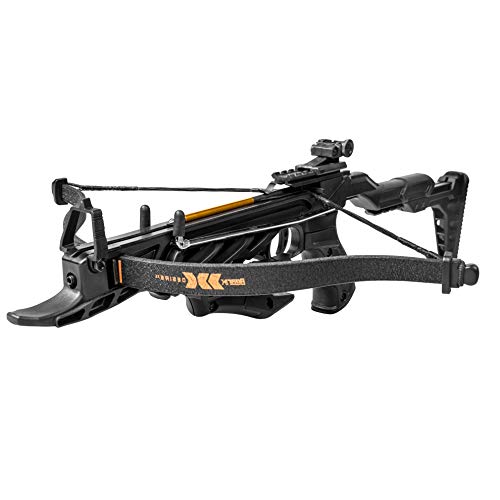

As an Amazon Associate we earn from qualifying purchases at no extra cost to you. Ratings are shown as listed on Amazon.
Top crossbow picks by hunting situation
- Best all-round deer crossbow: TenPoint Flatline 460 — compact, fast, and supplied with a crank-cocking system on many packages.
- Best high-speed option: Ravin R500 — approximately 500 feet per second, with a narrow reverse-draw design and integrated cocking mechanism.
- Best recurve choice: Excalibur Assassin Extreme — simpler limb architecture, good field serviceability, and a built-in crank aid.
- Best budget-oriented hunting option: Barnett Whitetail Hunter STR — moderate speed and a more accessible price range, with rope-cocking assistance generally included.
- Best compact turkey-oriented setup: a 300–350 feet-per-second reverse-draw or compact compound crossbow — lighter and less cumbersome in a blind than many 400-plus-feet-per-second models.
Crossbow comparison: deer versus turkey
The figures below are representative manufacturer specifications and can vary by package, production year, arrows, and accessories. Always confirm the exact configuration before buying.
| Model | Advertised speed | Draw weight | Approx. bare weight | Approx. width uncocked | Cocking method | Best fit |
|---|---|---|---|---|---|---|
| TenPoint Flatline 460 | Up to 460 fps | About 185 lb | About 7.5 lb | About 12 inches | Integrated crank system | Deer hunters wanting speed in a compact package |
| Ravin R500 | Up to 500 fps | About 17 lb peak draw force at the mechanism | About 8.4 lb | About 6 inches | Integrated VersaDrive-style cocking system | Experienced deer hunters prioritizing velocity and narrow handling |
| Excalibur Assassin Extreme | Up to about 400 fps | About 285 lb limb draw weight | About 7.7 lb | Roughly 30 inches axle-to-axle uncocked | Built-in crank aid | Hunters who value a recurve design and serviceability |
| Barnett Whitetail Hunter STR | Up to about 375 fps | About 185 lb | About 6.4 lb | About 18 inches | Rope cocker commonly supplied | Occasional hunters seeking lower cost and moderate weight |
| Compact 300–350 fps hunting model | 300–350 fps | Usually 150–200 lb | 5.5–7 lb | Approximately 12–20 inches | Rope cocker or optional crank | Turkey, blinds, and shorter carry distances |
What draw weight really changes
Draw weight is the force required to pull the string into the cocked position, although reverse-draw models and cocking mechanisms can make the force felt by the user much lower. A traditional compound or recurve crossbow with a 180–200-pound draw weight should not be confused with a 180-pound hand bow: the crossbow stores energy while cocked and releases it through a short power stroke.
Higher draw weight can contribute to greater arrow energy, but speed also depends on power-stroke length, limb design, cam efficiency, arrow mass, and string condition. Two crossbows with similar draw weights can therefore produce noticeably different velocities.
- For deer: roughly 350–450 fps is a useful practical range. It provides a relatively forgiving trajectory without automatically choosing the loudest or heaviest model.
- For turkey: approximately 300–375 fps is usually sufficient when paired with a suitable broadhead and a legal, ethical shot distance. A compact, quieter setup may be more valuable than another 50 fps.
- For users with limited cocking strength: select an integrated crank or a low-effort cocking aid rather than assuming a rope cocker will be comfortable.
Deer hunting: speed, energy, and carry weight
Deer hunting often involves a long walk, a raised stand, or repeated movement through thick cover. The Ravin R500 is exceptionally narrow when cocked and offers a very flat trajectory, but its price, specialized components, and relatively high overall weight make it more suitable for a committed user than a casual hunter.
The TenPoint Flatline 460 is a more balanced deer choice. Its shorter profile is useful in a blind or stand, and a crank system removes much of the physical effort of cocking. The trade-off is that a high-speed crossbow can be sharper in report and more demanding on arrows, strings, servings, and rail lubrication than a slower model.
For a first deer crossbow, a 350–400 fps model is often the sensible middle ground. It is fast enough for normal hunting distances, less expensive than flagship systems, and usually easier to tune and maintain.
Turkey hunting: why lighter and quieter can win
Turkey hunting places a premium on concealment and maneuverability. A wide crossbow can catch on the edge of a blind, while a heavy model becomes tiring when held ready for an extended period. Turkey also presents a smaller target area, so the ability to position the crossbow smoothly and quietly may matter more than maximum velocity.
Choose a model with a manageable stock, compact front end, and a reliable safety that can be operated without shifting your shooting position. A 300–350 fps crossbow can be a sensible turkey setup, especially when using a turkey-specific broadhead designed for the game and observing local regulations. Avoid assuming that a deer broadhead or a high-energy hunting arrow is automatically the best turkey combination.
Rope cocker or crank: which do you need?
Rope cocking device
A rope cocker usually halves the apparent effort by using both arms and body position to draw the string evenly. It is inexpensive, light, and easy to replace. It works well with many 150–200-pound compound crossbows, but it still requires enough mobility to pull the handles upward and keep the hooks seated correctly.
Integrated crank
A crank reduces the effort substantially and helps produce a consistent string position. It is the better choice for a heavy recurve, a high-draw-weight compound model, or anyone who finds rope cocking uncomfortable. The disadvantages are extra weight, more moving parts, and the need to inspect the cable, handle, gears, and mounting points.
Never substitute an improvised strap, cord, or drill attachment for the manufacturer’s approved system. Incorrect cocking can produce an uneven string position, poor accuracy, or equipment damage.
Decision matrix for choosing your crossbow
| Your situation | Prioritize | Most suitable choice |
|---|---|---|
| First-time deer hunter on a moderate budget | 350–400 fps, 6–8 lb weight, rope cocker | Mid-range compound model such as the Barnett Whitetail Hunter STR class |
| Frequent deer hunter using a blind or tight stand | Narrow profile, crank cocking, compact length | TenPoint Flatline 460 class |
| Experienced hunter wanting maximum trajectory | High speed, premium optics, integrated cocking | Ravin R500 class |
| Hunter prioritizing field service and simple construction | Recurve limbs, replaceable string, crank aid | Excalibur Assassin Extreme class |
| Turkey hunter carrying gear through cover | 5.5–7 lb weight, 300–350 fps, compact width | Compact hunting crossbow with rope cocker or small crank |
Noise and maintenance realities
Crossbows are not silent. String stops, limb dampeners, stock design, arrow mass, and loose accessories all affect the report and vibration. A heavier hunting arrow may reduce speed but can sometimes produce a less abrupt shot cycle. Confirm compatibility with the manufacturer rather than exceeding the recommended arrow weight.
The parts that commonly wear first are the string serving, center serving, cables on compound models, rail contact area, string stops, and cocking-device components. After every shooting session, inspect the serving for separation, check that bolts and scope mounts remain tight, and examine the limbs for cracks or splinters. Apply rail lubricant only as specified; excess lubricant can attract grit, while the wrong lubricant may damage the serving.
A simple ownership-cost calculation
Suppose a hunter shoots 120 practice arrows before a season, uses 20 arrows while sighting in and hunting, and replaces six arrows after damage or loss. At a general market range of about $10–$20 per hunting arrow, the annual arrow cost is approximately $60–$120 for replacements alone. Add a replacement string and serving job, commonly around $100–$250 depending on the model and labor, and a premium high-speed crossbow may cost more to keep ready than its purchase price suggests.
That is why a slightly slower model can be the better long-term choice for an occasional hunter: lower accessory costs, less demanding tuning, and fewer specialized parts can outweigh the appeal of maximum velocity.
Final buying advice
For most deer hunters, select a 350–460 fps crossbow with an integrated crank if repeated rope cocking is uncomfortable. Choose the TenPoint Flatline 460 for a balanced premium setup, the Ravin R500 for maximum speed and narrow handling, or the Excalibur Assassin Extreme for a recurve design with practical serviceability. For turkey, resist buying more power than you can comfortably carry and control; a compact 300–375 fps model with appropriate arrows, a quiet shot cycle, and a suitable broadhead is often the more useful tool.
Before hunting, verify season dates, permitted crossbow types, draw-weight rules, broadhead requirements, and minimum or maximum arrow specifications with your local wildlife authority. Practice from realistic positions, confirm the safety works correctly, and use only equipment matched to the manufacturer’s instructions.