Key takeaways
- Choose it for: long-term ownership, high frequency and maximum stability.
- Watch out for: high purchase cost, large footprint and difficult positioning after assembly.
- Garage requirement: leave access around the loading side and enough overhead clearance to handle plates comfortably.
The best belt squat machines for home gyms in 2026 are the Rogue Monster Rhino for maximum durability, the Titan Fitness Belt Squat Machine for lower-cost high loading, and a compact plate-loaded belt squat for lifters who need to preserve garage floor space.
Our top picks
![Belt Squat Machine 2.0 [Bells of Steel] Robust Leg Press Machine | Leg Workout Equipment Squat Machines for Home | Includes Weightlifting Belt, Top and Bottom Pegs | 11 Gauge Steel, 700 lb Capacity](https://m.media-amazon.com/images/I/41nLJA-6+gL._SL500_.jpg) Belt Squat Machine 2.0
Belt Squat Machine 2.0- Lift Heavy, Lift Happy - The Bells of…
- Get More, Pay Less - Don't settle for…
- Maximize Your Potential - This leg machine's innovative…
 Mikolo Belt Squat Machine
- 【Squat Helper】There is no doubt that squat is…
- 【Superior Quality】The glute workout machine is made of…
- 【Safer Security】Gritted pedals provide a non-slip surface for…
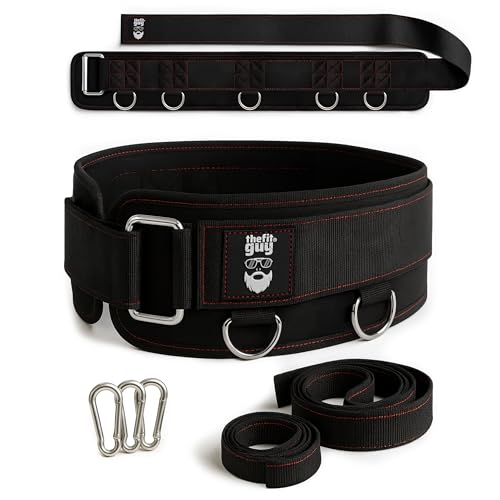 THEFITGUY Original Multi-Attachment Belt for Cable Squats
- Designed for cable squats and cable hip thrusts…
- 5 attachment points
- 2 straps and 3 metal hooks included
| Product | Key specs | |
|---|---|---|
| Belt Squat Machine 2.0 | Lift Heavy, Lift Happy - The Bells of… Get More, Pay Less - Don't settle for… Maximize Your Potential - This leg machine's innovative… | Check price |
| Mikolo Belt Squat Machine | 【Squat Helper】There is no doubt that squat is… 【Superior Quality】The glute workout machine is made of… 【Safer Security】Gritted pedals provide a non-slip surface for… | Check price |
| THEFITGUY Original Multi-Attachment Belt for Cable Squats | Designed for cable squats and cable hip thrusts… 5 attachment points 2 straps and 3 metal hooks included | Check price |
 THEFITGUY Original Belt Squat Belt for Rack THEFITGUY Original Belt Squat Belt for Rack | Stays Low Real Support Where It Counts: Reinforced 5-panel EVA… Locked-In Fit, No Slipping: Adjustable 2" inner strap… | Check price |
As an Amazon Associate we earn from qualifying purchases at no extra cost to you.
Quick comparison: the best belt squat machines
| Machine | Approx. footprint | Frame steel | Rated capacity | Approx. machine weight | Best for |
|---|---|---|---|---|---|
| Rogue Monster Rhino | About 42 x 80 in | 3 x 3 in, 11-gauge steel | About 1,000 lb | About 600 lb | Frequent, heavy training |
| Titan Fitness Belt Squat Machine | About 47 x 83 in | Heavy-duty welded steel, commonly listed as 11-gauge | About 1,000 lb | About 400–500 lb | Budget-conscious garage gyms |
| SquatMax-MD | About 45 x 55 in | Heavy-gauge steel frame | About 1,000 lb | About 350 lb | Shorter footprints and belt-squat specialists |
| Compact plate-loaded belt squat attachment | About 30–45 x 30–50 in, excluding rack | Usually 11-gauge steel | About 500–800 lb | About 80–180 lb | Small spaces and occasional use |
Dimensions and capacities vary by revision and configuration, so check the current manufacturer specification before ordering. The practical comparison is more important than the largest headline capacity: a 1,000-pound rating is useful only if the frame, loading arm, floor and your available plates can support it.
Best overall: Rogue Monster Rhino
The Rogue Monster Rhino is the strongest all-round choice when a belt squat will be a primary lower-body station rather than an occasional accessory. Its 3 x 3-inch, 11-gauge steel construction, large base and approximately 1,000-pound capacity provide a substantial margin for progressive training. The long footprint is the main trade-off: at roughly 80 inches deep, it consumes considerably more garage space than a compact attachment.
The Rhino is particularly suitable for users who train several times per week, share equipment with family members, or want a machine that remains stable during heavy squats, split squats and belt-loaded pulls. Expect a substantial assembly project. The frame and loading components are heavy enough that two adults, a clear assembly area and suitable lifting technique are sensible requirements.
- Choose it for: long-term ownership, high frequency and maximum stability.
- Watch out for: high purchase cost, large footprint and difficult positioning after assembly.
- Garage requirement: leave access around the loading side and enough overhead clearance to handle plates comfortably.
Best value: Titan Fitness Belt Squat Machine
Titan Fitness targets the same basic use case at a lower general market price, typically in the mid-hundreds to around the low four-figure range depending on configuration and promotions. Its large welded frame and approximately 1,000-pound capacity make it attractive for home lifters who want a dedicated machine without paying premium-brand pricing.
Its footprint is not small. Plan on approximately 47 by 83 inches, plus clearance for loading plates and stepping onto the platform. That makes it a better value choice than a space-saving choice. Quality control, finish and assembly fit can be less predictable across budget equipment, so inspect welds, fasteners, pulleys and plate sleeves during setup rather than assuming every component is perfectly aligned.
- Choose it for: a dedicated garage gym with a controlled budget.
- Watch out for: more involved assembly and the need to verify hardware tightness periodically.
- Best use: regular squatting, lunges and belt-loaded accessory work where a stable platform matters.
Best for a shorter footprint: SquatMax-MD
The SquatMax-MD is worth considering when depth is the limiting dimension. Its design is notably shorter than many traditional belt squat machines, with an overall footprint commonly listed at roughly 45 by 55 inches. That can make the difference in a single-car garage, although the machine still needs working room in front and beside the platform.
Its distinctive resistance path is intended to keep the load centered beneath the lifter rather than requiring a long rear loading arm. This can be useful where a conventional machine would obstruct a vehicle bay or storage area. The machine is still heavy and is not a portable piece of equipment in the everyday sense. Assembly may be less extensive than with a very large frame, but moving the assembled unit remains a two-person job.
- Choose it for: a garage where front-to-back space is more valuable than the lowest price.
- Watch out for: premium pricing and the need to confirm the exact resistance setup you are buying.
- Best use: frequent belt squats with a strong emphasis on compact layout.
When a compact belt squat attachment makes more sense
A rack-mounted or compact plate-loaded belt squat attachment is the sensible answer for a smaller gym, especially if you already own a sturdy power rack. These units generally weigh about 80 to 180 pounds and may occupy only 30 to 50 inches of floor depth apart from the rack. Their capacity is commonly lower than a full machine, but 500 to 800 pounds is more than enough for many home users.
The compromise is stability and setup time. Some attachments must be removed or repositioned for other rack exercises, and the rack itself must be anchored or sufficiently heavy. Never attach a belt squat arm to a light, freestanding rack without checking its rated load and resistance to tipping.
Decision matrix for a home garage
| Your situation | Best direction | Why |
|---|---|---|
| Under 100 square feet available | Compact attachment or SquatMax-MD | Reduces permanent floor coverage |
| Training once or twice weekly | Attachment or budget machine | A premium welded frame may not repay its cost |
| Training four or more times weekly | Rogue Monster Rhino or similar heavy-duty machine | Durability and quick repeatable setup matter more |
| New to belt squats | Stable platform with adjustable starting height | Makes technique practice less awkward |
| More than 700 lb of plates available | Full-size machine | Better stability and loading capacity |
| Limited budget | Titan Fitness or a compact attachment | Leaves money for a belt, plates and floor protection |
Steel gauge, capacity and the details listings leave out
Steel gauge is only one part of durability. In North American equipment, a lower gauge number means thicker steel: 11-gauge is thicker than 12-gauge, and both are substantially more robust than light 14-gauge tubing. Look at tubing size as well. A 3 x 3-inch, 11-gauge upright usually resists flex better than a smaller tube of the same gauge.
Also inspect the load path. A machine with a 1,000-pound rating needs reinforced pivots, properly captured bearings, strong welds and a platform that does not rock. The pulley cable, belt attachment point and loading sleeves often experience more wear than the main frame. A high capacity is less useful if the machine uses a narrow platform or awkward plate clearance.
Assembly and floor protection
Plan the installation before delivery. Measure the machine’s footprint, the door opening, the route from the entrance and the final loading clearance. A large machine may fit on paper but become unusable when a car, workbench or storage rack occupies the surrounding space.
- Clear an area larger than the listed footprint and lay out all hardware.
- Assemble the frame loosely so holes can align before final tightening.
- Install pulleys, cables and pivots without twisting the cable or trapping it against steel.
- Level the platform before loading plates.
- Perform several unloaded repetitions, then test with a light load.
- Recheck bolts after the first few sessions because settling can create looseness.
For a concrete garage floor, use dense rubber tiles at least 3/4 inch thick beneath the entire machine, with thicker 1-inch or 2-inch tiles under the loading side if plates may be dropped. Rubber protects the slab, reduces vibration and helps prevent the frame from creeping. Avoid soft foam puzzle mats under a heavy belt squat: they compress unevenly and can make the platform unstable. On a finished or sealed floor, add a moisture barrier if the rubber manufacturer recommends one, since trapped condensation can stain some surfaces.
Ownership costs and maintenance
Budget for more than the machine. A belt squat also requires a compatible belt, enough Olympic plates, rubber flooring and sometimes rack anchoring. As a simple example, if a $1,500 machine is used three times weekly for five years, that is about 780 sessions, or approximately $1.92 per session before plates and flooring. A $700 attachment used only once weekly for the same period would be about $2.69 per session. Frequency can matter more than the initial price.
Wipe sweat from the belt and platform, keep cable grooves free of debris and inspect pulley bearings, snap hooks, stitching and weld areas every month. Replace a frayed cable or cracked belt rather than trying to repair it with tape. Lubricate pivots only with the product specified by the manufacturer; excess oil attracts grit in a garage.
Final buying recommendation
Choose the Rogue Monster Rhino if you have the room and expect frequent heavy use. Choose the Titan Fitness machine if capacity and a dedicated platform matter more than premium finish. Choose the SquatMax-MD when garage depth is the constraint. If your space, budget or training frequency is limited, a well-supported compact attachment is usually the more rational purchase.
Before ordering, verify four measurements: the machine footprint, the route through your home, the plate-loading clearance and the usable height of your garage. Those checks prevent the most expensive mistake in belt-squat ownership: buying a capable machine that cannot be assembled, loaded or used comfortably where you intended to put it.