Key takeaways
- 3.5mV – 7mV MM (e.g., Ortofon 2M Red/Blue, Audio-Technica VM540ML): 36-42dB. Anything above 45dB will raise the noise floor unnecessarily.
- 1.8mV – 2.5mV High-Output MC (e.g., Sumiko Blue Point No.3): 42-48dB. Treat it like a low MM, not a true MC.
- 0.3mV – 0.5mV Low-Output MC (e.g., Hana SL, Ortofon Quintet Blue): 58-62dB. Requires a dedicated MC stage with low noise.
- 0.2mV and below (e.g., Denon DL-103): 60-65dB minimum. If your preamp maxes at 60dB, you will need to add 6-8dB at the amplifier and will hear more hiss.
The best phono preamps for vinyl in 2026 are the iFi Zen Phono for most MM/MC setups, the Pro-Ject Phono Box DS3 B for flexible cartridge matching, and the Schiit Mani 2 for budget MM and high-output MC, because they combine adjustable gain, correct loading for moving magnet and moving coil cartridges, and a low noise floor that keeps surface noise from vintage records from being amplified.
Choosing a phono preamp is not about “better sound” in the abstract. It is about matching your cartridge’s output and electrical requirements to a gain stage that can amplify it cleanly. Get the gain and loading wrong and you add hiss, hum, or a dull, muffled top end, no matter how good your turntable is.
Our top picks
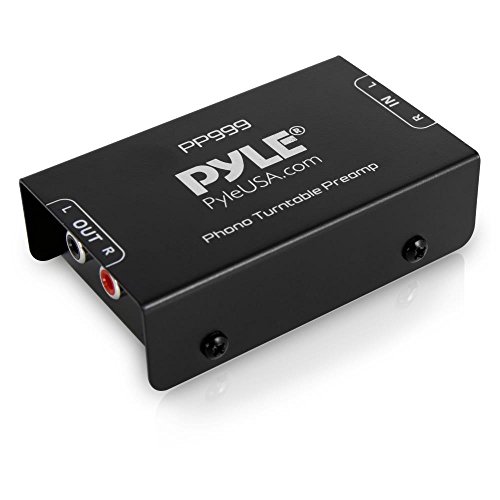


As an Amazon Associate we earn from qualifying purchases at no extra cost to you. Ratings are shown as listed on Amazon.
Why You Need a Phono Preamp and What It Actually Does
A phono cartridge outputs a tiny signal — 2.5mV to 7mV for moving magnet (MM), 0.2mV to 0.5mV for low-output moving coil (MC) — and it is also cut with RIAA equalization. A phono preamp does two jobs: apply the inverse RIAA EQ curve to restore flat frequency response, and add 35-65dB of clean gain to bring that signal up to line level for your amplifier or powered speakers. Using a standard line input without it results in extremely quiet, thin, and bright sound.
Many modern turntables and integrated amplifiers include a basic built-in phono stage. An external preamp matters when you need lower noise, accurate RIAA, or support for a cartridge type your built-in stage does not handle well, especially low-output MC cartridges or vintage MM cartridges that need specific capacitance loading.
MM vs MC vs Switchable: The First Decision
Moving Magnet (MM)
High output, requires 47k ohm impedance and 100-200pF capacitance loading in most cases. Requires 36-45dB of gain. Easiest to live with and the best match for entry and mid-range turntables like the Rega Planar 1-3, Pro-Ject Debut, and Technics SL-1200 series with stock cartridges.
Moving Coil (MC)
Low output, requires much higher gain (58-65dB) and low impedance loading, typically 50-1000 ohms, adjustable. Much more sensitive to noise floor and power supply quality. MC cartridges like the Denon DL-103, Ortofon Quintet Bronze, and Hana EL/SL reveal more detail but will sound hissy or unusable on a preamp designed only for MM.
Switchable MM/MC Preamps
These are the most versatile for 2026 buyers. They offer a switch or jumpers for gain and loading. If you own an MM now but might upgrade to MC later, or you swap between turntables, a switchable model prevents you from buying twice.
Comparison Table: Real Specs That Affect Matching
Noise floor and gain structure matter more than marketing. Here is how popular, widely available models compare on the specs that determine cartridge compatibility.
| Model | Type | Gain Settings | Input Loading | Signal-to-Noise Ratio | THD | Size / Weight |
|---|---|---|---|---|---|---|
| ART DJPRE II | MM only | 36, 39, 42, 45dB (variable trim) | 47k ohms / 100pF + 200pF switch | >90dB (A-weighted, MM) | 0.01% | 140 x 107 x 45mm / 0.45kg |
| Schiit Mani 2 | MM / MC switchable | 33, 42, 48, 60dB (4-step DIP) | 47k ohms MM / 47, 100, 47k ohms MC + 50-200pF | >95dB MM, >82dB MC | <0.005% | 127 x 89 x 32mm / 0.28kg |
| iFi Zen Phono | MM / MC / MC High | 36, 48, 60, 72dB | 47k MM / 110, 1k ohms MC, capacitance 110pF | >90dB MM, >80dB MC (EIN -151dBV) | <0.003% | 158 x 113 x 35mm / 0.46kg |
| Cambridge Audio Alva Duo | MM / MC switchable | 39dB MM / 57dB MC (fixed per mode) | 47k ohms / 100pF MM / 100 ohms MC | >95dB MM, >85dB MC | <0.0025% | 214 x 137 x 46mm / 0.85kg |
| Pro-Ject Phono Box DS3 B | MM / MC fully adjustable | 40, 45, 50, 55, 60, 65dB (continuous) | 10-1000 ohms variable MC, 47k MM / 47-500pF variable | >92dB MM, >78dB MC | <0.001% | 206 x 154 x 64mm / 1.1kg |
| Rega Fono Mini A2D MK2 | MM only | 41.5dB fixed | 47k ohms / 100pF | >89dB | 0.02% | 102 x 95 x 30mm / 0.25kg |
What this tells you: Fixed-gain models like the Cambridge Alva Duo and Rega Fono Mini are quiet and simple but lock you into one cartridge type. Variable models like the Zen Phono and Phono Box DS3 B let you dial gain in 6-12dB steps to match a low-output MC without clipping or excess hiss.
How to Choose Gain and Loading Correctly
Use the cartridge output to set gain. You want enough gain to drive your amp to full volume without turning the volume knob past 2 o’clock, but not so much that hiss becomes audible during quiet passages.
- 3.5mV – 7mV MM (e.g., Ortofon 2M Red/Blue, Audio-Technica VM540ML): 36-42dB. Anything above 45dB will raise the noise floor unnecessarily.
- 1.8mV – 2.5mV High-Output MC (e.g., Sumiko Blue Point No.3): 42-48dB. Treat it like a low MM, not a true MC.
- 0.3mV – 0.5mV Low-Output MC (e.g., Hana SL, Ortofon Quintet Blue): 58-62dB. Requires a dedicated MC stage with low noise.
- 0.2mV and below (e.g., Denon DL-103): 60-65dB minimum. If your preamp maxes at 60dB, you will need to add 6-8dB at the amplifier and will hear more hiss.
For loading, start with the cartridge manufacturer’s recommendation. Most MM cartridges specify 47k ohms plus 100-200pF total capacitance, which includes your tonearm cable. If your preamp adds 100pF and your cable is 90pF, you are at 190pF — often ideal. Too much capacitance rolls off highs and makes vocals sound veiled. For MC, start at 100 ohms for modern low-output coils. Raising to 200-500 ohms opens the top end slightly; lowering to 50-80 ohms tames brightness on vintage records.
Picks by Situation: Matching the Preamp to Your System
Best for Vintage Records and Noisy Pressings
Choose iFi Zen Phono. Its subsonic filter (20Hz) is critical for warped records from the 60s and 70s because it removes low-frequency rumble that wastes amplifier power and makes woofers pump. The four gain options let you run a vintage Shure M44 or Stanton 681 MM at 36dB for lowest hiss, and its -151dBV equivalent input noise floor keeps crackle from being exaggerated. It also includes balanced 4.4mm output if your amp supports it, which lowers hum over long cable runs.
Best for First MM Upgrade from a Built-In Stage
Choose Schiit Mani 2 or U-Turn Pluto 2. Both offer a clear drop in THD and better RIAA accuracy (typically +/-0.1dB to 0.3dB vs +/-1.5dB on cheap built-ins) without requiring DIP switches for every record. The Mani 2’s 42dB setting is the sweet spot for 4-5mV MM cartridges and its external wall-wart supply keeps transformer hum away from the sensitive phono section. Expect a general market range of $100-$170 for this tier.
Best for Switching Between MM and Low-Output MC
Choose Pro-Ject Phono Box DS3 B or Cambridge Audio Alva Duo. The Alva Duo is simpler with a front-panel MM/MC button and a built-in headphone amp for private listening, making it ideal if you swap cartridges infrequently. The DS3 B is for serious cartridge rollers — variable impedance (10 to 1000 ohms) and adjustable capacitance let you match exact factory specs for Ortofon, Hana, Dynavector, and vintage MCs that specify unusual loads like 30 ohms or 400 ohms. Its fully balanced circuitry also rejects noise if you use a turntable with balanced outputs like the Pro-Ject X2 B.
Best for All-Tube System Matching and Small Spaces
Choose Pro-Ject Tube Box S2. It uses two ECC83 tubes to add subtle even-harmonic warmth that can soften harsh, over-compressed reissues, but it still provides 40-63dB gain for MC. Note that tubes add microphonics and require replacement every 3,000-5,000 hours. It runs warmer and is larger, so allow ventilation and keep it away from the turntable to avoid feedback.
Decision Matrix: Find Your Match Fast
| Your Situation | Recommended Type | Key Feature to Prioritize | Example Model Type |
|---|---|---|---|
| One turntable, one MM cartridge, modern amp | Fixed MM, 39-42dB | Low THD and correct capacitance (100pF) | Rega Fono Mini A2D MK2, Pluto 2 |
| Collecting vintage mono / 78-era vinyl | MM with mono switch + subsonic filter | Subsonic filter, rumble filter, high overload margin (>25dB) | iFi Zen Phono, Pro-Ject Phono Box |
| Plan to move to MC within 2 years | Switchable MM/MC 40-60dB | Adjustable MC impedance, 60dB+ gain | Schiit Mani 2, Cambridge Alva Duo |
| Multiple cartridges / test pressings | Fully variable MM/MC | Continuously adjustable loading and gain | Pro-Ject Phono Box DS3 B, Musical Fidelity LX2-LPS |
| Small desk / near-field powered speakers | Compact MM/MC with line + balanced out | Size under 160mm wide, external PSU | iFi Zen Phono, Schiit Mani 2 |
Noise Floor, Gain and Why They Matter for Vintage Records
Noise floor is specified as signal-to-noise ratio (SNR) or equivalent input noise (EIN). A preamp with 90dB SNR MM will have about 6dB less audible hiss than one with 84dB. For MC, anything below 78-80dB SNR will produce audible hiss on quiet classical or jazz pressings.
Worked example: You have an Ortofon MC Quintet Blue (0.5mV output) and a preamp set to 60dB gain. Output voltage = 0.5mV * 1000 (60dB = 1000x voltage) = 0.5V. Your amplifier needs 0.3V input sensitivity for full power, so you have headroom. If you instead set gain to 48dB (251x), output is 0.125V and you must turn your amp up 12dB, which amplifies both music and the preamp’s noise floor equally. The extra gain is better applied cleanly in the phono stage than by cranking the line stage.
For vintage records, excess gain is the most common mistake. Owners set MC gain to 65dB for a 0.4mV cartridge and then hear tape hiss and pressing noise as loud as the music. Back gain down until the loudest passage just avoids clipping — indicated by a transient distortion on drum hits — and you will drop surface noise by several decibels without losing detail.
Setup Steps That Prevent Hum and Damage
An external preamp is a high-gain device. Install it correctly or it will hum.
- Ground first: Connect the turntable ground wire to the preamp’s ground post. If hum remains, try grounding the preamp chassis to your amplifier chassis with a separate wire. Do not float the ground.
- Separate power and signal: Keep the wall-wart and AC cables at least 15cm from RCA interconnects. Route RCA cables perpendicular to power cables, not parallel.
- Gain before loading: Set gain with the preamp off or volume down, then set loading. Changing gain while powered can produce a loud pop through speakers.
- Set capacitance including cable: Add cable capacitance (usually 80-120pF per meter, check your cable spec) to the preamp’s setting. If you are at 220pF total and highs sound dull, reduce preamp capacitance to 47pF or 100pF.
- Check RIAA accuracy: If vocals sound nasal or bass is bloated, your RIAA error may be off. Look for preamps specifying +/-0.2dB RIAA from 20Hz-20kHz; cheaper units at +/-1dB are audibly uneven.
Durability and Ownership Realities
Solid-state phono preamps last 8-12 years with no service, but they are not maintenance-free. What wears first is not the circuit but the connectors and switches. RCA jacks loosen after 100-150 insertions and cause intermittent channel dropouts. Clean them yearly with a dry cotton swab and DeoxIT if you swap cables often. DIP switches and jumpers oxidize; exercise them twice a year if you do not adjust them.
Tube models like the Tube Box S2 need tube replacement and generate heat that dries out nearby electrolytic capacitors faster, shortening service intervals to 5-7 years. Avoid placing any phono preamp on top of a hot amplifier or in a closed cabinet without airflow. Power supplies fail first — wall-warts humming audibly or running hot to the touch should be replaced with the manufacturer-specified voltage and polarity, not a generic supply, or you will inject noise.
Common mistakes: using 3m+ unshielded RCA cables from turntable to preamp, which act as antennas for hum; placing the preamp directly under a Wi-Fi router or near a dimmer switch; and setting MC loading to 47k ohms, which makes MC cartridges sound bright, edgy, and fatiguing because they are severely under-damped.
Frequently Asked Questions
Can I use an MM preamp with an MC cartridge?
No, unless it is a high-output MC (2mV+). A low-output MC at 0.3mV into a 40dB MM stage produces only 0.03V, requiring you to run your main amplifier near maximum where noise and distortion rise dramatically. You need 58dB or more for low-output MC.
Do I need to upgrade my preamp if my turntable already has one?
Only if you hear hiss, hum, distorted bass, or you are moving to a low-output MC. Compare by bypassing the internal stage. If the external preamp lowers the noise floor audibly at the same listening level, keep it.
What loading should I use for vintage MM cartridges like Shure V15 or Stanton 680?
Start at 47k ohms and 200-300pF total capacitance. Many vintage MMs were voiced for higher capacitance than modern designs and sound too bright below 150pF. Increase capacitance in 50pF steps until sibilance softens without dulling cymbals.