Key takeaways
- You normally ski at roughly 28–32 mph.
- You want one ski for recreational carving rather than tournament performance.
- Your boat has limited power or you prefer a less aggressive deep-water start.
- You are moving from two skis to one and want a forgiving transition.
The best water skis for beginners are usually wide combo skis with adjustable bindings, while experienced riders should choose a narrower slalom ski matched closely to body weight, boat speed, and turning goals.
The right ski is less about choosing the most expensive model and more about getting five decisions right: length, width, rocker, binding fit, and whether you want a combo or slalom setup. The established water-ski ranges from brands such as HO Sports, Connelly, Radar, O’Brien, and Jobe cover these categories well, but the specifications matter more than the logo.
Our top picks

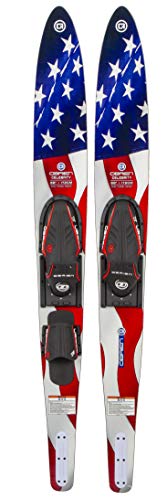


As an Amazon Associate we earn from qualifying purchases at no extra cost to you. Ratings are shown as listed on Amazon.
Best water skis by rider and situation
| Rider or use case | Best ski type | Typical length | Useful features | Typical boat speed |
|---|---|---|---|---|
| Child or very light beginner | Wide trainer or junior combo skis | 115–130 cm | Wide platform, trainer bar compatibility, adjustable bindings | 16–22 mph |
| Adult beginner, approximately 100–150 lb | Short or mid-size combo skis | 63–67 in | Wide body, moderate rocker, forgiving rear binding | 20–25 mph |
| Adult beginner, approximately 150–200 lb | Adult combo skis | 67–69 in | Wide tail, stable base, adjustable universal bindings | 22–28 mph |
| Heavier adult or slower boat | Extra-wide combo or crossover ski | 69–72 in | More surface area, low-effort deep-water starts | 20–26 mph |
| Intermediate slalom rider | Wide-body slalom ski | 65–69 in | Stable turn initiation, adjustable fin and binding positions | 28–32 mph |
| Advanced course skier | Narrow competition slalom ski | 64–69 in | Specific flex pattern, carbon or composite construction, precise setup | 30–36 mph |
These are starting ranges rather than universal rules. Manufacturers use different widths, rocker profiles, flex patterns, and binding systems, so check the individual sizing chart before ordering.
Best choices for beginners: wide combo skis
For a first ski, choose a combo pair rather than a single slalom ski. Combo skis are used as a pair for learning and can often be connected at the tips with a trainer rope or stabilizing bar. Their greater width creates more lift at lower speeds, making it easier to stand up without forcing the boat to accelerate quickly.
A good beginner setup has a stable platform, moderate rocker, and bindings that can be adjusted across more than one shoe size. Open-toe bindings are practical for families because they accommodate growing feet and different riders. A rear toe plate is useful once the rider is comfortable with a two-ski start, but it should not be so tight that the foot cannot release during a fall.
When to choose a junior ski
Children should not simply use shortened adult skis. Junior skis are typically narrower in overall length but often have a broad planing surface relative to their size. Look for a pair around 115–130 cm for smaller riders, with a trainer-bar attachment and bindings that fit securely without relying on oversized footwear.
Boat speed should stay within the ski maker’s guidance. A common beginner mistake is trying to compensate for an oversized ski by increasing speed. The better solution is a correctly sized, stable ski and a smooth throttle application.
Best skis for progressing riders: wide-body slalom designs
A wide-body slalom ski is the useful middle ground between a beginner combo pair and a narrow course ski. It is designed to be ridden alone, but its extra width makes starts and turns less demanding than on a competition-shaped ski.
This is the best choice for an adult who can reliably get up on combo skis and wants to learn carving, surface turns, and one-ski starts. Brands including HO Sports, Connelly, Radar, and O’Brien offer slalom and crossover categories with different widths and flex patterns.
Choose a wide-body slalom ski if:
- You normally ski at roughly 28–32 mph.
- You want one ski for recreational carving rather than tournament performance.
- Your boat has limited power or you prefer a less aggressive deep-water start.
- You are moving from two skis to one and want a forgiving transition.
Best skis for experienced riders: narrow slalom skis
Experienced riders who want faster edge changes and tighter turns should consider a conventional or competition slalom ski. These skis have less planing area and generally demand better posture, stronger grip, and more precise weight transfer. They reward correct technique but expose mistakes more quickly.
A narrow slalom ski makes sense when the rider can start consistently on one ski, maintain a stable athletic stance, and control the ski through both sides of a turn. Competition models often use carefully tuned composite or carbon constructions to control flex. That additional performance is valuable only when the rider has the technique and boat setup to use it.
Do not choose a competition ski solely because it is lighter or looks faster. A ski that is too small, too stiff, or too aggressive can make starts frustrating and cause the rider to ski defensively.
How to match ski length to weight
Length recommendations vary, but the following practical method works when comparing different brands:
- Start with the manufacturer’s weight bracket, not height alone.
- If you are near the top of a range, move toward the longer or wider option.
- If you are near the bottom and want quick turns, consider the shorter option.
- For beginners, favor surface area and stability over maneuverability.
- For advanced riders, use the ski’s recommended weight range precisely because flex and rocker are tuned around it.
For example, suppose a 185-pound beginner is choosing between a 67-inch combo ski rated for 130–180 pounds and a 69-inch model rated for 160–220 pounds. The 69-inch ski is the safer match: it supplies more lift, keeps the rider from sinking deeply during a start, and is less likely to feel nervous at moderate speed.
Rocker, width, and bindings: the specifications that change feel
Width
Width increases stability and lift but can make edge-to-edge transitions slower. Beginners generally benefit from wider skis. Advanced riders often prefer a narrower outline that rolls onto an edge quickly.
Rocker
Rocker is the curve from the ski’s tip to its tail. More rocker helps the ski release into turns and can make it less likely to catch an edge, but excessive rocker may reduce straight-line speed and stability. Moderate rocker is usually the most versatile choice for recreational skiing.
Bindings
Bindings should hold the foot firmly while allowing a controlled release in a fall. Open-toe bindings are convenient for shared equipment. Closed-toe bindings provide a more precise fit for dedicated riders, but sizing must be accurate. A binding that is too loose permits the foot to move; one that is excessively tight can be difficult to release.
Decision matrix: which setup fits your priorities?
| Priority | Recommended setup | Why | Trade-off |
|---|---|---|---|
| Lowest learning difficulty | Wide combo pair with trainer bar | Maximum stability and low-speed lift | Limited progression for aggressive turns |
| One setup for several family members | Adult combo skis with open-toe adjustable bindings | Accommodates different shoe sizes and skill levels | Less precise fit than dedicated bindings |
| Limited boat power | Wide-body ski, approximately 67–72 in | Planes at lower speed and eases deep-water starts | Slower edge changes |
| Recreational one-ski progression | Wide-body slalom ski | Combines stability with useful turning performance | Less forgiving than a combo pair |
| Course skiing and maximum responsiveness | Narrow slalom ski with adjustable fin and bindings | Precise edging and faster transitions | Requires accurate setup and stronger technique |
Ownership costs and durability
Water skis generally have few consumable parts, but bindings, fins, screws, and rope handles are exposed to repeated stress. Binding rubber and elastic components usually show wear before the ski laminate does. Inspect them for cracking, stretching, torn stitching, loose mounting hardware, and loss of grip.
After every use, rinse the skis and bindings with fresh water, especially after saltwater exposure. Let them dry in shade before storing them in a ventilated place. Avoid leaving skis on a hot dock, inside a sealed vehicle, or in direct sun for long periods; heat can accelerate adhesive and rubber deterioration.
A basic cost-per-use calculation can clarify whether a more durable setup is worthwhile. If a $500 combo package is used 25 times per season for four seasons, its equipment cost is:
$500 ÷ (25 uses × 4 seasons) = $5 per use
A $900 advanced slalom setup used only eight times per season would cost approximately $28 per use over four seasons, before replacing worn bindings or hardware. The more expensive ski is sensible when it matches the rider’s ability and frequency, not simply because its materials sound more advanced.
Common buying mistakes to avoid
- Buying by height while ignoring the manufacturer’s weight range.
- Choosing a narrow slalom ski for a rider who has not mastered two-ski starts.
- Using bindings that fit only one person when the equipment is shared.
- Assuming a faster boat speed will fix an unstable or undersized ski.
- Leaving wet skis in a closed bag, which can encourage odor, mildew, and hardware corrosion.
- Changing fin or binding positions without recording the original settings.
For most households, the best water skis are a correctly sized wide combo pair first, followed by a wide-body slalom ski when the rider is ready to progress. Dedicated advanced riders should then select a narrower slalom model based on exact weight, preferred boat speed, binding fit, and the type of turns they want to make.