Key takeaways
- Moderately flat shells make it easier to shift forward during steep climbs and slide back on descents. They suit riders who move frequently on the saddle.
- Deeply shaped or stepped shells give more obvious pelvic support. They can feel secure on long climbs but may restrict movement if the profile does not match your anatomy.
- Short saddles reduce contact with the nose when descending and suit riders who keep a consistent rearward position. A broad rear section becomes particularly important because the usable support area is shorter.
- A central channel or cutout can reduce pressure in the middle of the saddle, but its effect depends on shell width, saddle tilt, and your position. A cutout is not automatically more comfortable.
The best mountain bike saddles are the ones whose shell width matches your riding position, whose padding supports rather than sinks under you, and whose rails provide the right balance of weight, compliance, and durability: for most trail riders, the Ergon SM Pro, WTB Volt, and SQLab 611 Ergowave Active 2.1 are strong starting points.
Our top picks
 Comfortable MTB Gel Seat Mountain Bike Saddle
- 【New High-quality Materials】Padded by high elasticity and high-density…
- 【Breathable Hollow & Streamlined Design】Hollow design enhanced breathability,…
- 【Shock Absorber & Reflective Stripe】The dual stainless steel…
 ROCKBROS Bike Seat for Men Women
- Soft & Comfortable: The bike seat is made…
- Breathable Comfort: The bicycle's ergonomic saddle features a…
- Exceptional Support: The saddle rails are crafted from…
| Product | Key specs | |
|---|---|---|
| Comfortable MTB Gel Seat Mountain Bike Saddle | 【New High-quality Materials】Padded by high elasticity and high-density… 【Breathable Hollow & Streamlined Design】Hollow design enhanced breathability,… 【Shock Absorber & Reflective Stripe】The dual stainless steel… | Check price |
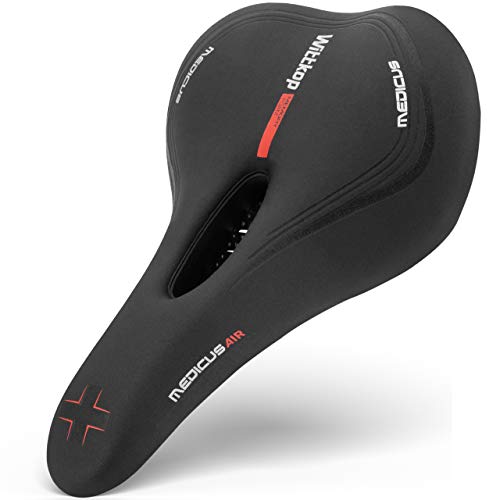 Wittkop Bike Seat Wittkop Bike Seat | Check price | |
| ROCKBROS Bike Seat for Men Women | Soft & Comfortable: The bike seat is made… Breathable Comfort: The bicycle's ergonomic saddle features a… Exceptional Support: The saddle rails are crafted from… | Check price |
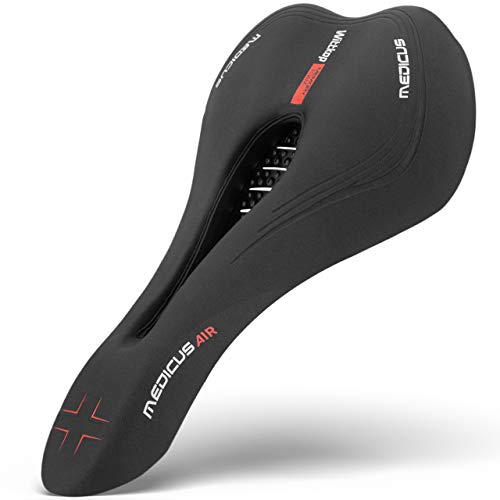 Wittkop Mountain Bike Seat Made of Comfortable Wittkop Mountain Bike Seat Made of Comfortable | The special foam layer of the saddle clings… The bike seat is partitioned into five individually… The internal braces of the Wittkop saddle for… | Check price |
As an Amazon Associate we earn from qualifying purchases at no extra cost to you.
Best mountain bike saddles at a glance
| Saddle | Best for | Typical width options | Approx. weight | Rail material | Padding and shell character |
|---|---|---|---|---|---|
| Ergon SM Pro | Trail riding and frequent climbing | Approx. 140 or 155 mm | About 300–330 g | CroMo steel | Moderately firm foam, pressure-relieving central channel, supportive rear |
| WTB Volt | Versatile trail and enduro use | Approx. 135, 142, or 150 mm | About 250–330 g, depending on version | Steel, CroMo, or titanium by model | Plush enough for rough trails, with a tapered nose and gently raised rear |
| SQLab 611 Ergowave Active 2.1 | Long climbs and upright-to-neutral trail positions | Approx. 14, ಸಂತ? | About 240–290 g, depending on width | CrMo or lightweight alloy, depending on version | Firm stepped profile with a central relief area and limited lateral movement |
| Selle Italia X-LR | Cross-country riders prioritising low weight | Approx. 131 or 145 mm | About 190–240 g, depending on version | Manganese, alloy, or carbon on premium models | Firm, lightly padded shell intended for efficient pedalling |
| Specialized Power Comp | Riders who prefer a short, broad-nosed saddle | Approx. 143, 155, or 168 mm | About 230–260 g | CroMo steel | Firm-medium padding, short length, broad rear support, central cutout |
The SQLab dimensions and weights vary by size and production version; the figures above are useful comparisons rather than a substitute for the specification of the exact saddle you buy.
What matters most: shell shape before padding
A saddle shell determines where your sit bones are supported and how easily you can move around the bike. Padding cannot correct a shell that is too narrow, too curved, or the wrong length for your riding position.
- Moderately flat shells make it easier to shift forward during steep climbs and slide back on descents. They suit riders who move frequently on the saddle.
- Deeply shaped or stepped shells give more obvious pelvic support. They can feel secure on long climbs but may restrict movement if the profile does not match your anatomy.
- Short saddles reduce contact with the nose when descending and suit riders who keep a consistent rearward position. A broad rear section becomes particularly important because the usable support area is shorter.
- A central channel or cutout can reduce pressure in the middle of the saddle, but its effect depends on shell width, saddle tilt, and your position. A cutout is not automatically more comfortable.
For mixed trail riding, a saddle with a supportive rear, a tapered nose, and a gently curved or moderately flat shell is usually the most adaptable. Very soft, hammock-like shells may feel comfortable for a short ride but can allow your pelvis to sink and create more pressure after several hours.
Padding density: soft is not the same as comfortable
Padding density changes how the saddle behaves under repeated impacts. Low-density foam feels welcoming at first and can help riders who spend little time seated. However, it compresses more deeply under the sit bones and may bottom out on rough climbs. Medium-density foam is the safer general-purpose choice for trail riding because it combines initial cushioning with more consistent support.
Firm padding is often preferable for cross-country and long climbing because it keeps your pelvis stable while pedalling. It may feel less luxurious when you first sit down, but pressure is spread through the shell rather than concentrated in a thick layer of foam. Riders who use padded shorts should be especially cautious about choosing an extra-soft saddle: the two layers can combine to create unwanted movement and heat.
The best compromise for many riders is a saddle with firmer sit-bone support and slightly softer material toward the nose and edges. This design cushions vibration without making the main pedalling platform unstable.
Rail material and rough-trail vibration
Rails connect the saddle to the seatpost and influence both weight and compliance. The difference is real, but it is smaller than the effect of shell shape, tyre pressure, suspension setup, and saddle height.
| Rail type | Typical characteristics | Best reason to choose it | Ownership consideration |
|---|---|---|---|
| Steel | Heavier, durable, generally least expensive | Budget trail bike or hardtail | Usually the best value; inspect for corrosion or bending after crashes |
| CroMo steel | Strong with a useful balance of weight and durability | Regular trail and enduro riding | Often the sensible upgrade over basic steel |
| Titanium | Light, fatigue-resistant, with some additional flex potential | High-mileage riders seeking lower weight and a smoother feel | Costs substantially more; check seatpost clamp compatibility |
| Carbon | Very light and tunable, but not automatically more comfortable | Weight-focused cross-country builds | Expensive and less forgiving of incorrect clamping or crash damage |
On a rigid or hardtail mountain bike, titanium or a carefully designed carbon shell can contribute to a smoother ride, but the improvement may not justify the price. On a full-suspension bike, a reliable CroMo saddle is often the better value because the rear suspension already handles much of the larger impact energy.
Head-to-head: which saddle fits your situation?
| Your priority | Best starting choice | Why | Trade-off |
|---|---|---|---|
| One saddle for general trail use | Ergon SM Pro | Balanced support, useful climbing shape, and durable CroMo rails | Not the lightest option |
| Affordable, familiar all-rounder | WTB Volt | Multiple widths and rail grades make it easy to match budget and fit | Versions feel noticeably different, so check the exact model |
| Long seated climbs and firm support | SQLab 611 Ergowave Active 2.1 | Stepped profile supports the rear and encourages a stable pedalling position | Its shape is less universally adaptable than a flatter saddle |
| Low weight and efficient cross-country pedalling | Selle Italia X-LR | Light construction and firm padding minimise movement | Less forgiving if your fit or riding position is not dialled in |
| Short saddle with broad rear support | Specialized Power Comp | Short-nose format gives descending clearance and a stable rear platform | Some riders find the broad shape restrictive when moving forward |
How to choose the correct width
Measure your sit-bone width, then add roughly 20–30 mm for a neutral mountain-bike position. The result is a starting point, not an exact prescription. A rider with sit bones measuring 115 mm might compare saddles around 135–145 mm; a rider measuring 130 mm might look around 150–160 mm.
- Place corrugated cardboard or a sit-bone measuring tool on a firm, slightly compressible surface.
- Sit in your normal riding posture for several seconds, leaning forward as you do on the bike.
- Measure the centres of the two impressions, not their outside edges.
- Compare that measurement with each brand’s sizing chart and select the nearest appropriate width.
- Check that the rails sit within the seatpost’s permitted clamp area; do not clamp carbon rails in a clamp designed only for metal rails.
Width is more important than a small weight saving. A saddle that is 70 g lighter but too narrow can leave the sit bones unsupported, while one that is slightly heavier and correctly sized can be more comfortable over a full day.
Setup makes or breaks saddle comfort
Begin with the saddle level using the manufacturer’s reference surface, then make changes in increments of about 1–2 degrees. Excessive nose-down tilt can make you slide forward, load your hands, and destabilise climbing. Excessive nose-up tilt can restrict hip movement and create pressure at the front.
Set fore-aft position only after saddle height is close. Moving the saddle forward makes steep climbing easier but increases knee flexion and shifts weight toward the front wheel. Moving it rearward opens the hip angle and can improve seated traction, but may make the reach feel longer. Change one variable at a time and record the original position.
Durability and maintenance realities
The cover usually shows wear before the shell fails. Repeated rubbing from shorts, mud trapped under the saddle, and frequent crashes can abrade the edges. Wipe the saddle with mild soap and water, avoid pressure-washing the rail and seatpost interface, and let it dry before storing the bike.
- Inspect the cover seams and underside after crashes.
- Check that the rails are straight and that the shell has no cracks or creaking.
- Keep the seatpost clamp tightened to its specified torque; overtightening can damage rails, especially carbon ones.
- Replace a saddle with a bent rail or cracked shell rather than trying to straighten it.
- Do not judge a new saddle after one short ride; give your position several rides, while stopping if you experience persistent pain, numbness, or discomfort.
For most riders, the smartest purchase is a correctly sized saddle with a medium-firm shell and CroMo rails rather than the lightest or most heavily padded model. Choose the Ergon SM Pro for balanced trail support, the WTB Volt for broad model and price flexibility, the SQLab 611 Ergowave Active 2.1 for firm climbing support, and a lighter Selle Italia X-LR or Specialized Power Comp when your riding position and preferred shape point clearly in that direction.