Key takeaways
- Place one anchor per furniture leg or corner for full stability.
- Position the loop close to the leg so there is minimal slack for the piece to build momentum.
- Use marine-grade stainless hardware near saltwater to prevent rust streaks.
Few things ruin a good patio faster than watching a lounge chair cartwheel across the yard during a gust, or finding your cushions in a neighbor’s hedge after an overnight storm. Homes on lakefronts, rooftops, coastal lots, and open prairies deal with sustained winds that treat lightweight furniture like a sail. The good news is that anchoring outdoor pieces is inexpensive, largely invisible, and something you can knock out in a single afternoon.
This guide covers how much wind actually moves furniture, the anchoring methods that work for decks versus concrete versus grass, and how to secure everything from dining chairs to umbrellas without drilling permanent holes in your deck. Done right, your setup rides out a 40 mph gust without you lifting a finger.
Our top picks




As an Amazon Associate we earn from qualifying purchases at no extra cost to you.
⚡ Save on Your Next PC — Amazon Prime
Prime members get fast free shipping on the systems above, plus early access to Prime Day & Black Friday PC deals. New members get a 30-day free trial.
Watch: How to Anchor Your Outdoor Furniture in Windy Areas — Video Review
Understand What You Are Fighting
Wind force rises with the square of speed, so a 30 mph gust pushes roughly four times harder than a 15 mph breeze. Flat-backed chairs, tabletops, and umbrellas act as sails, catching air and lifting before they slide. The two failure modes are sliding, where the piece scoots along the surface, and tipping, where it flips or blows away entirely. Anchoring solves both by tying the furniture to something heavier or fixed.
Anchoring Furniture on a Deck
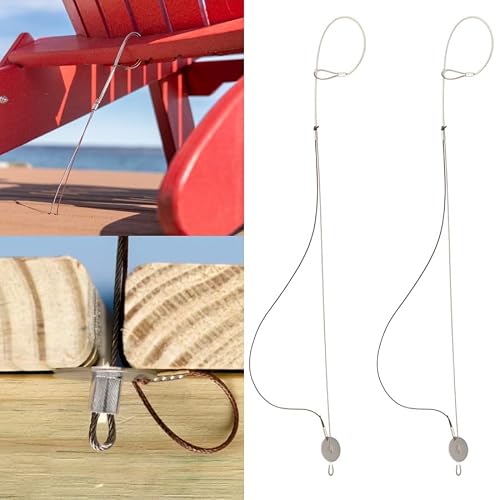
Wood and composite decks have a built-in advantage: the gaps between boards. Fishbone-style deck anchors slide into that gap, rotate to lock underneath, and give you a stainless steel loop to clip furniture to. A kit like the 8 Set Strong Outdoor Furniture Deck Anchor installs with no tools and includes carabiner cables, so you can move a chair for cleaning and re-clip it in seconds. For heavier reassurance, the USA-made 4-Pack Deck Anchor is rated to hold up to 286 pounds in high winds per anchor.
- Place one anchor per furniture leg or corner for full stability.
- Position the loop close to the leg so there is minimal slack for the piece to build momentum.
- Use marine-grade stainless hardware near saltwater to prevent rust streaks.
Anchoring on Concrete, Pavers, or Grass
Solid surfaces call for a different tactic since there are no board gaps. On grass or soil, long spiral ground stakes or the peg-and-carabiner style anchors found in the 12 Pack Deck Anchors Pegs kit drive straight down and hold canopy legs and lighter chairs. On concrete and pavers, add weight instead: sandbag anchors, planter bases, or furniture-grip pads that increase friction under each leg.
Do Not Forget Umbrellas and Canopies
An open umbrella is the single most wind-vulnerable item on any patio. Always close it when you leave, and pair the pole with a base of at least 50 pounds for a standard table umbrella or 75-plus pounds for a cantilever model. Freestanding canopies should be staked at every leg and taken down entirely when sustained winds are forecast above 25 mph.
Build a Simple Wind Routine
- Clip or stake the heaviest, most sail-like pieces permanently and leave them.
- Stack and store cushions in a deck box whenever you are not using the patio.
- Check anchor points at the start of each season for corrosion or loosening.
Tips
- Choose furniture with open, mesh, or slatted designs in very windy spots, since air passes through instead of pushing against it.
- Keep a few extra carabiner cables on hand so rearranging the patio never means losing your anchor points.
- Nest or fold stackable chairs together before a storm to reduce the number of loose pieces.
- Tie umbrellas to a table leg as a backup even when the base feels heavy enough.
Frequently Asked Questions
How much wind can move patio furniture?
Lightweight resin and aluminum chairs can start sliding around 20 to 25 mph and may tip or blow away by 35 to 40 mph. Umbrellas catch wind far sooner, sometimes lifting at just 15 mph if left open.
Do deck anchors damage my decking?
No. Fishbone-style anchors use the existing gap between boards and rotate to lock underneath, so they leave no holes and can be removed at any time. They are a favorite precisely because they are non-permanent.
What is the best anchor for furniture on concrete?
Since you cannot drive stakes into concrete without drilling, the simplest solutions are weighted bases, sandbag anchors clipped to the frame, or high-friction grip pads under each leg. Combining friction pads with a tie-down to a fixed rail is the most secure.
Should I bring furniture inside during a major storm?
For named storms or forecasts above 45 mph, yes, move what you can into a garage or shed. For routine gusty days, quality anchors rated in the 250-pound range per point will hold typical patio pieces without issue.
Conclusion
Wind is predictable, and so is the fix. Match your anchor to your surface, deck anchors for board gaps, stakes for grass, and added weight for concrete, then give special attention to umbrellas and canopies. A one-time investment of a few dollars per leg means you can enjoy an open patio in a windy location without the constant chase after runaway chairs.