Key takeaways
- Dense hedges with woody stems up to 1.25 inches: Husqvarna 322HD60 (gas).
- Mixed hedges, stems up to about 1 inch, gas weight not wanted: EGO HT2601 or EGO HT2411 (cordless 56V).
- Quiet suburban work with a 40V system: Husqvarna 320iHD60.
- Professional-class gas trimmer at a lower weight: Husqvarna 122HD60 or Stihl HS 82 R.
- Stems over 1.25 inches: loppers or a pruning saw, then trim the remainder.
For thick, woody hedges, the best heavy-duty picks are the Husqvarna 322HD60 gas trimmer for the most cutting capacity, the EGO HT2601 for a cordless trimmer rated to about 1.2 inches, and the Husqvarna 320iHD60 for a quieter 40V battery option rated to 1 inch. Anything thicker than those ratings belongs to a pruning saw or a pair of long-handled loppers, not a hedge trimmer.
The common mistake with thick growth such as leylandii, laurel, privet that has been left for years, or overgrown yew is to shop by blade length. Blade length sets how quickly you cover ground. What sets whether the machine cuts or stalls is the gap between the blade teeth, the blade drive, and the power behind it. This guide explains those three things, ranks eight heavy-duty options by power type, and shows how to decide when a trimmer is the wrong tool altogether.
Our top picks
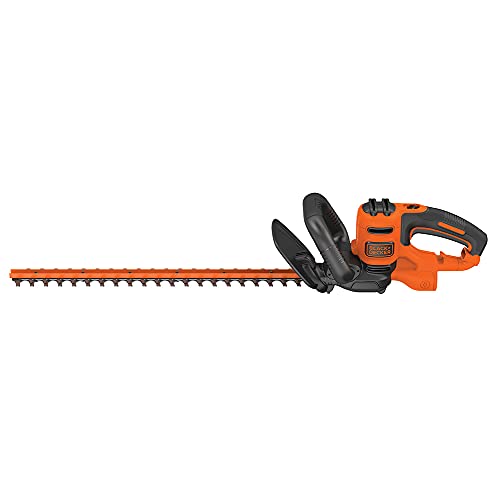


As an Amazon Associate we earn from qualifying purchases at no extra cost to you.
Quick picks by growth type
- Dense hedges with woody stems up to 1.25 inches: Husqvarna 322HD60 (gas).
- Mixed hedges, stems up to about 1 inch, gas weight not wanted: EGO HT2601 or EGO HT2411 (cordless 56V).
- Quiet suburban work with a 40V system: Husqvarna 320iHD60.
- Professional-class gas trimmer at a lower weight: Husqvarna 122HD60 or Stihl HS 82 R.
- Stems over 1.25 inches: loppers or a pruning saw, then trim the remainder.
How we chose
This guide is built from manufacturer specification sheets and published roundups, not from our own cutting trials. We make no claim of personal use. Models qualified if they met these criteria:
- A stated cutting capacity of about 1 inch or more for gas and professional-class battery models. Typical homeowner electric trimmers are rated to about three quarters of an inch.
- Blade length of 24 inches or more for dense hedges, or a dual-action blade with a tight stroke for control.
- A shipping model in 2026 with parts and service available through a dealer network.
- A blade guard, two-handed safety switch design and a blade stop that meet current safety standards for the class.
Cutting capacity is the thickest branch that the manufacturer says the blades can cut. It depends mainly on the tooth gap and is a best-case figure for green wood. Treat dry, hard or old wood as a lower number than the claim.
What makes a hedge trimmer cut thick branches
Tooth gap and cutting capacity
The gap between adjacent teeth is the limit of what the blades can pull in and shear. A wider gap lets a thicker stem enter the cutting zone. As a rule of thumb, a tooth gap of about 22 mm (just under an inch) is where trimmers begin to handle woody stems above one half inch reliably. Narrow gaps of 12 to 16 mm, common on light electric models, are designed for soft green growth and will stall or chew on anything woody.
Power type
- Gas (two-stroke): highest sustained power and the highest blade speed, at the cost of weight (often 11 to 16 lb fueled), noise, vibration and fuel handling. The best choice for long sessions on large, woody hedges.
- Battery (36 to 60V class): far quieter and lighter at 6 to 8 lb, and capable of 1 inch cuts in the best models. Runtime is limited, so plan on a spare battery for hedges longer than a few dozen yards.
- Corded electric: consistent power and low cost, but most are rated for three quarters of an inch or less and are restricted by cable reach.
Blade design
Dual-action blades, where both blades move, reduce vibration and let a machine cut cleanly. Laser-cut or hardened steel blades hold an edge longer in woody growth. Heavy-duty gas trimmers often have a gearbox with a high strokes-per-minute figure, and a rate around 4,000 or more helps the blades shear cleanly instead of tearing.
Comparison table
| Model | Power | Blade length | Stated capacity | Weight class | Tier |
|---|---|---|---|---|---|
| Husqvarna 322HD60 | Gas | 24 in | about 1.25 in | Heavy | Premium |
| Husqvarna 122HD60 | Gas, 21.7cc | 24 in | about 1 in | about 16 lb fueled | Mid-range to premium |
| Stihl HS 82 R | Gas | about 24 in | about 1 in | Heavy | Premium |
| Echo HC-2020 | Gas | about 20 in | about 1 in | Medium to heavy | Mid-range |
| EGO HT2601 | 56V battery | 26 in | about 1.2 in | about 6.9 lb | Premium |
| EGO HT2411 | 56V battery | 24 in | about 1 in | Light to medium | Mid-range to premium |
| Husqvarna 320iHD60 | 40V battery | 24 in | about 1 in | Light to medium | Premium |
| Fiskars 28 in loppers | Manual | 28 in handles | about 1.5 in | Light | Entry-level |
Figures are manufacturer or roundup claims for green wood, so use them as an upper limit. Some entries use classes (such as “heavy”) where we could not confirm an exact figure.
The eight options, ranked by use
1. Husqvarna 322HD60: best gas trimmer for thick woody growth
Spec line: gas two-stroke · 24-inch dual-action blades · about 1.25-inch cutting capacity · professional-class build
This is the highest-capacity trimmer in the group. It is aimed at landscapers who work on overgrown leylandii and laurel, and the blades are built to handle stems well above the capacity of homeowner electric models. The trade-off is weight, noise and the fuel mix.
Best for: neglected hedges with woody stems around one inch.
Skip if: your hedge is soft and green; the weight is unnecessary.
Pros: highest capacity, sustained power. Cons: heavy, loud, premium cost.
2. Husqvarna 122HD60: best lighter-spec gas option
Spec line: 21.7cc gas engine · 24-inch dual-action blades · about 16 lb fueled · about 1-inch capacity
The 122HD60 is a more modest gas machine than the 322HD60, and roundups name it a strong heavy-duty homeowner pick. At about 16 lb fueled it is heavier than any battery trimmer in this list, so plan on rests and use a shoulder strap if the model offers one.
Best for: owners with a long run of mature hedge.
Skip if: you cut for less than an hour at a time; a battery model is easier to carry.
Pros: strong engine, low running cost per hedge. Cons: weight, two-stroke maintenance.
3. Stihl HS 82 R: dealer-supported gas trimmer
Spec line: gas two-stroke · dual-action blades in the 24-inch class · about 1-inch capacity · rotating handle on the R model
The HS 82 R is a staple of the professional Stihl hedge trimmer line. We could not confirm a published tooth gap for it, so rely on the manufacturer’s capacity class and a dealer demonstration rather than the tooth gap rule. The main reasons to choose it are dealer servicing and a long parts-support history.
Best for: buyers who want a local dealer for service.
Skip if: you want the lowest entry cost.
Pros: pro-grade build, service network. Cons: premium cost, weight.
4. Echo HC-2020: mid-range gas trimmer
Spec line: gas two-stroke · dual-action blades in the 20-inch class · about 1-inch capacity
Roundups group the HC-2020 with the Husqvarna and Stihl trimmers as able to handle 1-inch stems reliably. It is a less costly path into gas power and is a reasonable pick for a hedge that is thick but not very long, since the shorter blade is easier to control.
Best for: medium-size yards with woody privet or boxwood.
Skip if: you need a 24-inch blade to cover long runs.
Pros: value in gas, manageable blade length. Cons: still weighty, slower per pass than a 24-inch blade.
5. EGO HT2601: best cordless for thick hedges
Spec line: 56V battery · 26-inch blade · about 1.2-inch capacity · about 6.9 lb · carbon fiber rail on the 26-inch model
The HT2601 is the highest-capacity cordless hedge trimmer in published roundups. At about 6.9 lb it is a fraction of the weight of a gas trimmer. Plan on spare batteries for large hedges, because heavy cutting drains a pack faster than light shaping does.
Best for: owners who want gas-level capacity without fuel.
Skip if: you have an acre of hedge and no spare batteries.
Pros: quiet, light, high capacity for a battery model. Cons: premium cost, runtime limits.
6. EGO HT2411: cordless 24-inch option
Spec line: 56V battery · 24-inch blade · about 1-inch capacity
Several roundups name the HT2411 as a best overall cordless trimmer, and it was introduced as the first cordless model rated for 1-inch branches. One older source quoted a smaller capacity, so treat 1 inch as a best-case green wood figure and expect less in dry growth.
Best for: mixed hedges, a step below the HT2601 in price.
Skip if: your hedge is mostly woody stems above three quarters of an inch.
Pros: quiet, lighter than gas. Cons: capacity claim is a best case.
7. Husqvarna 320iHD60: battery trimmer in the Husqvarna system
Spec line: 40V battery · 24-inch blade · about 1-inch capacity
The 320iHD60 is a good choice if you already own Husqvarna batteries or want the dealer network. Its stated capacity is similar to the HT2411, so the choice comes down to battery ecosystem and dealer support.
Best for: owners in the Husqvarna battery system.
Skip if: you need more than 1 inch of capacity.
Pros: professional-class blades, quiet. Cons: premium cost, runtime limits.
8. Fiskars 28-inch loppers: the right tool above trimmer capacity
Spec line: manual bypass loppers · 28-inch handles · about 1.5-inch capacity
These loppers are a complement rather than a trimmer. A lopper cuts a single stem cleanly, up to about 1.5 inches, and avoids shredding the bark and splitting the wood that a trimmer causes on thick stems.
Best for: removing the few thick stems that stall a trimmer.
Skip if: you need to shape a long hedge quickly.
Pros: no power or fuel, clean cuts. Cons: slow for large hedges.
Worked example: pick a trimmer for a leylandii hedge
- Measure the thickest stems. Suppose the leylandii has a few stems at 0.9 inch and many at 0.5 to 0.7 inch.
- Add a safety margin. Capacity figures are best case, so keep a margin of about 25 percent: required rated capacity is 0.9 divided by 0.75, or 1.2 inches.
- Match to the list. Only the Husqvarna 322HD60 (about 1.25 inches) and EGO HT2601 (about 1.2 inches) meet 1.2 inches.
- Choose power type by length. If the hedge is under about 40 yards, the cordless HT2601 with a spare battery is enough. Beyond that, choose the gas 322HD60.
- Remove the outliers. Use loppers for any stem above 1 inch and trim the rest.
When to use loppers or a saw instead
| Stem diameter | Best tool | Reason |
|---|---|---|
| Up to 0.5 in | Any electric or battery trimmer | Fits standard tooth gaps |
| 0.5 to 0.75 in | Battery or corded trimmer rated 0.75 in or more | Near the limit of light models |
| 0.75 to 1.25 in | Heavy-duty gas or high-capacity battery trimmer | Needs wide tooth gap and torque |
| 1.25 to 1.5 in | Bypass loppers | Clean single-stem cut |
| Above 1.5 in | Pruning saw | Beyond trimmer and lopper capacity |
Safety and technique
- Wear eye protection, hearing protection for gas models, sturdy gloves and long sleeves.
- Use both hands on the handles and keep a firm stance. Never trim above shoulder height or from a ladder with the machine running.
- Clear wire, fencing and stones from the hedge before cutting, because contact will damage the blades.
- Remove the battery or switch off and wait for the blades to stop before clearing a jam.
- Check for nesting birds before cutting in spring and summer. In many places active nests are legally protected.
- Do not force the blades into stems above the rated capacity. Stalling strains the gearbox and invites kickback of the machine.
Frequently asked questions
What is the best hedge trimmer for thick branches?
The Husqvarna 322HD60 gas trimmer has the highest stated capacity, about 1.25 inches. For a cordless option, the EGO HT2601 is rated to about 1.2 inches.
Both claims are best-case figures on green wood, so keep stems at least 20 to 25 percent below the rating.
What tooth gap do I need for woody growth?
Look for a tooth gap of about 22 mm or more for stems above one half inch. Narrow gaps of 12 to 16 mm suit soft growth only.
Many manufacturers do not publish the gap, so use the stated cutting capacity as a proxy.
Can a hedge trimmer cut a branch an inch thick?
Only the heavy-duty models rated to about an inch or more can, and only in green wood. Dry or hard wood needs loppers or a saw.
Forcing a lighter trimmer into thick stems stalls the blades and can damage the gearbox.
Is gas or battery better for thick hedges?
Gas gives the highest sustained power for long runs, while top battery models now match about one inch of capacity with less weight and noise. Choose by hedge length and tolerance for fuel.
For hedges over about 40 yards of thick growth, gas is still more practical unless you own spare batteries.
When should I use loppers instead of a trimmer?
Use loppers for individual stems above about one inch, up to the lopper rating. They cut cleanly and avoid splitting the wood the way a trimmer can.
A common workflow is to lop the thick stems first and then shape the hedge with the trimmer.
What blade length is best for thick hedges?
A 24-inch blade balances coverage and control for most thick hedges. Longer blades cover more ground but are harder to hold steady on dense growth.
Capacity depends on tooth gap and drive, not length, so do not pay extra for a longer blade expecting thicker cuts.
Can I trim leylandii hard back?
Leylandii does not regrow from old brown wood, so cut only into green growth. Trim lightly and often to keep the hedge in check.
Cutting into bare, brown wood leaves permanent gaps, so measure what is green before using a heavy-duty trimmer.
How do I maintain blades on a heavy-duty trimmer?
Clean sap from the blades after use, apply blade lubricant and sharpen or replace worn blades. Keep the gearbox greased as the manual directs.
Sharp, clean blades cut more easily and put less strain on the motor or engine.