Key takeaways
- Best all-around brass head: Rain Bird 25PJDAC
- Longer reach, brass: Rain Bird 35ADJTNTB
- Mid-range reach with a wide coverage figure: Rain Bird Maxi-Bird 2045PJ
- Tripod for tall grass and beds: Orbit heavy-duty brass tripod
- Zinc tripod for large open lawns: Orbit 56667Z
- Sled base for moving and easy placement: Melnor impact sprinkler on a metal sled
- Brass tripod on a budget-minded tier: Biswing brass tripod set
- Small to mid yards, plastic, 4-way pattern: Melnor MiniMax (not for very large lawns)
The best impact sprinkler for most large yards is the Rain Bird 25PJDAC brass head on a spike or sled base, with the Rain Bird 35ADJTNTB or Maxi-Bird 2045PJ when you need a longer throw and the Orbit tripod models when tall grass or flower beds block a ground-level spray. Pick by three numbers: the radius you need after adding overlap, the water pressure at your spigot, and whether the head sits on a spike, a sled or a tripod.
Impact sprinklers earn their place on big lawns because they throw a heavy, low-drift stream farther than oscillating or fixed-spray sprinklers, and their rotating arm lets you set a part-circle to keep water off the driveway and house. This guide covers throw radius, brass versus plastic arms, base types, arc settings, pressure requirements and head longevity, with a worked coverage calculation to help you plan placement.
Our top picks


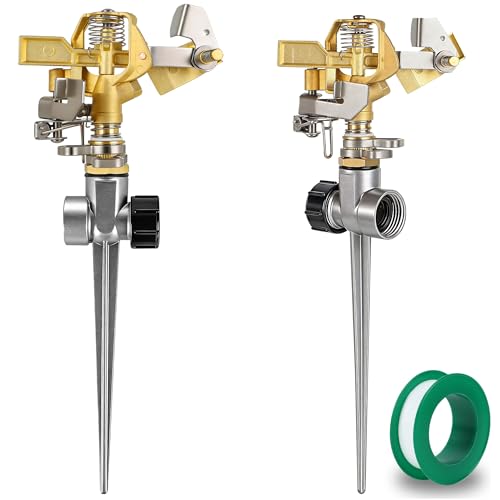
As an Amazon Associate we earn from qualifying purchases at no extra cost to you.
Quick picks
- Best all-around brass head: Rain Bird 25PJDAC
- Longer reach, brass: Rain Bird 35ADJTNTB
- Mid-range reach with a wide coverage figure: Rain Bird Maxi-Bird 2045PJ
- Tripod for tall grass and beds: Orbit heavy-duty brass tripod
- Zinc tripod for large open lawns: Orbit 56667Z
- Sled base for moving and easy placement: Melnor impact sprinkler on a metal sled
- Brass tripod on a budget-minded tier: Biswing brass tripod set
- Small to mid yards, plastic, 4-way pattern: Melnor MiniMax (not for very large lawns)
How we chose
This is a research-based guide. We compared manufacturer specifications with published reviewer comparisons and recurring owner complaints, not our own use of any sprinkler. We kept models that are widely sold, grouped them by base type and reach, and quote radius figures as ranges because different sources report different numbers for the same head. Radius depends strongly on water pressure and nozzle size, so treat every figure as a ceiling under good conditions. Where a number was inconsistent across sources, we say so.
Understanding the key specs
Throw radius and pressure
Radius is the distance from the head to the farthest drop. Impact heads typically list a range, such as 20 to 41 ft, because the nozzle setting and pressure change the throw. A low-pressure spigot will fall short of the top of the range. Some tripod heads claim figures around 85 ft in diameter, but those are for good pressure and open conditions. Plan with the middle of the range, not the maximum.
Brass versus plastic and zinc
Brass and bronze arms and bodies resist wear at the pivot, where an impact head fails first. Zinc alloy is cheaper and common on tripod sprinklers; it is sturdier than plastic but can corrode and stick in hard water. Plastic heads are light and low cost, adequate for small yards, and typically not the pick for heavy daily use on a large lawn. Look for a stainless steel spring, which keeps the arm snapping back reliably season after season.
Spike, sled and tripod bases
A spike base pushes into soil and holds the head steady, but it needs firm ground. A sled base rests on the surface, so you can drag the sprinkler to the next spot without pulling a stake. A tripod lifts the head 16 to 48 inches depending on the model, which lets the stream clear tall grass, hedges and flower beds. Taller tripods catch more wind and can tip if not set on level ground.
Arc adjustment
Adjustable arc, such as 20 to 360 degrees, lets you set a part-circle to avoid fences, driveways and windows. Set both stops firmly. Loose arc clips drift over time and begin to water the wrong areas.
Longevity
The common failure points are the pivot, the spring and the drive arm. Keep sand and grit out of the bearing, rinse the head after using well water or fertilizer through the line and replace worn nozzles, which change the stream and flow. Brass heads are typically the longest lasting and can be serviced; a cheap plastic head is often replaced instead.
Comparison table
| Model | Head material | Base | Radius or diameter (reported) | Arc | Best use |
|---|---|---|---|---|---|
| Rain Bird 25PJDAC | Brass and bronze | Sold as a head; add a spike or sled | 20 to 41 ft radius | 20 to 360 degrees | Most large lawns |
| Rain Bird 35ADJTNTB | Brass | Head; add a base | 23 to 50 ft radius | Adjustable | Longer throw |
| Rain Bird Maxi-Bird 2045PJ | Metal | Head; add a base | 22 to 45 ft radius, up to about 6,300 sq ft | Adjustable | Wide coverage per setup |
| Orbit heavy-duty brass tripod | Brass | Tripod, 22 to 48 in. | Long range; sources differ on the number | 360 degrees | Tall grass, beds |
| Orbit 56667Z zinc tripod | Zinc | Tripod | Up to about 85 ft diameter reported | Adjustable | Open large lawns |
| Melnor impact sprinkler | Metal head | Metal sled | About 85 ft diameter reported | Adjustable | Easy repositioning |
| Biswing brass tripod set | Brass | Tripod, 16 to 37 in. | Not specified; 20 to 60 psi | Adjustable | Value tripod |
| Melnor MiniMax | Plastic | Flow-through base | About 4,000 sq ft | 4-way | Smaller yards |
Best impact sprinklers for large yards, reviewed
Rain Bird 25PJDAC
Spec line: Brass and bronze · 20 to 41 ft radius · 20 to 360 degree arc · up to about 5,800 sq ft per position reported · needs a separate base
Best for: Most residential lawns, because it balances reach, durability and the ability to service the head.
Skip if: You need to clear tall plantings, which calls for a tripod, or you need a throw beyond the low 40s in feet.
- Pros: Metal construction, adjustable arc, common replacement parts, a long-standing design.
- Cons: Base is bought separately, a ground-level stream is blocked by tall plants, and radius drops with weak pressure.
Rain Bird 35ADJTNTB
Spec line: Brass · 23 to 50 ft radius · adjustable arc · larger nozzle for more reach
Best for: Wide lawns where the 25PJDAC falls short, especially with strong household pressure.
Skip if: Your spigot gives weak flow, because the larger nozzle uses more water and pressure to deliver its extra reach.
- Pros: A longer throw while keeping a brass body and adjustable arc.
- Cons: Higher flow demand, and a stream this strong can drift in wind.
Rain Bird Maxi-Bird 2045PJ
Spec line: 22 to 45 ft radius · up to about 6,300 sq ft · adjustable arc · metal construction
Best for: Covering a large area from one setup with fewer moves.
Skip if: You want the cheapest option, or your pressure is low.
- Pros: Wide stated coverage and a brand with good parts availability.
- Cons: Requires a base and decent pressure, and coverage claims are best-case.
Orbit heavy-duty brass tripod
Spec line: Brass head · adjustable 22 to 48 in. tripod · 360 degree rotation · long range at high pressure
Best for: Yards with tall grass, shrubs or borders where a ground-level head is blocked.
Skip if: Wind is common, or the ground is uneven, since a tall tripod can tip.
- Pros: Elevated stream clears obstacles, brass head, adjustable height.
- Cons: Reported coverage varies by source, and a tripod is bulkier to store and move.
Orbit 56667Z zinc tripod
Spec line: Zinc head · tripod · up to about 85 ft diameter reported · adjustable arc
Best for: Open, level lawns where reach matters and you want a tripod at a lower cost than brass.
Skip if: You water with hard well water that may corrode zinc, or you want a head you can service for many years.
- Pros: Good reach, elevated delivery, lighter than all-brass setups.
- Cons: Zinc is less durable than brass, and the claimed diameter assumes strong pressure.
Melnor impact sprinkler on a metal sled
Spec line: Metal head · metal sled base · about 85 ft diameter reported · adjustable arc
Best for: People who move the sprinkler across the lawn several times a day and do not want to pull a spike.
Skip if: Your lawn is on a slope, where a sled base may slide.
- Pros: No stake to pull, steady on flat ground, easy to reposition.
- Cons: Sleds can drift on slopes and uneven ground, and the reported diameter is a best case.
Biswing brass tripod set
Spec line: Brass head · 16 to 37 in. tripod · 20 to 60 psi operating range · adjustable arc · sold as a multi-pack
Best for: Budget-minded buyers who want brass heads on tripods for several zones.
Skip if: You want a long-established brand with ready spare parts.
- Pros: Brass construction, multi-pack, a wide pressure range.
- Cons: Radius was not specified in the sources we found, and brand support is thinner than the major makers.
Melnor MiniMax
Spec line: Plastic · flow-through base · about 4,000 sq ft · 4-way pattern
Best for: Small to mid-size yards where a lighter, lower-cost head is enough.
Skip if: The yard is truly large, because it covers less than the brass heads above.
- Pros: Light, flow-through base lets you chain a hose, a simple pattern control.
- Cons: Plastic wears sooner, and coverage is smaller.
Worked example: planning coverage and overlap
Suppose you use a head with a 35 ft radius from the middle of its listed range (for example the 25PJDAC, 20 to 41 ft).
- Diameter: 35 x 2 = 70 ft.
- Area of a full circle: 3.14 x 35 x 35 = about 3,850 sq ft.
- Head-to-head spacing: the common rule is to space heads at about one radius, so 35 ft apart, so every spot gets water from at least two heads.
- For a 100 ft by 140 ft lawn: 100 / 35 = about 3 heads across, 140 / 35 = 4 heads along. That is up to 12 positions, or 4 positions if you rotate one sprinkler across three rows over several runs.
Compare that with the 41 ft top of the range: the full circle covers 3.14 x 41 x 41 = about 5,280 sq ft, a gain of about 37 percent over 35 ft, but only if your pressure delivers it. A quick check with a spigot gauge, or by placing straight-sided containers across the throw for a run, shows what you are actually getting. If the water lands short of the numbers, move the heads closer rather than trust the label.
Decision matrix
| Your yard | Best base | Best head | Why |
|---|---|---|---|
| Large, open, level lawn | Sled or spike | Rain Bird 25PJDAC or 35ADJTNTB | Reach with a durable head |
| Tall grass, beds, hedges | Tripod | Orbit brass tripod | Clears obstacles |
| Slope | Spike | Brass head on a spike | Sleds slide, tripods tip |
| Weak pressure | Spike or sled | Smaller nozzle, closer spacing | Throw will fall short of the maximum |
| Frequent repositioning | Sled | Melnor impact sprinkler | No stake to pull |
Setup, safety and water use
- Run the hose for a few seconds before connecting to flush grit, which protects the pivot.
- Set arc stops so water avoids outdoor outlets, electrical equipment, windows and car windshields.
- Level a tripod and, in wind, lower it or spread the legs wider so it does not tip over.
- Do not stand in the arm’s path when it is running; the arm snaps back with some force and can pinch fingers.
- Water early in the morning to reduce evaporation, and check local watering rules.
- Drain and store brass heads indoors for winter; trapped water can crack a body in a freeze.
Frequently asked questions
What is the best impact sprinkler for a large yard?
The Rain Bird 25PJDAC is the most widely recommended all-around impact head, with a 20 to 41 ft radius and a brass body. Longer-throw options include the Rain Bird 35ADJTNTB.
Choose a tripod model from Orbit if tall plants block a ground-level stream.
How far does an impact sprinkler throw?
Typical ranges are 20 to 50 ft in radius for brass heads and up to about 85 ft in diameter for some tripod models, but the actual throw depends on pressure.
Weak pressure shortens the throw. Plan with the middle of the range and verify with a quick catch-container check.
Is a brass impact sprinkler worth it?
For a large lawn that you water often, yes. Brass resists wear at the pivot and can be serviced, so it typically outlasts plastic and zinc.
For occasional watering of a small area, a plastic or zinc head may be enough.
Spike, sled or tripod: which base is best?
Spikes are steady on firm ground, sleds are easy to move on flat lawns, and tripods lift the stream over tall plants. Pick by terrain and obstacles.
On slopes, use a spike. In wind, keep a tripod low or choose a spike or sled so it does not tip.
What water pressure do impact sprinklers need?
Most perform well from about 30 to 60 psi, with some tripod sets listing a 20 to 60 psi range, and throw increases with pressure up to the maker’s limit.
Check your spigot with a pressure gauge. If you are well below 30 psi, expect a shorter throw and consider a smaller nozzle and closer spacing.
How many sprinklers do I need for a big lawn?
Space heads about one radius apart for head-to-head overlap, then divide your lawn dimensions by that spacing. A 35 ft radius head needs about 35 ft spacing.
A 100 by 140 ft lawn needs up to about 12 positions, or fewer if you rotate one sprinkler across several runs.
Why does my impact sprinkler stop rotating?
Usually grit, mineral scale or a worn spring or bearing is blocking the arm. Low pressure can also stall it.
Flush the head, clean the pivot and replace the spring or nozzle if worn. If the body is corroded or cracked, replace the head.
Can I use an impact sprinkler on a slope?
Yes, with a spike base, which stays put better than a sled or tripod. Aim the stream uphill slightly to reduce runoff.
Water in shorter cycles on slopes so the soil absorbs it, then repeat, rather than running one long cycle that causes runoff.