Key takeaways
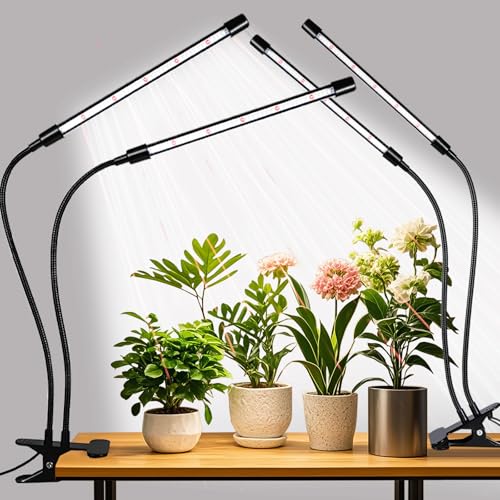
- Best for intensity (fruiting herbs, succulents, seedlings): SANSI 20W dual-gooseneck clip-on grow light.
- Best simple timer light for houseplants and herbs: GooingTop 10W clip-on with timer.
- Best for even coverage of a shelf: Bseah two-head clip-on full-spectrum light.
- Best for a single small pot or low-light foliage: SANSI 5W clip lamp.
- Best red-and-white flexible clamp or soil-stake light: Wolezek 48 LED clip light.
- Best if you already own a clamp lamp: Briignite A19 full-spectrum grow bulb.
- Best budget bulb for a reflector clamp: GE Grow LED BR30 bulb.
The SANSI 20W dual-gooseneck clip-on is the best clip-on grow light for plants that need real intensity, the GooingTop 10W timer clip light is the best simple pick for herbs and foliage houseplants, and the SANSI 5W clip lamp is the best low-light option for a single small pot. A clip-on light is a close-range fixture, so the number that matters is not wattage on the box but how much usable light reaches the leaves at the distance you will actually clip it.
This guide compares seven clip-on options by what they are good at, explains the specs that actually predict plant results, and includes a worked daily-light calculation so you can tell whether a given clip lamp can grow what you want.
Our top picks



As an Amazon Associate we earn from qualifying purchases at no extra cost to you.
Quick picks
- Best for intensity (fruiting herbs, succulents, seedlings): SANSI 20W dual-gooseneck clip-on grow light.
- Best simple timer light for houseplants and herbs: GooingTop 10W clip-on with timer.
- Best for even coverage of a shelf: Bseah two-head clip-on full-spectrum light.
- Best for a single small pot or low-light foliage: SANSI 5W clip lamp.
- Best red-and-white flexible clamp or soil-stake light: Wolezek 48 LED clip light.
- Best if you already own a clamp lamp: Briignite A19 full-spectrum grow bulb.
- Best budget bulb for a reflector clamp: GE Grow LED BR30 bulb.
How we chose
This is a research-based comparison, not a product trial. We compared manufacturer specifications and retailer listings and the shortlists that recur across 2026 buyer guides, and we kept only products that are currently sold with a clear clip, clamp, or screw-in format. Most grow-light output figures are manufacturer claims measured at a stated distance, so we state them with that caveat and avoid comparing numbers measured at different distances. Where a specification is not published or varies by listing, we describe the light by class instead of guessing. Our criteria:
- Light intensity at the plant. Measured as PPFD, in micromoles per square meter per second, at a stated distance. This matters more than watts.
- Spectrum. Full-spectrum white around 4000 to 6500 kelvin works for most leafy plants. Red-heavy mixes help flowering but look pink and make leaf checks harder.
- Timer and dimmer. Built-in timers and multiple brightness levels make a plant routine easier to keep.
- Clamp and neck. A strong clamp and a flexible gooseneck set the height and angle, which sets the real light level.
- Power and size. USB-powered lights are convenient. Higher-wattage models need a wall adapter and give higher intensity.
- Heat. LEDs run cool, but a light placed too close can still stress delicate leaves.
Specs that matter for clip-on lights
PPFD at distance
PPFD is the light that plants can actually use, measured at a given distance from the fixture. A clip-on light that is rated at a high number close to the lamp will drop off quickly as you move it away. When you compare lights, check the distance at which the number was measured. A figure at 6 inches and a figure at 12 inches are not comparable.
Spectrum and color temperature
Plants use mostly red and blue light, but a broad white spectrum also supports healthy leaf growth and lets you see leaf color accurately. Color temperature around 4000 kelvin looks warmer and about 6000 to 6500 kelvin looks cooler. Both can grow plants. Many budget red-and-blue lights save money, but the pink glow is harder to live with in a living room.
Wattage versus real output
Some listings advertise equivalent wattage, such as 300 watts, that has no relation to what the light draws or delivers. Look at actual electrical watts and PPFD instead. A 5-watt lamp can support a small foliage plant a few inches away. It cannot feed a tomato seedling tray at 18 inches.
Comparison table
| Light | Power | Spectrum | Timer and dimmer | Mount | Stated output |
|---|---|---|---|---|---|
| SANSI 20W dual gooseneck | 20 W | 4000 K, Ra about 100 | None stated | Dual gooseneck clip | About 402 micromoles per square meter per second (manufacturer figure; confirm the stated distance) |
| GooingTop 10W clip | 10 W | 6000 K, 84 LEDs | 4, 8, 12 hour timer, 5 brightness levels | 360-degree flexible clip | Not stated |
| Bseah two-head clip | 10 W | Full spectrum | 3 timer settings, 10 brightness levels | 360-degree gooseneck clip | Not stated |
| SANSI 5W clip lamp | 5 W | 4000 K | 3, 6, 12 hour timer, 4 brightness levels | 360-degree gooseneck pot clip | About 35.8 at 6 inches (listing figure) |
| Wolezek 48 LED | Not stated | Red to 6500 K mix | 6, 12, 16 hour timer, 5 brightness levels | Clamp or soil-insert, 360 degrees | Not stated |
| Briignite A19 bulb | 11 W | Full spectrum, about 4000 K reported | None (use a plug-in timer) | E26 socket in a clamp lamp | About 25 micromoles per second total output (manufacturer figure) |
| GE Grow LED BR30 bulb | Check package | Full-spectrum grow bulb | None (use a plug-in timer) | E26 socket in a clamp lamp | Check package |
Best for intensity
SANSI 20W dual-gooseneck clip-on
Spec line: 20 W · 4000 K · Ra about 100 · Dual gooseneck heads · Manufacturer-stated output of roughly 400 micromoles per square meter per second at its test distance.
Best for: Herb pots, succulents, orchid and seedling shelves, and any plant that needs more intensity than a small USB clip light delivers.
Skip if: You want a built-in timer. Pair it with a plug-in timer instead.
- Pros: Highest stated output in this group. High color rendering makes leaf color easy to read. Two adjustable heads cover a wider area.
- Cons: No built-in timer or dimmer. It needs a wall adapter and is bulkier than USB clip lights. The “300 W” in its listing is an equivalence claim, not electrical draw.
Best simple clip lights for houseplants and herbs
GooingTop 10W clip-on with timer
Spec line: 10 W · 6000 K · 84 LEDs · 4, 8, 12 hour timer · 5 brightness levels · 360-degree flexible clip.
Best for: Windowsill herbs, pothos, philodendron, and other moderate-light foliage plants on a desk or shelf.
Skip if: You are starting seeds or growing a fruiting plant that needs high intensity.
- Pros: Easy to use with a built-in timer and brightness steps. Cool white light looks clean in a living space.
- Cons: No published intensity figure, so you cannot calculate daily light exactly. It is best used with plants that tolerate moderate light.
Bseah two-head clip-on
Spec line: 10 W total · Full spectrum · 2-pack or two-head configurations · 3 timer settings · 10 brightness levels · 360-degree gooseneck clip.
Best for: A single shelf or a row of small pots where you want even coverage.
Skip if: You need high-intensity light for flowering or fruiting plants.
- Pros: Two heads spread light across a wider area. Ten brightness levels let you tune intensity.
- Cons: Output is not published per head. Listing formats vary, so confirm what comes in the box.
Wolezek 48 LED clip light
Spec line: 48 LEDs · Red and broad white mix from about 660 nanometers to 6500 K · 6, 12, 16 hour timer · 5 brightness levels · Clamp or soil-insert mount.
Best for: Small seedlings, microgreens, and leafy greens where a soil-stake mount or clamp is useful.
Skip if: A pink-tinted glow bothers you in a living room.
- Pros: The long 16-hour timer option suits seedlings. Two mounting styles make placement flexible.
- Cons: No published intensity or wattage. The red-heavy mix can make it harder to judge leaf health by color.
Best for low light and single pots
SANSI 5W clip lamp
Spec line: 5 W · 4000 K · 3, 6, 12 hour timer · 4 brightness levels · 360-degree gooseneck pot clip · About 35.8 micromoles per square meter per second at 6 inches (listing figure).
Best for: A single small plant such as a snake plant, pothos, or a small herb pot that needs supplemental light.
Skip if: You want to light more than one small pot or grow anything that wants strong light.
- Pros: One of the few clip lights with a published intensity at a stated distance. Timer and dimmer included. Warm white light looks natural indoors.
- Cons: Low output. Its stated figure falls off quickly beyond 6 inches, so it must sit close to the leaves.
Best if you already own a clamp lamp
Briignite A19 full-spectrum bulb
Spec line: E26 base · 11 W · About 1000 lumens · 180-degree beam · About 25 micromoles per second total output (manufacturer figure) · Reported around 4000 K.
Best for: Small setups where you already have a clamp lamp with an E26 socket and want a replaceable bulb.
Skip if: Your clamp lamp has a small reflector or a socket with a low wattage limit. Check the lamp rating first.
- Pros: Bulbs are cheap to replace. The total output figure is published, which makes comparison easier.
- Cons: A bare bulb lights a wide area with less intensity at the leaf than a close-range clip fixture. You will need a separate plug-in timer.
GE Grow LED BR30 bulb
Spec line: BR30 floodlight shape · E26 base · Full-spectrum grow formulation · Check the package for wattage and output.
Best for: A budget way to turn an existing reflector clamp lamp into a grow lamp for foliage plants.
Skip if: You need a published light output to plan growth. The listings do not give consistent numbers.
- Pros: The BR30 shape focuses light downward. Widely stocked and easy to replace.
- Cons: No built-in timer, and we could not confirm a published output figure, so use it for low-light foliage rather than demanding plants.
Decision matrix: match the light to the plant
| Plant type | Light need | Best match | Typical clip distance |
|---|---|---|---|
| Pothos, snake plant, ZZ plant | Low | SANSI 5W or GooingTop 10W | 6 to 12 inches |
| Basil, mint, parsley, chives | Medium to high | GooingTop 10W or SANSI 20W | 4 to 10 inches |
| Lettuce and microgreens | Medium | Bseah two-head or Wolezek 48 LED | 6 to 10 inches |
| Succulents and cacti | High | SANSI 20W | 4 to 8 inches |
| Seedlings to transplant | Medium to high | Wolezek 48 LED or SANSI 20W | 2 to 6 inches |
| Flowering or fruiting plants | Very high | Use a larger panel or bar light, not a small clip light | Not applicable |
Worked example: can this clip light grow my plant
Plants respond to the total light they collect in a day, called the daily light integral, or DLI, in moles per square meter per day. You can estimate it with a simple formula: PPFD in micromoles per square meter per second, times hours of light, times 0.0036.
- Start with the lamp figure. The SANSI 5W lists about 35.8 micromoles per square meter per second at 6 inches.
- Multiply by hours. On its 12-hour setting that is 35.8 times 12 times 0.0036, or about 1.5 moles per square meter per day.
- Compare to the plant. As a rough guide, low-light foliage plants do fine at about 2 to 6 moles per day of total light including window light. Leafy greens and herbs generally want about 12 to 17 moles per day. Fruiting plants want more.
- Judge the result. At about 1.5 moles per day, the 5 W lamp can top up a low-light foliage plant but cannot grow basil on its own.
- Test a stronger lamp. At 400 micromoles per square meter per second for 14 hours, the formula gives 400 times 14 times 0.0036, about 20 moles per day, which is enough for herbs and leafy greens at that distance. In practice, the figure falls as you move the light away or if the beam covers a wider area, so treat it as an upper bound at the measured spot.
The rule of thumb: for low-light foliage, a small clip light is enough. For herbs, lettuce, or succulents, use a high-intensity fixture clipped close, and for flowering or fruiting plants step up to a panel or bar light.
How to set up a clip-on grow light
- Pick a stable clip point. Use a sturdy shelf edge, pot rim, or desk edge. A weak clamp slips and drops the light on leaves.
- Start at 6 to 12 inches. Move closer for seedlings and succulents and further for heat-sensitive leaves. Raise it if leaves bleach or curl.
- Run 12 to 16 hours for most leafy plants. Use a built-in timer or a plug-in timer. A consistent schedule matters more than long hours.
- Give plants a dark period. Most plants need several hours of darkness each night.
- Rotate pots. A clip light covers a small area. Turn pots weekly to even growth.
- Watch plant signs. Long, pale, leaning stems mean too little light. Bleached or crispy leaf tips mean too much or too close.
- Keep electricals dry. Position the adapter and cord away from watering spots and use plugs in dry outlets.
Common mistakes
- Trusting equivalent wattage claims. A listing that says 300 W equivalent is marketing, not output.
- Clipping too far away. Light intensity drops quickly with distance, so a light that works at 4 inches can be too weak at 18.
- Expecting a clip light to fruit tomatoes. Fruiting plants need far more light than a clip fixture gives.
- Leaving lights on all day. Plants need a dark period.
- Skipping a timer. Manual switching makes light hours irregular.
Frequently asked questions
What is the best clip-on grow light for indoor plants?
The SANSI 20W dual-gooseneck is the best for intensity, and the GooingTop 10W with a built-in timer is the best simple option for houseplants and herbs.
For a single small pot in low light, the SANSI 5W clip lamp is enough.
Are clip-on grow lights strong enough to grow herbs?
Some are. A higher-intensity clip fixture placed within about 4 to 10 inches can grow basil, mint, and parsley. A small 5 W lamp only supplements light.
Check the stated intensity at a given distance and aim for about 12 moles of daily light for leafy herbs.
How far should a clip-on grow light be from plants?
Start at 6 to 12 inches for most plants, closer for seedlings and succulents. Adjust based on how the leaves look.
If leaves bleach or curl, move the light up. If stems stretch and turn pale, move it closer.
How many hours a day should a clip-on grow light run?
Most leafy plants and herbs do well with 12 to 16 hours of light daily. Low-light foliage plants can get 8 to 12 hours on top of window light.
Use a timer for a regular schedule and give plants a dark period at night.
What color temperature is best for a grow light?
Full-spectrum white between about 4000 and 6500 kelvin works well for most plants. Warm 4000 K suits living rooms, while cooler 6000 K looks crisper.
Red-heavy lights can help flowering, but they cast a pink glow and make it harder to judge leaf health.
Can I use a regular LED bulb as a grow light?
A regular bulb is not tuned for plants and often gives too little usable light. A full-spectrum grow bulb in a clamp lamp is a better choice.
Bulbs spread light widely, so they give lower intensity at the leaf than a close-range clip fixture.
Do clip-on grow lights get hot?
LED clip lights run cool compared with older lamps, but they still give off some warmth. Keep at least a few inches between the light and delicate leaves.
Check the fixture after an hour of use and move it if the area feels warm to the touch.
Do I need a timer for a clip-on grow light?
A timer is not required but it is very helpful. It keeps light hours steady and prevents plants from getting too much or too little light.
Many clip lights have a built-in timer. If yours does not, use a plug-in outlet timer.