Key takeaways
- Plants 5 feet and taller (rubber tree, bird of paradise, large dracaena): FECiDA 76-inch or HMVPL 75-inch, because both are listed with maximum heights of roughly 75 to 76 inches.
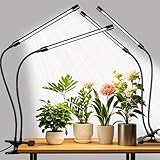
- Wide plants with a broad canopy: Kullsinss dual-head, because two heads cover more width than a single gooseneck.
- Plants 3 to 4 feet (monstera, snake plant, mid-size ficus): LBW 68-inch or Aumtrly floor lamp, whose listed ranges top out in the low 60s to high 60s of inches.
- Tabletop-to-floor mixed collections under 4 feet: Yiyehu tripod or GHodec tripod, which trade maximum height for portability.
- Several plants or a shelf of mixed heights: a frame-style stand such as the Spider Farmer frame, which carries separate bar lights over a footprint instead of one spot.
For tall plants, the strongest picks are the FECiDA 76-inch floor lamp grow light and the HMVPL 75-inch COB stand light for ceilings above eight feet and plants near five feet, with the Kullsinss dual-head stand light for wide, bushy specimens and the LBW 68-inch floor lamp as the entry-level option for plants under about four feet. What separates these from short desktop stands is simple geometry: the pole must rise well above the top leaf, and the base must be heavy enough that a tall pole does not become a tip-over hazard.
This guide is built around that geometry. Below you will find a worked height calculation, a comparison table, eight stand-style grow lights grouped by the plant height they actually suit, and the safety and setup details that matter once a light is standing eight inches from a fiddle leaf fig. Specs come from manufacturer-style listings and published roundups, and where listings disagree we say so instead of picking a number.
Quick answer: which stand for which plant
- Plants 5 feet and taller (rubber tree, bird of paradise, large dracaena): FECiDA 76-inch or HMVPL 75-inch, because both are listed with maximum heights of roughly 75 to 76 inches.
- Wide plants with a broad canopy: Kullsinss dual-head, because two heads cover more width than a single gooseneck.
- Plants 3 to 4 feet (monstera, snake plant, mid-size ficus): LBW 68-inch or Aumtrly floor lamp, whose listed ranges top out in the low 60s to high 60s of inches.
- Tabletop-to-floor mixed collections under 4 feet: Yiyehu tripod or GHodec tripod, which trade maximum height for portability.
- Several plants or a shelf of mixed heights: a frame-style stand such as the Spider Farmer frame, which carries separate bar lights over a footprint instead of one spot.
How we chose
This is a research-based selection, not a lab comparison. We compared published specifications and buyer-facing listings for floor-standing and tripod grow lights, then filtered on the criteria that decide whether a stand works for a tall plant.
- Maximum pole height of at least plant height plus 12 inches. A light that cannot rise above the canopy ends up lighting the upper leaves from the side, if at all.
- Full-spectrum white LEDs. Broad-spectrum white light (roughly 380 to 800 nm in the listings that state a range) renders leaves in natural color, so you can spot pests and yellowing.
- Base weight and footprint. A tall, narrow pole with a light plastic base is the main failure mode.
- Head design. Single gooseneck, dual head, COB panel, or multi-bar frame, matched to canopy width.
- Timer or dimming control built in, or compatibility with an external timer. Plants need a consistent photoperiod.
- Wattage class. Most floor-lamp grow lights are low-wattage and suited to foliage plants, not fruiting crops.
We did not include any product we could not confirm as an existing floor, tripod, or frame-style grow light stand in published 2026 roundups. Where a spec appears in only one source, it is labeled as listed.
Worked example: how tall must the stand be?
Use this step-by-step logic before you shop. Measure from the floor, not from the soil.
- Measure total plant height from the floor to the top leaf, including the pot and any plant stand. Example: a bird of paradise in a 14-inch pot measures 62 inches overall.
- Add working distance. Low-wattage floor lamps are usually positioned about 6 to 12 inches above the foliage because output falls off quickly with distance; higher-wattage panels can sit farther away. Take 12 inches as a safe planning number: 62 + 12 = 74 inches.
- Compare to the stand’s maximum height. A 68-inch stand falls 6 inches short. A 75-inch or 76-inch stand clears it with a small margin.
- Account for the growth you want. If the plant adds 6 inches a year, a 76-inch stand has roughly one year of headroom before the light is touching the leaves.
- Check the minimum height too. A stand listed as 40 to 76 inches cannot be lowered to 20 inches for a young cutting. If you will raise a seedling or rooted cutting, pick a stand whose minimum is under 24 inches.
A second check uses daily light. Daily light integral (DLI, in mol per square meter per day) equals light intensity in micromoles per square meter per second, times hours of light, times 0.0036. At 150 micromoles for 12 hours, that is 150 x 12 x 0.0036, or about 6.5 mol. Many foliage houseplants do acceptably in roughly the 5 to 10 mol range, so a modest lamp running 12 hours can be enough for a low-light species but not for a sun-loving one. Because most listings do not publish intensity at a given distance, treat wattage as a rough class guide and watch the plant: tight, short internodes and steady new growth mean the light is adequate.
Comparison table
| Model | Style | Listed height range | Listed power / light source | Notable feature |
|---|---|---|---|---|
| FECiDA 76-inch floor lamp | Single-head floor lamp | 40 to 76 in | 25W, 208 LEDs | Daisy-chain support |
| HMVPL COB 75-inch | COB floor stand | Up to about 75 in | 20W COB, CRI 98+ | 2-year warranty listed |
| Kullsinss tall dual-head | Dual-head telescoping pole | 24 to 68.7 in | Full-spectrum LED | Removable and telescoping poles |
| LBW 68-inch floor lamp | Gooseneck floor lamp | 20 to 68 in | 10W | Heavy base, 16-hour timer listed |
| Aumtrly floor grow light | Gooseneck floor lamp | 17 to 61 in in some listings | Full-spectrum LED | Frequent top pick in roundups |
| Yiyehu full spectrum | Detachable tripod | 15 to 62 in | Full-spectrum, 380 to 800 nm | Tripod detaches for use on shelves |
| GHodec tripod | Tripod | 15 to 48 in | Full-spectrum LED | Compact for smaller plants |
| Spider Farmer frame stand | Frame / rack | About 2.5 to 5 ft | Holds separate bar lights up to about 26 in wide | Covers a footprint, not a single point |
Note on the Aumtrly: its name suggests a 68-inch pole, but several listings give a range of roughly 17 to 61 inches. Confirm the exact maximum on the product page before relying on it for a tall plant.
Best for plants over 5 feet
FECiDA 76-inch floor lamp grow light
Specs: 40 to 76 in · 25W · 208 LEDs · daisy-chain support · single head
Best for: Tall single-trunk plants such as large rubber trees and bird of paradise, where the head has to rise well above six feet.
Skip if: You need to start low. A minimum of 40 inches means the light cannot hover over a small cutting.
Pros:
- Tallest listed range in this group, so it clears most indoor plants with headroom.
- The highest wattage class among the floor lamps here, which helps at longer working distances.
- Daisy-chain support lets you power several lamps from one outlet.
Cons:
- High minimum height limits flexibility.
- A tall pole needs careful placement away from foot traffic.
HMVPL COB 75-inch stand light
Specs: up to about 75 in · 20W COB LED · CRI 98+ · 2-year warranty listed
Best for: Growers who care about how true the leaf color looks, since a CRI above 95 renders greens and variegation accurately.
Skip if: You want multiple heads. COB designs concentrate output in one panel.
Pros:
- High color rendering helps with spotting pests and nutrient problems early.
- Height comparable to the FECiDA.
- Longer warranty than many budget floor lamps.
Cons:
- Single COB panel covers a smaller footprint than a dual head.
- Lower listed wattage than the FECiDA, so keep it closer to the foliage.
Best for wide, bushy plants
Kullsinss tall dual-head grow light
Specs: 24 to 68.7 in · two heads · removable and telescoping poles · full spectrum
Best for: Wide plants and plant groupings where one narrow beam leaves one side in shade.
Skip if: Your plant tops 5 feet, since 68.7 inches is the ceiling.
Pros:
- Two heads spread light across a wider canopy.
- A fairly low minimum height of 24 inches works for a plant that is still growing.
- Removable pole sections help with shipping, storage, and rearranging.
Cons:
- Telescoping joints can slip if not tightened fully, so check them periodically.
- Two heads take more floor space than a single pole.
Best for plants 3 to 4 feet
LBW 68-inch adjustable floor grow light
Specs: 20 to 68 in · 10W · heavy base · 16-hour timer listed · gooseneck head
Best for: Budget buyers with a plant under about four feet, such as a young fiddle leaf fig or a mid-size monstera.
Skip if: The plant is already near five feet or you want to light a large canopy from a distance. 10W is a low-wattage class.
Pros:
- Wide height range from 20 inches up, which suits a plant you are growing out.
- Heavy base listed, helpful for stability.
- Built-in timer function reduces extra equipment.
Cons:
- Low wattage means the head must sit close to leaves.
- Better for low- to medium-light foliage species than for light-hungry plants.
Aumtrly floor grow light
Specs: about 17 to 61 in (verify on the listing) · gooseneck head of about 7.8 in · full-spectrum LED
Best for: Plants such as dracaenas and snake plants in the 3 to 4 foot range, where a flexible neck lets you angle the light.
Skip if: You need guaranteed clearance above five feet, given the range discrepancy between sources.
Pros:
- Frequently recommended in published roundups for tall indoor plants.
- Flexible gooseneck allows angled placement.
Cons:
- The listed height and the product name do not match across sources.
- Compact head on a tall pole can look top-heavy without a good base.
Best portable and multi-plant options
Yiyehu full-spectrum tripod grow light
Specs: 15 to 62 in · detachable tripod · 380 to 800 nm
Best for: People who want one light to move between a floor stand and a shelf or tabletop.
Skip if: A tripod’s wide legs will not fit your corner.
Pros:
- Detachable tripod gives two mounting modes.
- Published spectral range is stated in the listing.
Cons:
- Tripod footprint is wider than a round-base pole.
- Maximum height falls short of the tallest options.
GHodec tripod grow light
Specs: 15 to 48 in · tripod · full-spectrum LED
Best for: Small and medium plants up to roughly 3 feet, and propagation areas.
Skip if: The plant is already above 3 feet. A 48-inch maximum leaves little clearance.
Pros:
- Compact and easy to store.
- Low minimum height suits seedlings and cuttings.
Cons:
- Not a tall-plant solution on its own.
Spider Farmer frame-style stand
Specs: about 2.5 to 5 ft adjustable frame · accepts lights up to about 26 in wide · light sold separately
Best for: Several plants of mixed height, where a bar light spreads coverage across a footprint.
Skip if: You have one tall plant. A frame suits a group better than one tree. Note too that the source describing this stand was an older article, so confirm current availability.
Pros:
- Frame holds a light over a footprint, not a single point.
- Height adjustable across roughly a 2.5-foot range.
Cons:
- Larger footprint than a pole stand.
- Lights are a separate purchase.
Decision matrix
| Your plant | Floor-to-top height | Stand class to look for | Examples above |
|---|---|---|---|
| Young fiddle leaf fig or monstera | Under 3 ft | Minimum height under 24 in, max over 48 in | LBW, Kullsinss, Yiyehu |
| Mid-size dracaena or snake plant | 3 to 4 ft | Max height 60 to 68 in | LBW, Aumtrly, Kullsinss |
| Large rubber tree or bird of paradise | 4.5 to 6 ft | Max height 75 in or more | FECiDA, HMVPL |
| Wide, multi-stem plant | Any, canopy over 30 in wide | Dual head or panel over bars | Kullsinss, frame plus bar light |
| Several plants in a corner | Mixed | Frame stand or daisy-chained lamps | Spider Farmer frame, FECiDA |
What to check before you buy
Stability and tip-over safety
A pole nearly six feet tall with a small base can topple if bumped. Look for a weighted or wide round base, and consider anchoring the pole to a wall with a bracket, especially around children and pets. Keep the cord routed along the wall so it is not a trip hazard, and never let the cord hang loose across a walkway.
Heat and clearance
LED lamps run much cooler than older lighting, but the head can still warm leaf tissue if pressed against it. Keep the head a few inches from foliage and raise it as the plant grows. Do not place the light where water from misting or watering can reach the plug, switch, or head.
Photoperiod and timers
Most foliage plants do well with 10 to 14 hours of light a day. Use the stand’s built-in timer if it has one; otherwise plug it into a separate outlet timer. A consistent schedule matters more than squeezing extra hours, and plants also need a dark period.
Spectrum and color rendering
Full-spectrum white LEDs are the easiest to live with in a living room because they look like normal white light. Purple-pink lights can work but make plants look dim and make it harder to read leaf color. If a listing publishes CRI, higher is better for judging plant health by eye.
Wattage class
The lamps here are low-wattage and suit foliage plants. If you want to bring a flowering or fruiting plant through winter, you need a higher-output fixture. In that case, a frame stand carrying a bar light is a more realistic path than a single floor lamp.
Common mistakes
- Buying a stand rated for 62 inches for a plant that is already 60 inches including its pot.
- Placing the light beside the plant instead of above it. Light from the side leaves the top unlit and the plant leans toward the lamp.
- Skipping rotation. Turn the pot a quarter turn every week or two so the plant grows evenly, even with a stand light overhead.
- Assuming more hours means more growth. Without enough intensity, longer hours will not make up the difference.
- Ignoring the cord length. A stand placed far from an outlet makes extension cords necessary.
Setup tips for a tall stand
- Assemble the pole fully and tighten each telescoping joint before placing it near the plant.
- Set the head 8 to 12 inches above the top leaves to start, then adjust based on how the plant responds.
- Run the cord along the wall and plug into a timer rated for the lamp’s load.
- Check the leaf tips weekly for browning, a sign the head is too close, and for stretched, pale new growth, a sign it is too far.
- Raise the head each time the plant gains about 6 inches, and recalculate using the worked example above.
FAQ
How tall should a grow light stand be for a 5-foot plant?
Choose a stand that reaches at least 72 inches. Add about 12 inches of working distance to the plant’s floor-to-top height, then pick a stand whose maximum height exceeds that number.
For a 60-inch plant including its pot, 72 inches is the minimum. A 75 or 76-inch stand leaves a little room for growth.
Do tall plants need a stronger light than short plants?
Not by size alone. Light need depends on the species, but taller plants usually sit farther from a lamp, so a higher-wattage or better-positioned head helps.
A low-wattage light placed close to the top leaves can work for low-light foliage plants. Sun-loving species need stronger output.
How many hours a day should a stand grow light stay on?
Most foliage houseplants do well with 10 to 14 hours daily. Use a timer for consistency and leave a dark period each night.
Start at 12 hours and adjust. Pale, leggy growth suggests more intensity, not necessarily more hours.
Can one stand light cover several plants?
One light covers several plants only if they sit within its beam. Cluster them under the head, use a dual-head model, or switch to a frame-style stand with a bar light.
Daisy-chain support on some floor lamps lets you power several from one outlet, which is another option for a corner of plants.
Is a tripod or a pole stand more stable for tall plants?
A wide tripod resists tipping well but needs floor space. A pole with a heavy, wide base is compact but demands a stable weight.
For anything near six feet tall, either style should be on a hard, level surface and ideally anchored to a wall with a bracket.
Can I use a regular full-spectrum floor lamp as a grow light?
Only if it emits enough light in the right range. A standard household bulb is generally too weak for growing, so choose a lamp sold as a grow light with a stated spectrum or power class.
Check for a listed wattage and, where available, a spectral range such as 380 to 800 nm.
How close should the light be to the plant?
Start about 8 to 12 inches above the top leaves for a low-wattage floor lamp, then adjust. Leaf browning means move it up, and stretched growth means move it closer.
Higher-wattage lights can sit farther away. Follow the manufacturer’s guidance for your model.
Do grow light stands need a separate timer?
Not always. Some listings include a built-in timer, such as the 16-hour timer listed for the LBW. Others require an external outlet timer.
If you add a timer, check that its load rating comfortably exceeds the lamp’s power draw.