Key takeaways
- Best for a traditional bedroom: A furniture-style bed with a wood headboard and footboard, such as a suitable configuration from Transfer Master. Check the model’s available finishes and dimensions; product options can vary.
- Best for a softer, upholstered look: A bed with padded, wipeable upholstery or a compatible upholstered headboard. Confirm that the upholstery is designed for frequent cleaning and does not obstruct rails or controls.
- Best when doorway fit is uncertain: A split-frame or knock-down bed that can be assembled in the room. Ask the supplier for the largest package dimension and the assembled frame width—not just the mattress size.
- Best when care tasks require height adjustment: A hi-low model that raises and lowers the sleeping surface. Compare its minimum and maximum deck heights, which are more useful than the phrase “adjustable height.”
Best Adjustable Home Hospital Beds That Look Like Furniture
The best adjustable home hospital beds that look like furniture are wood-finish or upholstered models with a suitable mattress platform, enough adjustment for the user’s needs, and a frame that fits through the home’s narrowest doorway. For a bedroom-first look, compare full-size furniture-style models such as the Transfer Master Supernal Hi-Low, and weigh their finish and footprint against more clinical-looking adjustable beds with added wood trim. Before choosing, confirm the exact frame dimensions, mattress requirements, delivery path, and whether the bed’s controls and safety features meet the user’s needs.
Best picks by situation
- Best for a traditional bedroom: A furniture-style bed with a wood headboard and footboard, such as a suitable configuration from Transfer Master. Check the model’s available finishes and dimensions; product options can vary.
- Best for a softer, upholstered look: A bed with padded, wipeable upholstery or a compatible upholstered headboard. Confirm that the upholstery is designed for frequent cleaning and does not obstruct rails or controls.
- Best when doorway fit is uncertain: A split-frame or knock-down bed that can be assembled in the room. Ask the supplier for the largest package dimension and the assembled frame width—not just the mattress size.
- Best when care tasks require height adjustment: A hi-low model that raises and lowers the sleeping surface. Compare its minimum and maximum deck heights, which are more useful than the phrase “adjustable height.”
Compare the details that affect décor and fit
Furniture-style home hospital beds are not one standardized category. A decorative headboard may be paired with a clinical frame, while some models conceal more of the mechanism behind wood panels. Upholstery, rails, mattress systems, and lift options can also change the final dimensions. Use the figures below as planning ranges, not specifications for a particular model; verify every measurement on the exact configuration before ordering.
Our top picks
 AbyssZen Home Care Electric Adjustable Bed Frame
- Designed with Your Safety in Mind: Our adjustable…
- Independence Made Easy: Lower or secure the side…
- Soft Light, Right When You Need It: Tap…
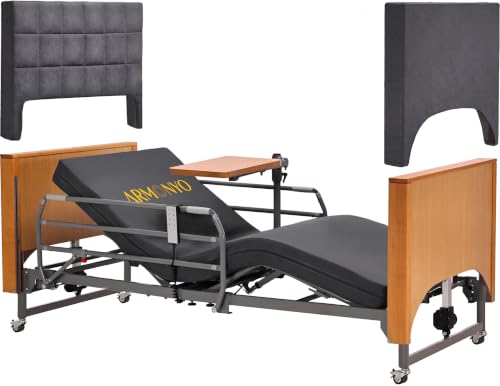 ARMONYO Electric Hospital Bed for Home Use
- Designed for home settings, this medical hospital bed…
- LOW 8.5" HEIGHT FOR SAFER TRANSFERS - ADJUSTABLE…
- This electric hospital bed includes height adjustment (8.5"–25"),…
 Full Electric Hospital Bed for Home Use
- [Ultra-Low 8"‑23.4" Height for Fall-Prevention & Safe Transfers]Our…
- [Solid Wood Headboard &Footboard With Detachable Upholstered Padding]Designed…
- [Premium JIECANG Motor Actuators&Multi‑Function Electric Adjustment]Equipped with JIECANG…
As an Amazon Associate we earn from qualifying purchases at no extra cost to you.
| Configuration to compare | Typical sleep surface | Planning frame footprint | Finish and care | Doorway-fit note |
|---|---|---|---|---|
| Furniture-style twin | About 36 × 80 in | Roughly 40–44 × 84–90 in | Wood veneer or solid-wood components; dust and clean according to the finish instructions | A 36 in mattress does not mean a 36 in frame. Measure the widest assembled point. |
| Furniture-style full | About 54 × 80 in | Roughly 58–62 × 84–90 in | Wood panels or upholstered accents; check how seams and trim tolerate routine cleaning | Often needs more turning clearance in a hall or bedroom entrance than a twin. |
| Split-frame, room-assembled model | Commonly twin or full; model-specific | Varies with headboard, footboard, and rail options | May offer wood-look panels or fabric-covered components | Ask for the largest carton dimension and whether assembly can be completed in the bedroom. |
| Upholstered headboard with adjustable base | Typically matched to a compatible mattress size | Base width plus headboard and rail projection | Performance fabric may look residential; follow the maker’s cleaning guidance | Headboards can be wider than the base. Measure them separately. |
These ranges describe common planning dimensions for residential bed sizes and frames, not guaranteed product specs. A particular hospital bed may use a nonstandard mattress, have a different outer width, or require a specific mattress thickness. Ask the supplier for a dimension drawing that includes rails, headboard, footboard, wheels, and any protruding controls.
How to choose a finish without compromising function
Wood finishes
Light oak and maple tones tend to sit comfortably beside pale floors and neutral bedding; walnut and darker stains can make a bed feel more like substantial bedroom furniture. A veneer can provide a consistent appearance at a lower price than solid wood, but edges and corners are more vulnerable to chips. Ask whether the finish can be cleaned with the products used in the home, and whether replacement panels are available.
Upholstery
Upholstered headboards soften the room’s appearance, but fabric can collect dust and may be harder to clean after spills. For frequent care, ask about the upholstery’s cleaning instructions and whether a removable cover is available. Avoid assuming that “medical grade” or “easy clean” means compatible with every disinfectant; use only products approved by the manufacturer.
Rails and controls
Rails and pendant controls can make a bed look more clinical, yet they may be important to the intended setup. Do not remove, substitute, or reposition safety components based on appearance alone. Confirm compatibility with the bed and discuss rail use with the person’s clinician or equipment supplier, especially if mobility or fall risk is a concern.
Measure the route before ordering
- Measure the narrowest clear opening. Include the front door, interior doors, hallway pinch points, and any turn into the bedroom. Measure with doors open and note handles, trim, and nearby furniture.
- Compare the opening with delivery pieces. Ask for the largest package dimensions and whether the frame arrives assembled. A bed that fits through a doorway in parts may still need a clear, workable assembly area.
- Check the room layout. Mark the full frame footprint, not only the mattress rectangle. Leave access for caregivers, drawers, bedside furniture, and the bed’s movement through its adjustment range.
- Confirm floor and power details. Ask about total bed weight, caster requirements, outlet location, cord routing, and backup operation during a power interruption. Avoid running cords where they create a trip hazard.
- Get the mattress specification in writing. Verify length, width, thickness, and type. A regular residential mattress may not fit safely or function properly on a hospital-bed deck.
Match the bed to the household
| Situation | What to prioritize | Likely direction |
|---|---|---|
| Tight doorway or upstairs bedroom | Knock-down assembly, package size, delivery access, and weight of individual components | Room-assembled or split-frame configuration, if available |
| Bed will be visible in a shared bedroom | Headboard and footboard style, finish samples, concealed hardware | Wood-finish furniture-style model |
| Frequent cleaning is expected | Wipeable surfaces, accessible seams, approved cleaning products, replacement-part availability | Simpler wood or cleanable upholstery rather than delicate fabric |
| Several people will assist with care | Height range, control access, clearance around the bed, service support | Compare hi-low models and confirm operation with the equipment provider |
| Budget is limited | Required functions first; finish options, delivery, setup, mattress, and service costs | Consider a simpler adjustable bed with compatible decorative panels, if the supplier confirms the combination is safe |
Budget for ownership, not just the frame
As a broad U.S. market guide, a basic adjustable home hospital bed may cost from several hundred dollars to a few thousand, while furniture-style and specialty configurations can reach several thousand dollars or more. These are general ranges, not quotes: mattress, rails, headboard, delivery, installation, warranty, and service can change the total substantially. Ask for an itemized quote and check whether the supplier offers repair support where the bed will be used.
For example, if a furniture-style upgrade costs $900 more and the household expects to use the bed for three years, the upgrade works out to about $25 per month ($900 ÷ 36). That calculation does not establish value by itself; it helps compare the appearance benefit with other needs, such as a compatible mattress or delivery and setup.
What tends to wear—and how to avoid common problems
With regular use, moving joints, casters, pendant cables, upholstery seams, and finish edges can need attention before the main frame. Follow the manufacturer’s maintenance schedule, keep moving parts clear of bedding and cords, and stop using the bed if a control, cable, rail, or lift mechanism appears damaged. Do not lubricate or modify components unless the manufacturer specifies how.
Common purchasing mistakes include measuring only the mattress, assuming a standard mattress will fit, overlooking headboard width, and choosing a decorative finish before confirming essential functions. Keep the model number, configuration, mattress details, and service contact together. If the bed is being selected for a health or mobility need, involve the person’s clinician or qualified equipment provider to confirm appropriate features and setup.