Key takeaways
- Latex and other water-based wall paints: A 515 is a common starting point for interior walls when the coating label allows a 0.015-inch orifice. A 517 may suit thicker paint or faster coverage if the pump supports it. Strain paint when appropriate, and do not thin it unless the coating manufacturer permits it.
- Lacquer and fine-finish work: Start with a smaller opening—often in the 0.009- to 0.013-inch range—and a narrower fan such as a 211 or 311, subject to the lacquer label and tip-maker guidance. Lacquer’s fast drying and finish sensitivity make control, compatible equipment, ventilation, and correct cleanup especially important. Use only a sprayer and fluid path approved for the coating and its solvent.
- Trim and doors: A 311 or 313 limits overspray and is easier to control around edges than a wide wall tip. For a coating that is too heavy for a small opening, step up only as needed rather than compensating with excessive pressure.
- Large exterior surfaces: A 515, 517, or larger tip can improve coverage when the material and sprayer are rated for it. Test the pattern and adjust distance and overlap before starting the full surface.
Best Airless Sprayer Tips for Professional Painters
The best airless sprayer tip for professional painters is the smallest orifice that reliably handles the material and keeps the job moving: use a 311 or 313 for trim and doors, a 515 or 517 for walls, and a larger-orifice tip only when thick coatings or high output require it. Match the first digit to the fan width, the last two to the orifice size, then check the coating label and sprayer’s maximum tip rating.
How to read a tip number
A tip marked 515 has a nominal 10-inch fan at about 12 inches from the surface and a 0.015-inch orifice. The first digit is doubled for the approximate fan width; the final two digits give the orifice in thousandths of an inch. Actual fan width changes with distance, pressure, coating, and tip wear, so treat the number as a starting point—not a guarantee.
Our top picks
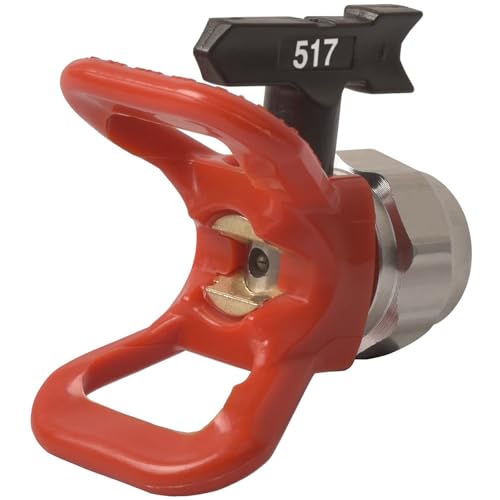 GDHXW 7/8 Guard Combo 517 Airless Spray
- Matching model of nozzle base: 243611 Nozzle model:517
- Please note: the nozzle seat only matches the…
- Guard Combo Made of high strength metal and…
 GRACO TrueAirless 515 Spray Tip
- 10 in
- 0.015 in
- Graco-exclusive SoftSpray Technology provides better control to easily…
 Titan HEA 311 Reversible Airless Spray Tip
- Outputs a 6-8” spray pattern to easily spray…
- For use with Wagner Control Pro and Titan…
- Ideal for use with sealers, transparent stains, and…
As an Amazon Associate we earn from qualifying purchases at no extra cost to you.
A larger orifice passes more material, but it also demands more pump capacity and can create a heavier coat. A wider fan covers more area per pass, but is less convenient in tight spaces. Choose both dimensions for the surface and coating, not just for speed.
Common sizes at a glance
| Tip | Approx. fan width at 12 in. | Orifice | Good starting applications |
|---|---|---|---|
| 211 | 4 in. | 0.011 in. | Narrow trim, small components, detail work |
| 311 | 6 in. | 0.011 in. | Cabinet parts, narrow doors, small areas |
| 313 | 6 in. | 0.013 in. | Trim and doors with coatings that need slightly more flow |
| 315 | 6 in. | 0.015 in. | Broader trim or smaller wall sections |
| 515 | 10 in. | 0.015 in. | Interior walls and ceilings with compatible coatings |
| 517 | 10 in. | 0.017 in. | Walls and other surfaces needing more flow |
| 619 | 12 in. | 0.019 in. | Large surfaces with coatings and equipment suited to the flow |
These are common nominal sizes, not universal recommendations. Tip makers may differ in available sizes and naming details. Always confirm the permitted tip size in your sprayer manual; a pump that cannot supply the selected tip may produce poor atomization or fail to maintain pressure.
Pick by coating and job
- Latex and other water-based wall paints: A 515 is a common starting point for interior walls when the coating label allows a 0.015-inch orifice. A 517 may suit thicker paint or faster coverage if the pump supports it. Strain paint when appropriate, and do not thin it unless the coating manufacturer permits it.
- Lacquer and fine-finish work: Start with a smaller opening—often in the 0.009- to 0.013-inch range—and a narrower fan such as a 211 or 311, subject to the lacquer label and tip-maker guidance. Lacquer’s fast drying and finish sensitivity make control, compatible equipment, ventilation, and correct cleanup especially important. Use only a sprayer and fluid path approved for the coating and its solvent.
- Trim and doors: A 311 or 313 limits overspray and is easier to control around edges than a wide wall tip. For a coating that is too heavy for a small opening, step up only as needed rather than compensating with excessive pressure.
- Large exterior surfaces: A 515, 517, or larger tip can improve coverage when the material and sprayer are rated for it. Test the pattern and adjust distance and overlap before starting the full surface.
Tip choice alone does not make a finish smooth. Use the coating’s specified pressure range, keep the gun perpendicular to the surface, overlap passes consistently, and maintain a wet edge where the product directions call for one. Excess pressure can accelerate tip wear and increase overspray.
Decision matrix for a working painter
| Situation | Practical starting choice | Why |
|---|---|---|
| Frequent interior repainting | 515 for compatible wall paint; keep a 517 for coatings needing more flow | Balances coverage and output on broad surfaces |
| Cabinet or trim finishing | 211 or 311, matched to coating instructions | Narrower fan offers more control and reduces wasted spray |
| Occasional small repairs | 311 or 313, after checking pump and coating limits | Useful middle ground for narrow panels and limited areas |
| Thick coating or high-output work | Choose the smallest approved orifice that sprays well; consider 517 or 619 only if rated | More flow can help, but demands more pump capacity and may deposit paint too quickly |
| Solvent-based lacquer | Small-orifice fine-finish tip and solvent-compatible equipment | Control and material compatibility matter more than maximum coverage |
Wear life: what fails first on site
The orifice is the working edge of the tip and gradually erodes under abrasive coatings. As it wears, the fan can become wider and less defined, flow rises, and it becomes harder to maintain a consistent film thickness. Mineral fillers and frequent spraying tend to wear tips faster than clean, less abrasive coatings. There is no dependable universal service-life figure: hours depend on material, pressure, filtration, and cleaning.
Inspect the pattern on scrap at the start of a job and whenever the finish changes. A sound pattern is even, with tapered edges. A distorted or heavy-centered pattern may indicate a worn or partially blocked tip. Turn a reversible tip to clear a clog according to its instructions; if the pattern remains poor after cleaning, replace it rather than increasing pressure.
Keep a spare tip in the sizes used most often, and track how each performs on recurring jobs. A tip is a consumable, so its purchase price is only part of the cost: an undersized tip can slow production, while an oversized or worn one can waste coating and increase rework.
Setup and cleanup that protect the tip
- Confirm compatibility. Check the coating label, tip maker’s guidance, and sprayer manual for approved materials, orifice limits, and any solvent restrictions.
- Prepare the coating. Mix as directed and strain it when needed. Removing debris reduces clogs; straining does not make an incompatible tip suitable.
- Test the pattern. Spray a test board at a consistent distance. If the pattern tails, increase pressure only within the coating and machine limits. If it still tails, inspect for a clog, unsuitable tip, or worn tip.
- Clean promptly. Flush with the cleaning fluid specified for the coating and equipment. Remove the tip and guard for cleaning as directed, and avoid poking the orifice with wire or hard tools that can damage its profile.
- Store safely. Follow the sprayer manufacturer’s storage procedure and keep tips protected from impact and dried residue.
Bottom line
For most professional painters, a 515 is a versatile starting point for compatible wall paints, while 311 and 313 tips suit narrower trim and door work. Lacquer generally calls for a smaller, controlled setup and verified solvent compatibility. Before buying, check the coating’s permitted tip range, your sprayer’s capacity, the required fan width, and the cost of replacing tips as they wear.