Key takeaways
- 10-inch frying pan: The most versatile size for eggs, vegetables, grilled cheese, chicken breasts, and meals for one to three people.
- 2- to 3-quart saucepan with lid: Useful for oatmeal, rice, sauces, reheating, and boiling a modest amount of pasta or vegetables.
- 5- to 6-quart stockpot with lid: Large enough for pasta, soup, chili, and batch cooking without taking up the space of a restaurant-sized pot.
- 8- to 10-inch skillet or sauté pan: Helpful when cooking two components at once or when the 10-inch pan is occupied. In a very small kitchen, this is the first piece to omit.
- 3- to 4-quart sauté pan with lid: Its straight sides and larger capacity suit one-pan meals, braises, curries, and shallow frying. Some sets substitute this for the second skillet.
The best cookware sets for beginners are usually a five-piece stainless-steel or hybrid set with a 10-inch frying pan, a 2- to 3-quart saucepan, and a 5- to 6-quart stockpot—but the right choice depends on your cooktop, cleaning habits, and how often you cook.
Our top picks
 Cuisinart Chef's Classic Stainless Steel Pots and
- This Cuisinart stainless steel cookware set includes 1.5…
- Premium stainless steel pots and pans set with…
- Cast stainless steel Cool Grip stick handles are…
 CAROTE 21pcs Pots and Pans Set Non
- Optimal storage and easy stacking with the handles…
- Cleanup with zero elbow grease thanks to the…
- Removable handle for the transition from all kinds…
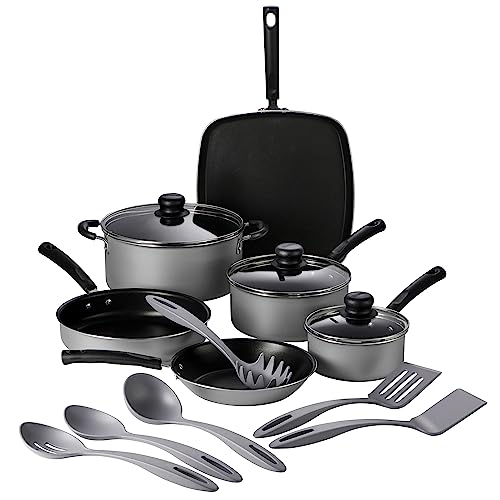 Tramontina Primaware 15-Piece Non Stick Pots and
- Crafted with sturdy aluminum construction for long-lasting performance,…
- Features a nonstick interior that promotes healthier cooking…
- Ergonomically designed handles stay cool during stovetop cooking,…
| Product | Key specs | |
|---|---|---|
| Cuisinart Chef's Classic Stainless Steel Pots and | This Cuisinart stainless steel cookware set includes 1.5… Premium stainless steel pots and pans set with… Cast stainless steel Cool Grip stick handles are… | Check price |
| CAROTE 21pcs Pots and Pans Set Non | Optimal storage and easy stacking with the handles… Cleanup with zero elbow grease thanks to the… Removable handle for the transition from all kinds… | Check price |
| Tramontina Primaware 15-Piece Non Stick Pots and | Crafted with sturdy aluminum construction for long-lasting performance,… Features a nonstick interior that promotes healthier cooking… Ergonomically designed handles stay cool during stovetop cooking,… | Check price |
 T-Fal Ultimate Hard Anodized Nonstick Pots and T-Fal Ultimate Hard Anodized Nonstick Pots and | Heavy Gauge Construction: Built to stand the test… Our Pots and Pans Set Non Stick Includes:… Thermo-Spot Technology: Our frying pans nonstick set has… | Check price |
As an Amazon Associate we earn from qualifying purchases at no extra cost to you.
The five pieces beginners actually use
Large cookware sets often advertise 10, 12, or 15 pieces, but lids, steamer inserts, and duplicate pans can inflate the count. For most first kitchens, these five vessels cover everyday meals:
- 10-inch frying pan: The most versatile size for eggs, vegetables, grilled cheese, chicken breasts, and meals for one to three people.
- 2- to 3-quart saucepan with lid: Useful for oatmeal, rice, sauces, reheating, and boiling a modest amount of pasta or vegetables.
- 5- to 6-quart stockpot with lid: Large enough for pasta, soup, chili, and batch cooking without taking up the space of a restaurant-sized pot.
- 8- to 10-inch skillet or sauté pan: Helpful when cooking two components at once or when the 10-inch pan is occupied. In a very small kitchen, this is the first piece to omit.
- 3- to 4-quart sauté pan with lid: Its straight sides and larger capacity suit one-pan meals, braises, curries, and shallow frying. Some sets substitute this for the second skillet.
A practical beginner set therefore contains either one skillet plus one sauté pan, or two skillets in different sizes. You do not need a tiny egg pan, a giant 8-quart pot, or several matching lids unless you already know you will use them.
Stainless steel vs. nonstick vs. cast iron
| Cookware type | Best use | Typical useful life | Typical weight | Induction compatibility | Main drawback |
|---|---|---|---|---|---|
| Tri-ply stainless steel | Searing, sauces, pasta, vegetables, oven cooking | 10-20+ years with care | 2.5-5 lb per pan | Yes, if the base is magnetic | Food can stick without preheating and enough fat |
| Coated nonstick | Eggs, pancakes, delicate fish, low-fat cooking | 3-7 years, sometimes longer with careful use | 1.5-4 lb per pan | Only if marked induction-compatible | Coating wears from high heat, metal tools, and abrasive cleaning |
| Cast iron | Steak, cornbread, roasting, high-heat browning | Decades or longer | 5-8 lb for a 10- to 12-inch skillet | Yes | Heavy, slow to heat, and requires drying and seasoning care |
Stainless steel: the strongest all-round foundation
Stainless steel is the best choice for beginners who want one set to handle most techniques and last for many years. Look for a tri-ply or clad construction: stainless steel cooking surfaces surround an aluminum core, spreading heat more evenly than a thin single-layer pan. A 2.5- to 3-millimeter total base or a clearly described aluminum core is a useful quality indication.
Stainless steel is excellent for browning because fond—the browned residue left after searing—can be loosened into a pan sauce. It is also generally oven-safe, though the exact temperature limit depends on the handles and lids. The learning curve is preheating. If water droplets sizzle and evaporate instantly rather than forming small beads, the pan may be too hot; reduce the heat before adding oil.
Common mistakes include heating an empty pan on high for several minutes, adding cold meat to a barely warm surface, and scrubbing a hot pan under cold water. These habits can cause sticking, discoloration, or warping.
Nonstick: the easiest surface for delicate foods
Nonstick cookware is forgiving for eggs, pancakes, fish, and foods that tend to tear. It is also usually lighter than stainless steel or cast iron. For a first kitchen, one 10-inch nonstick frying pan paired with stainless-steel pots can be more useful than an entirely nonstick set.
Nonstick coatings are consumable components, not permanent surfaces. Use silicone, wood, or plastic utensils; avoid stacking pans without protectors; and wash with a soft sponge. Most coated pans perform best over low to medium heat. High heat can shorten coating life, especially when the pan is empty.
Do not assume that a heavy pan is automatically induction-ready. Induction requires a magnetic base, so check the packaging or look for an induction symbol. A simple magnet test on the underside can provide a quick indication, although the manufacturer’s specification is more reliable.
Cast iron: durable, but not the simplest complete set
Cast iron can last for generations and works on gas, electric, and induction cooktops. It retains heat exceptionally well, making it valuable for steak, roasted vegetables, skillet bread, and deep browning. A 10- or 12-inch skillet is a sensible single purchase.
Its drawbacks matter more to beginners than its durability does. A 10-inch skillet may weigh about 5 to 7 pounds before food is added, and it responds slowly when you change the burner temperature. Dry it immediately after washing, apply a very thin film of cooking oil when needed, and avoid leaving acidic foods such as tomato sauce in it for long periods. Enameled cast iron avoids much of the seasoning work but is heavier and typically costs more.
Which cookware material should you choose?
| Your situation | Best starting choice | Why | What to avoid |
|---|---|---|---|
| Budget-conscious, cooks several times weekly | Stainless pots plus one nonstick skillet | Covers most foods and limits replacement costs to one coated pan | A very large set with duplicate pieces |
| Mostly eggs, pancakes, and quick meals | Nonstick frying pan plus a small stainless saucepan | Easy food release without sacrificing a durable pot | Using nonstick for high-heat searing |
| Enjoys steak, roasting, and rustic cooking | Stainless set plus a 10- or 12-inch cast-iron skillet | Combines easy-care pots with excellent heat retention | A complete cast-iron set if lifting weight is inconvenient |
| Induction cooktop | Magnetic stainless, cast iron, or induction-rated nonstick | These materials can transfer energy from the induction field | Nonmagnetic aluminum or copper without an induction base |
| Small kitchen or limited storage | One 10-inch skillet, 2-quart saucepan, and 5-quart pot | Three vessels handle most single-person or couple-sized meals | Tall, nested sets with many rarely used pieces |
| Frequent batch cooking | Tri-ply stainless set with a 6- to 8-quart pot | Durable, versatile, and roomy enough for leftovers | A small 3-quart pot as the only large vessel |
How much cookware do you really need?
Use capacity rather than the number printed on the box. A 2-quart saucepan holds about 1.9 liters, enough for two portions of rice or sauce but cramped for family pasta. A 5-quart pot holds about 4.7 liters and suits a package of pasta, soup for several servings, or a batch of chili. A 10-inch frying pan has roughly 78 square inches of cooking surface, while a 12-inch pan has about 113 square inches—around 45 percent more area, but also more weight and storage demand.
For one or two people, the three-piece setup is often sufficient. For three or more people, add a 3- or 4-quart sauté pan so you can cook a main dish without overcrowding the skillet. Overcrowding causes food to steam rather than brown and makes even good cookware seem ineffective.
What to check before buying a set
- Induction rating: Confirm every piece you need works on induction; some sets include a nonmagnetic aluminum pan alongside compatible pots.
- Base construction: Tri-ply or fully clad stainless generally heats more evenly than a thin pan with only a small bonded disc.
- Handles: Riveted handles are secure, while welded interiors are easier to clean. Check whether handles remain cool only on the stovetop; they can still become hot in the oven.
- Lid fit: A tight lid should sit steadily without excessive rattling. Tempered-glass lids make monitoring easier, while metal lids tolerate higher heat.
- Oven limit: Verify the separate ratings for pans, handles, lids, and nonstick coatings. A set is only as oven-safe as its least-resistant component.
- Weight and storage: A durable pan that is too heavy to lift comfortably will be used less often. Measure cabinet height before choosing a tall stockpot.
Cost and ownership reality
Entry-level cookware sets commonly range from about $80 to $180, mid-range clad stainless sets from roughly $180 to $500, and premium sets above that. A cheaper large set is not necessarily better value if half the pieces remain unused. For example, a $150 set used twice a week for five years equals about 520 uses, or approximately 29 cents per use before replacement. A $90 set used only once a week for three years equals about 156 uses, or nearly 58 cents per use. Frequency and durability matter more than the initial piece count.
The first item likely to wear out is a coated frying pan, not a stainless pot. Budget for replacing that pan periodically, and protect it from metal utensils and dishwasher abrasion. Stainless steel may develop rainbow discoloration or stuck-on residue, but these are usually cosmetic or cleanable rather than signs that the pan has failed. Cast iron can rust if stored damp, but surface rust can generally be removed and the pan reseasoned.
Bottom line
For most beginners, choose a five-piece tri-ply stainless-steel set if you want maximum versatility and long ownership, or combine stainless-steel pots with one induction-compatible nonstick skillet if easy egg and pancake cooking matters most. Add a cast-iron skillet only when you value high-heat searing and do not mind its weight and maintenance. Whatever material you select, prioritize the three core sizes—a 10-inch skillet, 2- to 3-quart saucepan, and 5- to 6-quart pot—then buy additional pieces only when your actual cooking habits justify them.