
Key takeaways
- Best overall: Taylor K-2006 (drop kit covering chlorine, pH, alkalinity, hardness and CYA)
- Best for weekly speed: AquaChek 7-Way test strips
- Best budget strip: EasyTest 7-Way test strips
- Best for salt pools: Taylor K-2006-SALT (adds a salt test)
- Best digital: LaMotte ColorQ Pro 7 (handheld photometer)
- Simple six-parameter strip for casual owners: HTH 6-Way test strips
- Lean drop kit: Taylor K-2005 (similar chemistry with fewer extras)
The best pool test kit for most home owners is the Taylor K-2006 drop kit, with AquaChek 7-Way strips as a fast weekly backup and the Taylor K-2006-SALT as the pick for salt pools. If you want a no-guesswork reading and will pay more, the LaMotte ColorQ Pro 7 digital photometer is the upgrade. Everything below explains why, and how to match a kit to your pool.
Pool water chemistry is a short list of numbers: free chlorine, pH, total alkalinity, calcium hardness and cyanuric acid (CYA, the stabilizer). Get them wrong and you get cloudy water, algae, stained plaster, scaled heaters or burning eyes. The kit you choose decides how trustworthy those numbers are, how long each check takes, and what each reading costs over a season. The three families are drop (titration and comparator) kits, test strips and digital testers, and they behave very differently.
Our top picks
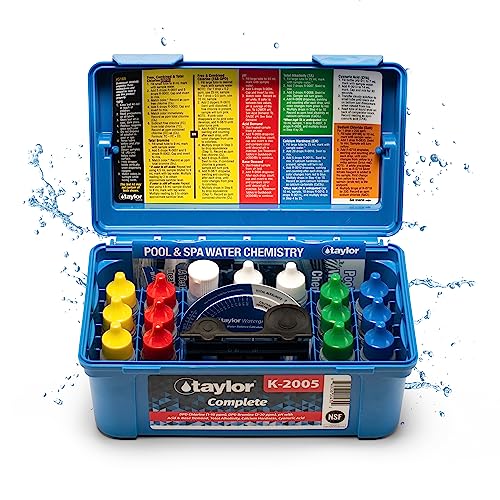
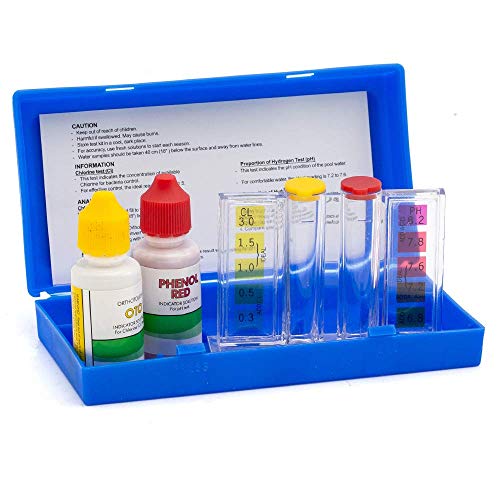

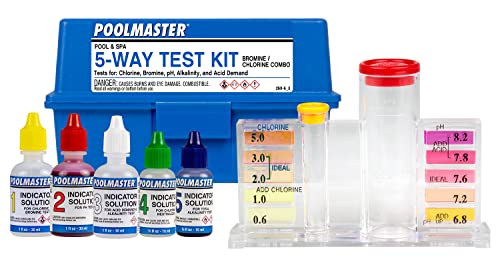
As an Amazon Associate we earn from qualifying purchases at no extra cost to you.
Quick picks
- Best overall: Taylor K-2006 (drop kit covering chlorine, pH, alkalinity, hardness and CYA)
- Best for weekly speed: AquaChek 7-Way test strips
- Best budget strip: EasyTest 7-Way test strips
- Best for salt pools: Taylor K-2006-SALT (adds a salt test)
- Best digital: LaMotte ColorQ Pro 7 (handheld photometer)
- Simple six-parameter strip for casual owners: HTH 6-Way test strips
- Lean drop kit: Taylor K-2005 (similar chemistry with fewer extras)
How we chose
This guide is research-based. We compared manufacturer specifications, published instructions, pool-industry guidance on measurement methods, and the points that reviewers and pool owners repeatedly raise about each kit. We did not run lab trials, and nothing here is a measured accuracy figure from us. Where a spec could not be confirmed we describe the kit by class instead. The criteria, in order of weight:
- Parameters covered. A home kit must read free chlorine, pH, total alkalinity and CYA at minimum. Calcium hardness matters for plaster and heaters. Salt pools also need a salt reading.
- Method and resolution. Titration counts drops, so each drop is a fixed step. Colour-matching a strip pad is a visual estimate. A photometer measures the colour with a sensor.
- Behavior at high chlorine. After a shock or a SLAM (a deliberately high-chlorine cleanup), strips and simple comparators can bleach out or mislead. Titration keeps working.
- Reagent life. Liquid reagents and strips both degrade with heat, sunlight and air. A cheap kit that has expired is worse than no kit.
- Cost per test. Upfront price divided by realistic season use, plus refills.
- Time and ease. If a test takes too long, people skip it, and a skipped test is the real accuracy killer.
Drops vs strips vs digital: how the methods differ
Drop kits (titration and comparator)
Kits like the Taylor K-2006 use reagent bottles and a graduated sample vial. For chlorine, the K-2006 uses a DPD titration method (FAS-DPD): you add reagent to the sample, turn it pink, then count drops of a titrant until the pink vanishes. Each drop is a fixed increment, so the reading is a count rather than a colour judgment. The same logic covers alkalinity and calcium hardness, while pH uses a colour comparator and CYA uses a turbidity vial, where you add reagent and watch a black dot disappear into cloudiness.
Strengths: best accuracy available to home owners, works at very high chlorine levels, reagents last a long time when stored properly, and refills are cheap per test. Weaknesses: slower, a learning curve, and the colour and clarity judgments for pH and CYA still involve your eyes.
Test strips
Strips have reagent pads that change colour after a dip. You compare the pads to a printed chart. They are the fastest method and the cheapest upfront. Pool-industry sources commonly place strip accuracy well behind liquid kits, with the error widest for chlorine and CYA. The reasons are structural: lighting changes how colours look, timing matters, wet fingers contaminate pads, and a bottle left in a hot shed loses reliability. Strips are still excellent for noticing trends between more careful checks.
Digital testers
Digital testers fall into two groups. Photometers such as the LaMotte ColorQ Pro 7 use the same chemistry as a drop or tablet kit but read the colour with a sensor, removing human colour judgment. Smart monitors that sit in the water or read a strip through an app add convenience but often depend on a subscription or proprietary refills. For a home owner, a photometer is a premium purchase that pays off if you dislike colour matching or have low vision, and it is a clear fit for anyone managing several pools.
Comparison table
| Kit | Method | Core readings | Salt reading | Best for | Cost tier |
|---|---|---|---|---|---|
| Taylor K-2006 | FAS-DPD titration, comparator, turbidity | Free and total chlorine, pH, total alkalinity, calcium hardness, CYA | No | Chlorine pools, accuracy | Mid-range to premium |
| Taylor K-2006-SALT | Same as K-2006 plus salt test | Same core readings plus salt | Yes | Salt-chlorine pools | Premium |
| Taylor K-2005 | FAS-DPD titration, comparator, turbidity | Chlorine, pH, alkalinity, hardness, CYA | No | Titration with a leaner set | Mid-range |
| LaMotte ColorQ Pro 7 | Digital photometer | Multiple pool parameters including chlorine, pH, alkalinity, hardness and CYA | Check model options | Removing colour matching, several pools | Premium |
| AquaChek 7-Way | Strip | Free and total chlorine, pH, alkalinity, hardness, CYA, bromine | No | Fast weekly checks | Entry-level |
| EasyTest 7-Way | Strip | Similar seven-pad range | No | Lowest cost per quick test | Entry-level |
| HTH 6-Way | Strip | Chlorine, bromine, pH, alkalinity, hardness, CYA | No | Casual owners, easy to find | Entry-level |
Pad sets can differ between production runs and packaging. Always confirm the exact parameters on the pack, particularly whether CYA is included.
The kits, one by one
1. Taylor K-2006: best overall
Spec line: FAS-DPD chlorine titration · comparator pH · titration alkalinity and hardness · turbidity CYA · reagent bottles in a carry case
Best for: Owners of chlorine pools who want one kit to settle disputes, diagnose problems and run a proper SLAM.
Skip if: You will only test once every few weeks, or you cannot face counting drops.
- Pros: Titration for chlorine remains useful at shock-level readings where strips mislead. Covers the full home list. Individual reagents are sold separately, so you can refill only what you use.
- Cons: Slower than strips. Reagents need cool, dark storage and a yearly refresh for the colour-based tests.
2. Taylor K-2006-SALT: best for salt pools
Spec line: K-2006 chemistry · adds a salt titration test · case and reagents
Best for: Salt-chlorine pools that also need accurate CYA and chlorine readings, since cell output and CYA interact strongly.
Skip if: Your salt system has a built-in display you only cross-check occasionally, or you have a traditional chlorine pool.
- Pros: One case covers everything, so you do not need a separate salt meter.
- Cons: Costs more than the base kit.
3. Taylor K-2005: lean drop kit
Spec line: FAS-DPD chlorine titration · comparator pH · titration alkalinity and hardness · turbidity CYA
Best for: People who want the titration approach without the extra bromine and troubleshooting tests they will never use.
Skip if: You run a bromine spa or want the widest diagnostic range. Check current pack contents because the exact test list can change.
- Pros: Same method logic as the K-2006 for the core readings, usually at lower cost.
- Cons: Fewer extras for troubleshooting.
4. LaMotte ColorQ Pro 7: best digital
Spec line: Handheld photometer · sensor reads colour on reagent tests · multi-parameter pool coverage · battery powered
Best for: Owners who struggle with colour matching, anyone who services several pools, and those who want a repeatable reading.
Skip if: You have one pool and are comfortable with a drop kit. The extra cost buys objectivity, not new chemistry. The instrument still needs fresh reagents and correct sampling.
- Pros: Removes human colour judgment, fast once set up, clear numerical result.
- Cons: Premium cost, reagents and tablets are still consumables, and a dirty cuvette or bad technique can spoil any result.
5. AquaChek 7-Way: best weekly strip
Spec line: Seven-pad strip · free and total chlorine, pH, alkalinity, hardness, CYA, bromine · chart on the bottle
Best for: Quick weekly checks, trend spotting and families who want a test that takes under a minute.
Skip if: You just shocked the pool or are chasing algae. Use a drop kit for those decisions.
- Pros: Fast, cheap per check, widely available, good for noticing drift.
- Cons: Colour matching is subjective, pads age fast once the bottle is opened, and heat damage is common.
6. EasyTest 7-Way: best budget strip
Spec line: Seven-pad strip · chlorine, pH, alkalinity, hardness, CYA and more · bottle of strips
Best for: Owners who want the lowest cost per quick check and will confirm anything important with a drop kit.
Skip if: You rely on a single test to dose chemicals, or cannot store strips somewhere cool and dry.
- Pros: Very low cost, broad pad set.
- Cons: Same strip limits on accuracy as any dip strip, and bottle size is typically modest, so cost per test depends on how quickly you use the bottle.
7. HTH 6-Way: easy casual strip
Spec line: Six-pad strip · chlorine, bromine, pH, alkalinity, hardness, CYA
Best for: Casual owners who buy supplies at a general retailer and want a simple chart.
Skip if: You need separate free and total chlorine pads or a salt reading.
- Pros: Simple and easy to find.
- Cons: Fewer pads than seven-way strips, with the same limitations as other strips.
Which tests matter, and the thresholds that drive buying
You do not need every possible reading every day. Prioritize these:
- Free chlorine: The sanitizer. Check at least a few times a week in summer. The level you need rises with CYA.
- pH: Commonly targeted in the 7.2 to 7.8 range. It affects comfort and chlorine efficiency, and it drifts, so check often.
- Total alkalinity: Buffers pH. Check weekly to monthly. Typical guidance is roughly 80 to 120 ppm, though some pool types call for different targets, so follow your pool builder’s advice.
- CYA: Shields chlorine from sunlight but weakens it when too high. Check at the start of the season and after heavy rain or refills. Many owners aim for around 30 to 50 ppm in a chlorine pool.
- Calcium hardness: Matters for plaster and heater protection. Check monthly or at opening and closing.
- Salt: Only for salt systems. Check when the controller flags low salt or after big water additions.
If a kit lacks CYA or a reliable chlorine method, it is the wrong kit, because CYA sets the chlorine target you need to hit.
Worked example: cost per test over a season
Use this to compare kits honestly. Assume a 26-week swim season, three quick checks per week and one detailed check per week.
- Quick checks: 3 x 26 = 78 strip tests. A typical 50-count bottle covers 50, so you need two bottles, leaving 22 spare strips that may degrade before you use them.
- Detailed weekly checks: 26 drop-kit runs. Chlorine and pH use a handful of drops each, so a standard refill set generally lasts a season or more for the titration tests, though colour-based reagents are best replaced yearly regardless.
- Compare: Strips cost little per check, but the 78 quick checks give a rough picture. The 26 titration checks are fewer but each is one you can dose from. A mixed routine of strips for trends plus a drop kit for decisions usually costs less than a digital-only setup and beats strips alone on reliability.
- Waste factor: If you only test twice a month, a strip bottle may expire before you finish it. The true cost per useful test then rises, and a drop kit with long-life reagents becomes the cheaper option per reliable reading.
Decision rule: if you test more than twice a week and value speed, choose strips with a drop kit as backup. If you test less often or dose chemicals from the numbers, make the drop kit your main tool.
Decision matrix
| Your situation | Best choice | Why |
|---|---|---|
| Chlorine pool, one household, dose from numbers | Taylor K-2006 | Titration accuracy plus full range |
| Salt-chlorine pool | Taylor K-2006-SALT | Adds salt and keeps CYA and chlorine accuracy |
| Quick weekly check on a tight budget | EasyTest 7-Way or AquaChek 7-Way | Fast and low cost |
| Trouble reading colours or managing several pools | LaMotte ColorQ Pro 7 | Sensor removes subjective reads |
| Want titration with fewer extras | Taylor K-2005 | Leaner kit |
| Casual weekly checks from a general retailer | HTH 6-Way | Simple and easy to find |
How to get accurate readings with any kit
- Sample correctly. Take water from elbow depth, away from returns and skimmers, with a clean container held upside down until you reach depth.
- Read right away. Chlorine and pH shift as a sample sits, so do not carry a sample inside for later.
- Rinse and dry. Rinse vials with pool water, not tap water, and keep hands dry when using strips.
- Respect timing. Read strips within the pack’s stated window. Add reagent drops exactly as directed, holding bottles vertical so drop size is consistent.
- Use neutral light. Read colours in daylight shade or against a white background. Direct sun and coloured lights distort matches.
- Store reagents cool. Keep kits out of a hot garage or shed and out of direct sun. Close caps immediately.
- Date the bottles. Write the opening date on every reagent bottle and strip tube, and replace by the manufacturer’s guidance.
- Log results. A simple log shows trends, such as pH creeping up after each shock, long before the water turns green.
Safety notes
- Pool chemicals and reagents can irritate skin and eyes. Wear eye protection when handling reagent bottles and never taste or sniff them.
- Never mix different pool chemicals, and never mix chlorine products with acids or with each other. Store them separately, sealed, dry and out of children’s reach.
- Dispose of used test water and expired reagents according to local rules. Many areas have household hazardous waste drop-offs.
- Follow the label of any chemical you add after a reading, and add chemicals to water rather than water to chemicals unless the label says otherwise.
- Keep reagents away from pets and children, and return the kit to its case after use.
Common mistakes
- Trusting an old strip bottle. If it has been open for a year or sat in the sun, replace it.
- Ignoring CYA. A chlorine level that works at one CYA can be too low at a higher CYA, so test CYA at least at the start of the season.
- Checking only pH and chlorine. Alkalinity and hardness quietly control whether pH stays put.
- Dosing from a single reading. One odd reading deserves a retest before you add chemicals.
- Buying the cheapest kit for a salt pool. Salt cells need a salt reading, and a weak kit leaves you guessing.
Frequently asked questions
Which is more accurate, test strips or a drop kit?
A drop kit is generally more accurate than strips. Titration counts drops rather than judging a colour, so results are more repeatable and still useful at high chlorine levels.
Strips remain handy for quick trend checks, but use a drop kit for anything you plan to dose from, especially after shocking.
Do I need a digital pool tester at home?
Most home owners do not need one. A drop kit gives strong accuracy at lower cost, and a photometer mainly removes colour-matching errors.
Consider one if you struggle to tell colours apart, manage several pools, or want consistent numbered readings.
How often should I test my pool water?
In swim season, check free chlorine and pH two to three times a week. Check alkalinity weekly to monthly, and CYA and hardness at opening and as needed.
Test more after heavy rain, big swim days, heat waves or when you add fill water, because chemistry shifts quickly.
Why does CYA matter so much for test kit choice?
CYA sets how much free chlorine your pool needs, so a kit without a reliable CYA test leaves you guessing your chlorine target.
Check that any kit you buy includes CYA, and remember that turbidity-based CYA tests read in steps rather than giving a precise number.
How long do pool test reagents and strips last?
Shelf life varies by product, so follow the dates and guidance on the pack. Heat, sun and open air shorten life for both liquids and strips.
As a habit, replace colour-based reagents yearly, mark the opening date on every bottle, and discard strips that look faded or have sat somewhere hot.
Can I use the same kit for a saltwater pool?
You need a salt reading plus the usual chlorine, pH, alkalinity and CYA tests. A kit such as the Taylor K-2006-SALT combines these.
Alternatively, use a drop kit for chemistry and a separate salt meter or the controller reading for salt, and cross-check the controller occasionally.
Why do my strip and drop kit readings disagree?
Different methods, colour judgment, timing and aged reagents all cause differences. When they disagree, trust the fresher titration reading and retest with new reagents.
Retest with a new strip from a different bottle if you want to see whether the strip bottle is the problem.
Is it worth getting a pool store water test?
A store test is a useful second opinion a few times a season, but sample age and different methods can affect results.
It does not replace your own measurements, because pool chemistry changes day to day and you need your own numbers in between.
Final recommendation
Buy the Taylor K-2006 if you want one dependable kit, add AquaChek 7-Way or EasyTest 7-Way strips for quick checks, and step up to the K-2006-SALT if your pool uses a salt cell. Choose the LaMotte ColorQ Pro 7 when you want a sensor to read the colours for you. Whatever you buy, store it cool, date the reagents and log your numbers, because consistent water checks matters more than the brand on the case.


