Key takeaways
- Wire-free installation saves hours of prep and looks cleaner long-term
- Integrated brush system maintains charging contacts automatically
- Owners report it struggles with dense, tall grass after a missed schedule
A robot mower promises to cut your grass on a schedule while you forget about it entirely. In practice, the category ranges from units that genuinely handle uneven terrain and obstacles to ones that stall on a damp patch and leave your lawn looking like a checkerboard. The gap between those extremes is enormous, and the price spread—from under $400 to over $2,000—reflects it.
We compared published specs, prices, and recurring owner complaints across the best robot mower options currently available to identify where that gap actually matters. The decisive factors are navigation reliability on your specific yard shape, whether the unit handles slopes and edges without human intervention, and whether coverage ratings match your lawn’s real dimensions rather than the manufacturer’s generous estimate. Here’s what separates the worthwhile machines from the ones that end up gathering dust.
Our top picks



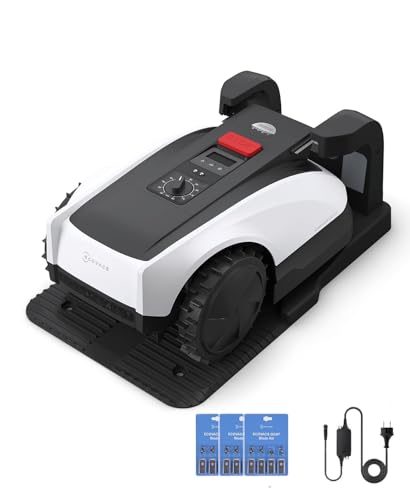


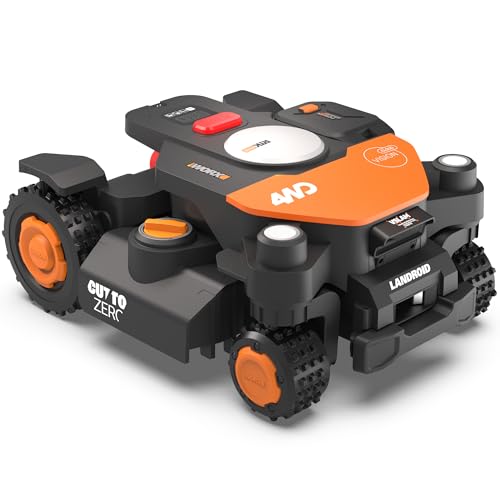
As an Amazon Associate we earn from qualifying purchases at no extra cost to you.
Quick Picks
| Product | Best for | Price |
|---|---|---|
| WORX Robot Lawn Mower (1/4 Acre, Brushes) | Wire-free convenience on small flat yards | $799.99 |
| LEBOSBO V3 AI Vision | Lowest-cost entry into robot mowing | $399.99 |
| Segway Navimow X430 | Large lawns with steep slopes | $2,249 |
| ECOVACS Goat A2000 LiDAR PRO | Reliable navigation on moderately complex yards | $1,399 |
| ECOVACS Goat O1000 RTK Care | Flat, open quarter-acre lots on a budget | $664 |
| ECOVACS Goat O1000 LiDAR PRO | Small yards with irregular edges needing built-in trimming | $999 |
| Sunseeker X5 AWD | Half-acre yards under tree canopy | $1,384 |
| WORX WR342 4WD (1/2 Acre) | Moderately sloped half-acre lots without wire | $2,069.99 |
How We Picked
We narrowed this list by weighing four things: coverage area versus your actual lawn size (manufacturers tend to measure on flat, obstacle-free ground), navigation technology and whether it demands a perimeter wire, slope and obstacle handling capability, and long-term owner satisfaction around reliability and app connectivity. Price was the final filter—this list spans three tiers so readers with different budgets and yard shapes can find a legitimate match.
The 8 Best Robot Mower in 2026
WORX Robot Lawn Mower for 1/4 Acre, Wire-Free with Brushes
A sensible entry point for a quarter-acre yard that is mostly open and flat. The wire-free setup means you skip burying perimeter cable, and the brush system keeps charging contacts clean without manual scraping.
- Wire-free installation saves hours of prep and looks cleaner long-term
- Integrated brush system maintains charging contacts automatically
- Owners report it struggles with dense, tall grass after a missed schedule
Skip it if your lawn has significant slope or complex garden beds; the quarter-acre rating leaves little margin for error on a larger property.
LEBOSBO V3 AI Vision Robotic Lawn Mower
At under $400, this is the most affordable way into wire-free robot mowing. The AI vision system maps your lawn from above rather than relying on buried wire, which is genuinely convenient for small, simple yards.
- Lowest price on this list by a wide margin
- AI vision navigation eliminates perimeter wire entirely
- 1,600 square feet of rated coverage means owners describe it running out of battery mid-job on anything approaching that limit
Skip it if your lawn is larger than a small front yard or has more than a couple of obstacles; this unit has no margin for complexity.
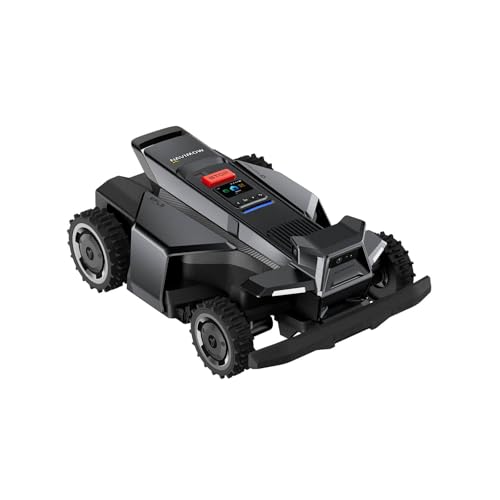
Segway Navimow X430
The most capable unit on this list for large, challenging lawns. With 4WD rated for 84 percent slopes, dual 180-watt motors, and a zero-turn system that avoids ruts, it handles terrain that stops most competitors. The one-acre coverage and 0.75-to-4-inch cutting-height range give it serious versatility.
- 4WD and 84 percent slope rating make it the only real option for steep properties
- Zero-turn system leaves no damage on soft ground
- The $2,249 price is overkill for a flat quarter-acre lot
Skip it if your yard is small and flat—you are paying for capability you will never use.
ECOVACS Goat A2000 LiDAR PRO
Dual LiDAR is the headline feature here, and owner feedback consistently notes more reliable navigation than single-camera setups at this price. For yards with moderate complexity—curves, trees, garden borders—the A2000 maps and mows with fewer re-routing errors than competitors in the same range.
- Dual LiDAR provides robust mapping without perimeter wire
- Strong owner feedback on navigation consistency across varied lawn shapes
- No published cutting-height range, making compatibility with taller grass settings hard to confirm
Skip it if you need a specific cutting height above roughly 3 inches and cannot verify the manufacturer supports it.
ECOVACS Goat O1000 RTK Care
RTK positioning is typically found on mowers costing twice this much, so getting it at $664 for a quarter-acre lot is a genuine value proposition. RTK uses satellite corrections rather than cameras, meaning it handles low-light and overcast conditions better than vision-only systems.
- RTK navigation at this price point is exceptional value
- Reliable in shaded or overcast conditions where cameras struggle
- Requires clear sky for RTK signal—dense tree cover causes it to lose positioning
Skip it if your yard has heavy mature tree canopy; the satellite-based system will not function well under it.
ECOVACS Goat O1000 LiDAR PRO
This wire-free, LiDAR-based unit adds built-in edge trimming—a feature that usually requires a separate trimmer. App control and AI obstacle avoidance round out a package for people with complex small lawns who want to avoid burying wire or trimming edges by hand.
- Built-in edge trimming eliminates a common manual chore
- Dual-LiDAR plus AI obstacle avoidance handles garden furniture and toys well
- At $999, it is significantly costlier than the O1000 RTK for the same coverage, making the value proposition harder to justify
Skip it if your edges are already straight and well-defined—you will not benefit enough from the trimmer to warrant the premium.
Sunseeker X5 AWD
The Sunseeker combines RTK and Vision AI in a dual-navigation system, falling back on one if the other is disrupted. AWD adds traction on slopes, and the half-acre coverage fills a gap between the quarter-acre units and the full-acre Segway.
- Dual RTK and Vision AI navigation provides redundancy single-system mowers lack
- AWD handles moderate slopes without stalling
- At $1,384 for half an acre, it is pricier than the ECOVACS A2000 despite comparable LiDAR-class navigation
Skip it if your lawn is genuinely flat and small—the redundancy will not matter and you can save several hundred dollars.
WORX Robot Lawn Mower 4WD for 1/2 Acre (WR342)
For a half-acre yard with gentle slope, this 4WD WORX fills the niche between the affordable quarter-acre units and the full-acre Segway. Wire-free setup with all-wheel drive handles grades without a perimeter cable. At $2,070, however, you are paying a premium for coverage that sits between two more capable options.
- 4WD with wire-free installation suits moderately sloped yards up to half an acre
- WORX support network and parts availability reduce long-term ownership risk
- The price overlaps with the Segway X430, which offers double the slope rating and wider cutting-height range
Skip it if your property approaches an acre or has steep terrain—the Segway delivers more capability for similar money.
Buying Guide
Navigation Technology: Wire-Free, RTK, and LiDAR
The cheapest robot mowers still use buried perimeter wire. Wire-free options use camera-based AI vision, LiDAR scanning, or RTK satellite positioning. Each has a failure mode. Cameras struggle in low light or uniform grass. LiDAR handles obstacles well but is sensitive to heavy dust and dense foliage. RTK is precise but needs open sky. For most suburban yards with scattered trees and garden beds, dual-system setups or LiDAR with AI give the best real-world reliability. Single-system units demand more attention to whether your lawn’s conditions suit them.
Coverage Area and Cutting Height
Manufacturers rate coverage on ideal conditions—flat, dry, obstacle-free grass. A unit rated for a quarter acre may not finish a slightly larger or irregular lawn without stopping to recharge. Check the cutting-height range if your grass species needs a higher setting; the Segway X430’s 0.75-to-4-inch range is unusually wide. Most budget units cluster around one to two inches, which works for standard fescue but not for taller ornamental grasses.
Slope Handling and Drivetrain
Flat yards hide drivetrain differences. The moment your property has grade, two-wheel-drive mowers slip or stall, and 4WD or AWD becomes non-negotiable. Slope ratings are expressed as percentages; anything above 30 percent will defeat most standard units. The Segway’s 84 percent rating is exceptional and relevant only for genuinely steep properties. For yards with a gentle 10-to-20 percent grade, the WORX 4WD or Sunseeker AWD provide adequate traction without the full-acre premium.
Our Verdict
The Segway Navimow X430 is our top pick for anyone with a large or challenging lawn—the 4WD, zero-turn system, and wide cutting-height range make it the most capable machine here. For flat, open quarter-acre yards, the ECOVACS Goat O1000 RTK is the budget pick, delivering premium navigation at a mid-range price. If your quarter-acre lot has heavy tree canopy that blocks RTK signal, the Sunseeker X5 wins because its dual RTK and Vision AI system maintains positioning where satellite-only mowers lose it.
FAQ
Do robot mowers work on wet grass?
Most modern units will pause or refuse to mow when grass is wet, and cutting wet grass clumps the deck regardless of the mower’s technology. Scheduling mows for dry periods matters more than choosing a specific model.
Do I still need to trim edges myself?
Only the ECOVACS O1000 LiDAR PRO lists built-in edge trimming. Most robot mowers leave a small gap along fences and garden beds. Plan on a trimmer pass if your lawn meets anything hard-edged.
How long do robot mower batteries last?
Most units use lithium-ion packs rated for three to five years of regular use before noticeable capacity loss. Replacement costs are typically significant, so check parts availability before committing to an unfamiliar brand.
Will a robot mower handle my yard’s shape?
Complex yards with narrow passages, islands, or multiple disconnected areas benefit most from LiDAR or dual-navigation systems. Single-camera AI vision mowers struggle in confined or oddly shaped spaces and are best reserved for open, simple lawns.