Key takeaways
- Pro: Fast setup with no boundary wire required
- Pro: Simple app-based height adjustment
- Con: Single-camera navigation fails on complex terrain
The concrete problem every buyer of a best robot lawnmower is solving is the same: they want to never touch a push mower again without spending three years on a product that can’t handle their yard. The category has matured far past the boundary-wire era, and wire-free models now dominate, but the gap between a unit that quietly maintains your lawn week after week and one that frustrates you on day thirty remains enormous. That gap comes down to navigation technology, terrain capability, and whether the mower’s rated coverage matches the actual shape of your property.
What separates the good from the bad in 2026 is navigation redundancy. A single-camera unit on a small, flat, obstacle-free lawn is genuinely adequate. A property with mature trees, irregular beds, steep slopes, or evening mowing schedules demands multiple positioning systems working together. Owner feedback makes clear that budget units rarely fail on day one—they fail on day thirty, when an overgrown corner or a wet morning exposes the limits of the hardware. We compared published specs, street prices, and aggregated owner reviews across eight current models to identify which machines earn their cost.
Our top picks





As an Amazon Associate we earn from qualifying purchases at no extra cost to you.
Quick Picks
| Product | Best for | Price |
|---|---|---|
| WORX Wire-Free 1/4 Acre | Small, simple lawns on a tight budget | $799.99 |
| LEBOSBO V3 AI Vision | Absolute lowest entry price on an AI-vision mower | $399.99 |
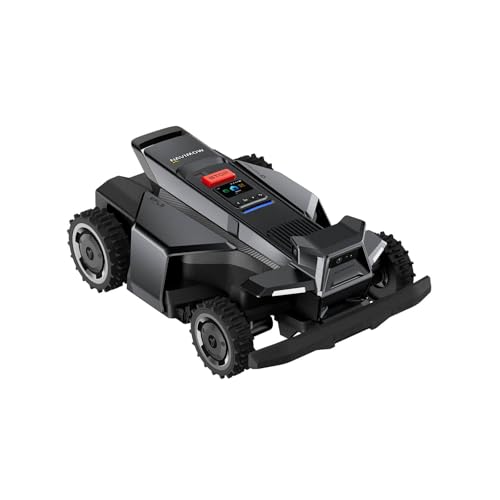
| Segway Navimow X430 | Large sloped properties needing all-terrain power | $2,249 |
| Sunseeker X5 AWD | Mid-size lawns with moderate terrain challenges | $1,384 |
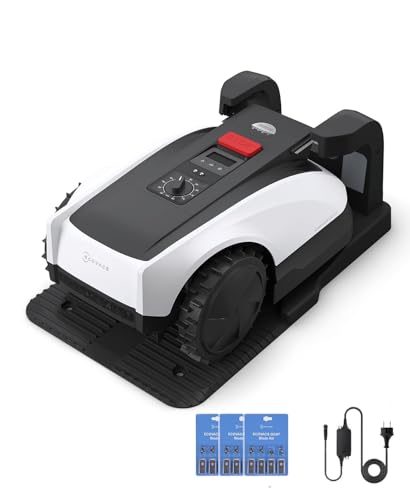
| ECOVACS Goat A2000 | Dense-tree yards where GPS signal is unreliable | $1,399 |
| YARDCARE V100 | First-time buyers with small, sunny, flat lawns | $399.99 |
| ECOVACS Goat O1000 | Quarter-acre lots with clear sky access | $664 |
| MOVA LiDAX Ultra 1000 | Complex multi-zone properties without RTK dependency | $999 |
How We Picked
We evaluated these eight models on four criteria: navigation technology and redundancy (the primary differentiator in this generation of wire-free mowers), slope and terrain handling capability (a mower that cannot climb your hill is useless regardless of software), cut quality and edge coverage (the spec owner complaints cite most often), and price-to-coverage ratio (whether the rated acreage realistically fits your property shape and not just its square footage).
The 8 Best Robot Lawnmower in 2026
WORX Wire-Free 1/4 Acre
The WORX targets owners of modest, rectangular lawns who want wire-free mowing without spending over $800. Owner feedback praises its brush-based navigation as adequate on open grass with few obstacles. It installs quickly without perimeter boundary work, and cutting-height adjustment from the app is straightforward. The downside: on yards with flower beds, tight corners, or slopes beyond gentle, the single-camera system loses its bearings and leaves visible uncut patches. Skip it if your property has more than one mature tree or an irregular fence line.
- Pro: Fast setup with no boundary wire required
- Pro: Simple app-based height adjustment
- Con: Single-camera navigation fails on complex terrain
LEBOSBO V3 AI Vision
At $399.99, the LEBOSBO V3 is a proof-of-concept robot mower for buyers testing the category with minimal financial risk. The price is the lowest viable entry among AI-vision units, and setup documentation is clear enough for a non-technical homeowner. The consistent con from owner reviews: navigation becomes unreliable on anything larger than a perfectly flat, obstacle-free section. Edges get missed, and the unit occasionally traps itself on minor bumps. Skip it entirely if your lawn exceeds 1,600 square feet or has any grade—this is a simplicity play, not a serious mowing solution.
- Pro: Lowest price among AI-vision mowers
- Pro: Beginner-friendly setup
- Con: Poor navigation consistency beyond flat, open ground
Segway Navimow X430
The Navimow X430 is the most capable mower in this roundup by a wide margin. It handles 84% slopes with 4WD, delivers zero-turn precision that prevents turf scarring, and its twin 180-watt motors cut through thick growth without stalling. The adjustable cutting-height range of 0.75 to 4 inches lets you switch from formal to meadow aesthetics, and the rated coverage comfortably handles properties that defeat every other unit here. The real con is price: $2,249 is a serious commitment, and zone-mapping setup adds time. Skip it if your yard is under half an acre—you are paying for headroom you will never use.
- Pro: 84% slope rating with 4WD handles terrain no competitor matches
- Pro: Wide 0.75–4 inch cutting-height range for style flexibility
- Con: $2,249 price tag and complex initial mapping
Sunseeker X5 AWD
The X5 occupies the sweet spot for buyers with a half-acre property, moderate slopes, and a budget under $1,400. RTK positioning combined with Vision AI provides two independent navigation layers, which owner reviews credit with noticeably better reliability than single-system units on tree-heavy lots. All-wheel drive handles wet mornings and slight inclines without wheel-spin, and the wire-free setup eliminates the boundary-wire step. The con: 0.5-acre coverage is tight. A long driveway turnaround or a side strip puts you near the limit. Skip it if your property is larger or heavily wooded—look at the Segway or ECOVACS A2000 instead.
- Pro: Dual-layer navigation (RTK plus vision) for consistent path reliability
- Pro: AWD handles wet and sloped conditions without losing traction
- Con: 0.5-acre coverage ceiling limits complex properties
ECOVACS Goat A2000
The dual LiDAR system makes the A2000 the natural choice for yards with dense tree canopy where satellite positioning degrades. LiDAR does not care whether you can see the sky, and owners report consistent navigation under mature oaks and pines where RTK units drift noticeably. The con is situational: $1,399 is a premium price for a capability that becomes irrelevant on open lawns. Buying it without a canopy problem is overspending. Skip it if your yard is mostly open grass—the ECOVACS Goat O1000 at $664 covers that scenario for nearly half the money.
- Pro: Dual LiDAR penetrates heavy tree canopy where RTK fails
- Pro: Consistent owners report reliable navigation under mature trees
- Con: Premium price unjustified on open-lawns without shade problems
YARDCARE V100
Tied with the LEBOSBO at $399.99, the YARDCARE V100 relies on HD vision alone for lawns up to 1,600 square feet. The camera resolves obstacles sharply in good lighting, and the price removes nearly all purchase anxiety for a first-time buyer. The critical limitation: owners with any tree cover or evening mowing schedules report navigation failures the camera cannot overcome in low light. Unlike LiDAR or RTK, vision is time- and weather-dependent. Skip it if you plan to run the mower at dawn, dusk, or under partial shade—choose the RTK-based ECOVACS O1000 instead.
- Pro: Tied for lowest price among current AI-vision options
- Pro: Sharp obstacle detection in bright conditions
- Con: Navigation collapses in low light or under tree cover
ECOVACS Goat O1000
At $664, the Goat O1000 delivers RTK navigation for a quarter-acre lot, making it the best value among positioning-reliable mowers. RTK accuracy means predictable paths and fewer missed strips along borders, and the price undercuts nearly every competitor in this size bracket. The con: RTK requires clear sky access. Dense canopy or tall structures that block satellite signals degrade performance the same way they degrade any GPS-based unit. Skip it if trees cover more than roughly half your lawn—the dual-LiDAR A2000 is the better tool for that environment.
- Pro: RTK precision at a sub-$700 price point is category-leading value
- Pro: Predictable mowing paths reduce missed-border complaints
- Con: Requires clear sky; tree canopy degrades positioning
MOVA LiDAX Ultra 1000
The MOVA packs 360-degree 3D LiDAR, AI vision, and zero-edge cutting into a $999 wire-free package. Up to 150 managed zones with dual maps handle multi-section yards that defeat single-map competitors, and the 1.2-to-3.9-inch cutting range plus 45% slope rating cover most real-world geometries without RTK dependency. The con: $999 is not cheap, and the multi-sensor stack generates setup data that owners describe as fiddly during initial mapping. Skip it if your yard is a simple rectangle—zone management is overkill for one clean plot.
- Pro: 150 zones and dual maps handle multi-property and complex layouts
- Pro: LiDAR plus vision provides navigation redundancy without RTK
- Con: Initial mapping and data setup adds complexity
Buying Guide
Navigation Type Is the Single Most Important Spec
Wire-free mowers use three positioning methods, sometimes in combination. RTK (real-time kinematic) relies on satellite signals and needs clear sky; it delivers the most predictable paths on open lawns but fails under canopy. LiDAR builds a 3D map from reflected laser pulses, works in darkness and under trees, but carries a price premium. Vision-based systems use cameras to detect grass and obstacles, are the cheapest, but degrade in low light and against complex textures. If your yard has mature trees, prioritize LiDAR or dual-sensor units. If it is open and sunny, RTK gives you the best path consistency per dollar. Single-vision units should only serve small, flat, well-lit patches.
Slope Rating and Drive Configuration
Manufacturer slope ratings are the number most often contradicted by owner experience. A mower rated for a certain grade will handle it dry and slow, but wet grass effectively halves usable traction. Two-wheel-drive units struggle on anything beyond a gentle incline; all-wheel drive or 4WD configurations with higher motor output maintain grip where wheel-spin would otherwise stall progress. Check the drive type alongside the slope rating—these specs together tell you whether the machine can actually complete a mowing cycle on your terrain, especially in spring and autumn when mornings are damp.
Edge Coverage and Cutting-Height Flexibility
Owner complaints about uncut strips along fences, beds, and walls are the most common recurring frustration across this category. Zero-edge or zero-turn cutting designs position the blade closer to the perimeter and reduce or eliminate these gaps. If your yard has a formal border, flower beds, or a close-cut aesthetic requirement, prioritize units with edge-focused cutting geometry over those that simply rate high on acreage. Cutting-height range matters for the same reason: a mower limited to a narrow band near the top cannot adjust to seasonal growth, thatch buildup, or a desired lawn look. Broader ranges give you more options across the growing season.
Our Verdict
Top pick: The Segway Navimow X430 is the most capable robot lawnmower in this group by a wide margin. Its 84% slope handling, 4WD, twin-motor power, and zero-turn precision make it the only unit here that will not be defeated by terrain. If your budget stretches that far and your property is complex, nothing else in this list comes close.
Budget pick: The ECOVACS Goat O1000 at $664 offers the best navigation reliability per dollar among the affordable options. RTK positioning on a quarter-acre lot with clear sky access is a genuinely practical, dependable setup that outperforms every sub-$500 vision-only unit on consistency.
Condition where another wins: If your property is heavily wooded and RTK is unreliable, the ECOVACS Goat A2000’s dual LiDAR becomes the smarter choice despite its higher cost—tree canopy is the one environment where LiDAR decisively outperforms every other method here.
FAQ
Do robot lawnmowers still need a perimeter wire?
Most current models, including all eight on this list, are wire-free and use GPS, RTK, LiDAR, or camera-based positioning instead. Some older or entry-level units still offer a boundary-wire option, but the 2026 market has largely moved past it. Wire-free does not mean setup-free—you still map zones and define keep-out areas via an app.
How much maintenance does a robot mower require?
Maintenance is minimal compared to a gas or electric push mower: clean the underside after heavy cuts, check blade sharpness periodically, and store the charging station in a sheltered spot during winter. Blades are small and cheap to replace. The primary maintenance task is keeping sensors and cameras clear of grass clippings and mud so navigation stays accurate.
Can a robot mower handle tall or overgrown grass?
Most robot mowers are designed for regular maintenance cutting and struggle if grass is allowed to grow significantly above the cutting height. Units with higher motor output and wider cutting-height ranges, like the Navimow X430, can manage taller growth better than budget models. For an overgrown lawn, mow it down manually first, then let the robot maintain it.
Is robot mowing safe around children and pets?
Robot mowers have blade guards, lift sensors, and obstacle detection that make them safer than a push mower left on a lawn. Most models stop blades within seconds if lifted or if an object is detected nearby. However, no mower is fully childproof—teach young children not to touch or ride the unit, and use app-based scheduling to avoid running it during playtime if you are uneasy.