Key takeaways
- Pro: Integrated brush system trims edges during normal operation, reducing the need for a separate string trimmer.
- Pro: Wire-free setup means no boundary loop to bury or repair when you reorganize flower beds.
- Con: Coverage capped at a quarter acre, so it falls short for larger properties.
A robot lawn mower promises to give you back the hours you used to lose to a push mower or a noisy riding deck. The problem is that not every model on the market delivers on that promise equally. Early units dragged perimeter wires across the yard, got confused by a garden hose, or left large patches of unmowed grass while their owners assumed everything looked fine. Today’s best units solve those frustrations with camera vision, LiDAR mapping, RTK satellite positioning, or some combination of all three — but the price spread is enormous, and the feature names can make it hard to know which technology actually matters for your specific lawn.
What separates a worthwhile robot lawn mower from a disappointing one comes down to a handful of things: how reliably it maps and covers your grass without human babysitting, how well it avoids obstacles without leaving trim marks on flower beds, how it handles slopes and uneven terrain, and whether the cutting width and coverage area justify the sticker price. A model that looks impressive on a spec sheet can still frustrate owners if its navigation stumbles in shade, under tree canopies, or around furniture. We compared every product in this roundup on published specs, listed prices, and recurring themes in owner feedback to help you match the right machine to your yard without wasting money on capability you do not need or underbuying into a robot that will quit on you by August.
Our top picks




As an Amazon Associate we earn from qualifying purchases at no extra cost to you.
Quick Picks
| Product | Best for | Price |
|---|---|---|
| WORX Wire-Free with Brushes | Owners who want edge work included | $799.99 |
| LEBOSBO V3 AI Vision | Small-lawn budgets under $400 | $399.99 |
| ECOVACS Goat A2000 LiDAR PRO | Medium lawns needing precise navigation | $1,399 |
| Segway Navimow X430 | Large properties and steep slopes | $2,249 |
| ECOVACS Goat O1000 RTK Care | Best value RTK under $700 | $664 |
| Sunseeker X5 AWD | Half-acre yards wanting all-wheel drive | $1,384 |
| ECOVACS Goat O1000 LiDAR PRO | Quarter-acre yards wanting built-in edging | $999 |
| YARDCARE AI Vision | Smallest budgets with camera navigation | $399.99 |
How We Picked
We evaluated each model on four criteria that consistently drive owner satisfaction or frustration. First: navigation technology and reliability, because a robot that re-maps poorly or loses signal under tree cover creates more work than it saves. Second: coverage area relative to price, so you are not paying for capability your lawn will never use. Third: obstacle avoidance quality, which separates a set-it-and-forget-it mower from one that needs daily intervention. Fourth: terrain handling, specifically slope tolerance and whether all-wheel or 4WD drive is included, since even a quarter-acre yard with a grade can stall a two-wheel robot repeatedly.
The 8 Best Robot Lawn Mower in 2026
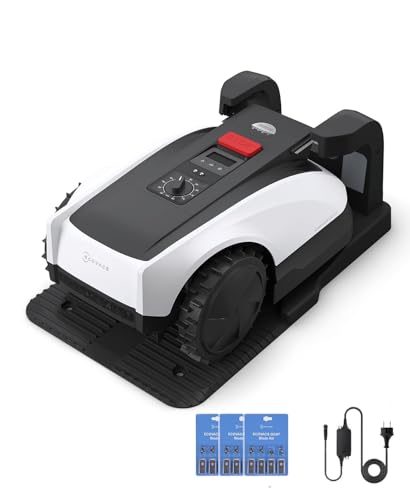
WORX Robot Lawn Mower for 1/4 Acre, Wire-Free with Brushes
Designed for owners with modest lawns who also want clean edges without pulling out a separate trimmer. The built-in brushes handle perimeter cleanup as part of the mowing cycle, saving you an extra step each week.
- Pro: Integrated brush system trims edges during normal operation, reducing the need for a separate string trimmer.
- Pro: Wire-free setup means no boundary loop to bury or repair when you reorganize flower beds.
- Con: Coverage capped at a quarter acre, so it falls short for larger properties.
Skip this if your yard exceeds a quarter acre or if you need aggressive slope handling; the single-motor platform is tuned for flat, contained spaces.
LEBOSBO V3 AI Vision Robotic Lawn Mower
For homeowners with a small, simple lawn who want to dip into robot mowing without spending more than a basic gas trimmer. The AI Vision camera handles navigation without perimeter wires, which keeps setup to a matter of minutes.
- Pro: Under $400 pricing makes it one of the cheapest entry points into camera-guided robot mowing.
- Pro: 1600-square-foot coverage fits most urban and townhouse lawns comfortably.
- Con: Camera-only navigation can struggle in heavy shade or low-light conditions common under mature trees.
Pass on this if your lawn has more than a handful of obstacles, slopes steeper than a gentle grade, or dense tree canopy that shadows the camera frequently.
ECOVACS Goat A2000 LiDAR PRO Robot Lawn Mower
Suits owners with a medium-sized, complex lawn who want map precision without paying for a full-coverage flagship. Dual LiDAR sensors build and maintain a spatial model that does not degrade when light conditions change.
- Pro: Dual LiDAR navigation produces consistent coverage paths even in shaded or overcast conditions where camera-only units falter.
- Pro: Higher-than-average coverage area places it between small-yard units and large-lawn flagships in value.
- Con: Price sits well above comparable RTK-equipped rivals from the same family.
Skip it if your lawn is flat, open, and under a quarter acre — a cheaper RTK model will cover you with less complexity.
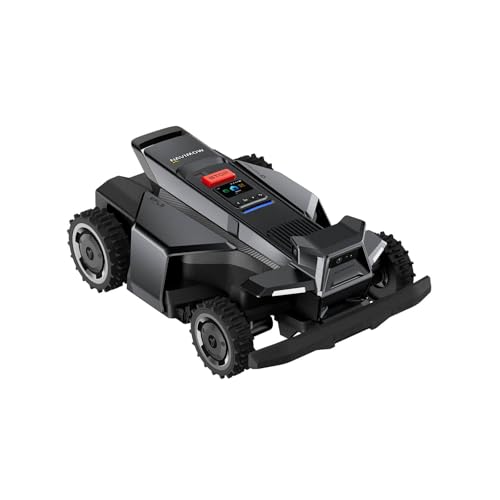
Segway Navimow X430 Robot Lawn Mower
Built for large properties with challenging terrain. The 4WD drivetrain and 84-percent slope rating put it in a class of its own for yards with significant grades, and the zero-turn design prevents the raking damage that conventional turning radii cause on soft spring turf.
- Pro: Twin 180-watt motors and 4WD deliver confident traction and cutting power on slopes that stall two-wheel competitors.
- Pro: Cutting height range of 0.75 to 4 inches lets you switch between a manicured look and a taller, drought-tolerant setting.
- Con: The $2,249 price demands a property large enough to justify it; owners with smaller lawns will never use the full acre coverage.
Not worth it if your yard is flat and under half an acre — you are paying for terrain capability you will not need.
ECOVACS Goat O1000 RTK Care Robot Lawn Mower
The value pick for quarter-acre owners who want satellite-guided accuracy without paying flagship prices. RTK navigation keeps the mower on a fixed grid pattern, which produces more uniform coverage than random-bounce units.
- Pro: At $664 it undercuts nearly every other RTK-equipped robot lawn mower by a wide margin.
- Pro: Wire-free RTK setup avoids the boundary-loop maintenance headaches that plagued earlier models.
- Con: Coverage is limited to a quarter acre, so it is genuinely unsuitable for larger plots.
Skip this if your property has tall structures or dense tree cover that can intermittently block the RTK satellite signal, causing navigation confusion.
Sunseeker X5 AWD Robot Lawn Mower
Targets half-acre owners who want all-wheel drive and dual navigation (RTK plus Vision AI) in a single package. The combination means the robot can fall back on its camera when the satellite signal weakens under canopy or near buildings.
- Pro: AWD drivetrain handles moderate slopes and soft ground that would bog down two-wheel competitors at this price point.
- Pro: Dual navigation (RTK and Vision AI) provides redundancy that most rivals in this price bracket lack.
- Con: At $1,384 you are paying a premium that a smaller, simpler robot could match for a flat lawn.
Not the best choice if your yard is flat and open — the AWD and dual navigation add cost without meaningful benefit in those conditions.
ECOVACS Goat O1000 LiDAR PRO Robot Lawn Mower
For quarter-acre owners who want precise mapping, obstacle avoidance, and built-in edge trimming without the price tag of the larger A2000. The dual-LiDAR system avoids the light-dependency issues that camera-only units face, and the edge-trimming feature rounds out the weekly mowing task.
- Pro: Built-in edge trimming eliminates a separate perimeter task, which owner reviews consistently call the most tedious part of robot-mowing ownership.
- Pro: App control with AI obstacle avoidance lets you set zones and restrictions from a phone rather than walking the yard with boundary tape.
- Con: The $999 price is nearly double the RTK Care model’s cost for the same coverage area, a premium you pay for LiDAR precision and edging.
Skip it if you already own a trimmer and do not care about the edge feature — the RTK Care variant covers the same lawn for less money.
YARDCARE AI Vision Robotic Lawn Mower
Functionally a mirror of the LEBOSBO V3 in price and coverage, aimed at small-lawn owners who want camera navigation without wires. The Dark Grey finish blends into garden furniture and patio surroundings better than the Brighter units.
- Pro: $399.99 pricing with AI Vision and no perimeter wire keeps total ownership cost low from day one.
- Pro: 1600-square-foot coverage is well matched to suburban townhouse and cottage lawns.
- Con: Single-camera navigation offers no redundancy when the lens is obstructed by rain, pollen, or shadow.
Pass if your lawn is irregular in shape, heavily shaded, or has permanent structures that frequently block the camera’s field of view.
Buying Guide
Navigation Technology: RTK vs. LiDAR vs. Vision AI
The single biggest differentiator among current robot lawn mowers is how the unit knows where it is. RTK uses satellite positioning with ground correction, producing a fixed grid pattern that delivers uniform coverage but can lose signal under dense canopy or near tall walls. LiDAR builds a 3D spatial map using laser sensors, working equally well in shade and darkness but at a higher component cost. Vision AI relies on onboard cameras and image recognition, which keeps prices down but introduces light dependency. Many premium models combine two systems for redundancy. Match the technology to your yard’s exposure: open and sunny favors RTK, heavily wooded favors LiDAR, and budget-conscious owners can accept Vision AI if the lawn is small and simple.
Drivetrain and Slope Handling
A robot lawn mower that cannot maintain traction on your hillside is a robot that will stop mowing every rainy spring. Two-wheel drive is fine for flat or gently undulating lawns. All-wheel drive adds confidence on moderate grades and soft ground. True 4WD with a high slope rating — the Segway X430’s 84 percent is the extreme end — is what you need for steep, uneven properties. Look for zero-turn capability if you want to avoid the scuffing that tight-radius turns leave on damp turf.
Cutting Width, Height Range, and Coverage Rating
Manufacturers rate coverage in acres or square feet, and you should buy with at least twenty to thirty percent headroom over your actual lawn size to account for the mower’s travel time back to its dock. A wider cutting deck means fewer passes and faster cycles. Cutting-height range determines versatility: a 0.75-to-4-inch span lets you shift between a tight show-lawn setting and a taller, more forgiving height during summer drought stress. If you prefer a manicured look, prioritize models with narrow height adjustment steps rather than just a wide range.
Our Verdict
Top pick: The Segway Navimow X430 is the most capable robot lawn mower on this list, and for owners with a large or sloped property its 4WD, 84-percent slope rating, and one-acre coverage make it worth every dollar of the $2,249 price. Budget pick: The ECOVACS Goat O1000 RTK Care wins decisively under $700, delivering satellite-guided precision on a quarter acre without the LiDAR premium. Conditional winner: If your lawn is flat, shaded, and you want built-in edge work without a separate trimmer, the ECOVACS Goat O1000 LiDAR PRO justifies its higher price over the RTK Care model by keeping the camera-independent navigation and the edging brushes.
FAQ
Do robot lawn mowers still need a boundary wire?
No — every model in this roundup operates wire-free, using RTK satellite positioning, LiDAR mapping, or AI Vision cameras to define the mowing area. Boundary wires are now found mostly on older or very low-cost units, and the shift to wireless navigation is one of the biggest practical changes in this category.
Will a robot lawn mower work on a sloped yard?
It depends on the drivetrain and the slope rating. Two-wheel-drive models handle gentle grades but will stall or slip on anything steeper than a moderate hill. All-wheel-drive and 4WD units, like the Segway X430 and Sunseeker X5, are specifically engineered for significant inclines. Check the published slope rating against your yard’s steepest section before buying.
What is the real difference between RTK and LiDAR navigation?
RTK uses satellite signals with a ground antenna for precise, grid-pattern coverage, but it can lose lock under heavy tree canopy or next to tall buildings. LiDAR uses spinning laser sensors to build a 3D map of the environment and works independently of light or sky visibility. RTK units are generally less expensive; LiDAR units carry a price premium but perform more consistently in shaded or obstructed yards.
Can a robot lawn mower handle my flower beds and garden furniture?
Modern models with AI obstacle avoidance, such as the ECOVACS LiDAR PRO variants, will detect and route around most objects. However, very thin stems, low garden borders, and furniture placed at the edge of the mowing zone can still cause the robot to trim plants it should miss. The WORX’s brush system is designed to work edges deliberately, while other owners typically add physical barriers or keep beds outside the mapped area.