
Key takeaways
- Pro: Up to 50 minutes of runtime across both batteries handles most small yards in a single session.
- Pro: Lightweight push design is easy to maneuver around flower beds and tight corners.
- Con: At $356.99 it costs more than several gas-powered competitors with larger decks.
What's inside
Choosing a Craftsman lawn mower or a capable alternative means matching power, deck size, and runtime to your actual yard — not the idealized version you picture at the store. Small flat lots and large sloped lawns demand completely different setups, and buying the wrong one means either wasting money on overkill features or fighting a machine that can’t handle terrain or grass height beyond its limits.
What separates a good mower from a mediocre one in this price range comes down to a handful of things: whether the engine or motor actually delivers on its displacement or voltage claims, how many height adjustments you get and how easy they are to change mid-mow, and whether the deck width lets you finish in a reasonable number of passes. Owner feedback consistently flags flimsy bagging systems and unreliable pull-starts as the two biggest letdowns, so we paid close attention to which models avoid those common complaints.
As an Amazon Associate we earn from qualifying purchases at no extra cost to you. Product prices and availability are accurate as of the date shown and are subject to change.



Quick Picks
| Product | Best for | Price |
|---|---|---|
| CRAFTSMAN V20 20 in (CMCMW220P2) | Small-to-medium yards, cordless convenience | $356.99 |
| PowerSmart 21″ Self-Propelled Gas | Slopes and medium yards | $275.49 |
| PowerSmart EasyCut 18″ | Small yards on a tight budget | $169.99 |
| PowerSmart EasyGlide 21″ | General-purpose push mowing | $279.99 |
| PowerSmart 22″ Self-Propelled Gas | Larger yards needing self-propulsion | $289.99 |
| Greenworks 48V 20″ | Medium yards, cordless with power | $329.99 |
| MZK 20V 13″ | Tiny yards, storage-limited owners | $119.98 |
| CRAFTSMAN V20 Dethatcher (CMCOE210B) | Lawn health, thatch removal | n/a |
How We Picked
We evaluated each option across four criteria: deck width relative to price, power delivery (engine cc or battery voltage and amp-hours), number and usability of height adjustments, and bagging or mulching versatility. For gas models, we also looked at whether the manufacturer specifies a proven 4-cycle or OHV configuration, since pull-start reliability is the most cited complaint on budget engines. Owner feedback from verified buyers on retail sites was weighted for long-term durability notes over initial unboxing enthusiasm.
The 8 Best Craftsman Lawn Mower in 2026
CRAFTSMAN V20 20 in Lawn Mower (CMCMW220P2)
This is the go-to for anyone with a small-to-medium yard who wants to skip oil changes and gas storage entirely. The brushless motor is the standout feature — it runs longer per charge than brushed alternatives and generates less friction heat during extended mowing. Two 5Ah batteries and two chargers are included, so you can swap batteries without waiting for a recharge, and the low-profile deck slides under fences and garden beds that block taller mowers.
- Pro: Up to 50 minutes of runtime across both batteries handles most small yards in a single session.
- Pro: Lightweight push design is easy to maneuver around flower beds and tight corners.
- Con: At $356.99 it costs more than several gas-powered competitors with larger decks.
Skip it if your yard exceeds a quarter acre or has steep inclines — a self-propelled or gas-powered option will save you effort and time.
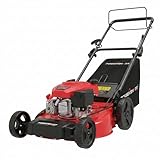
PowerSmart 21″ Self-Propelled Gas Lawn Mower
The rear-wheel drive is the defining feature here, and for sloped terrain it’s a meaningful advantage over front-drive or push-only models because it puts more weight on the drive wheels. The 170cc OHV engine is a solid displacement class for residential mowing, and the 3-in-1 system covers bagging, mulching, and discharge without requiring a second machine.
- Pro: Six cutting heights give fine-tuned control for seasonal grass length changes.
- Pro: Durable steel deck resists denting from hidden toys or garden edging.
- Con: No battery backup means you’re tied to gas storage and seasonal maintenance.
Skip it if your yard is flat and under a tenth of an acre — a push model or the MZK would serve you better at lower cost.
PowerSmart EasyCut 18-Inch Gas Lawn Mower
At $169.99 this is the cheapest functional gas mower in our roundup, designed for small yards where an 18-inch deck means fewer passes than a 13-inch model but still fits through narrow side gates. The 144cc 4-cycle engine is the right size class for this deck width — anything smaller would bog in thick grass, anything larger would be overkill.
- Pro: Side discharge keeps the mowing path clear without the weight and hassle of a bag.
- Pro: Five height positions cover the range most small-yard owners actually need.
- Con: No mulching mode means clippings stay visible until you collect or rake them.
Skip it if you have more than a tenth of an acre or need bagging — you’ll want a larger deck and 3-in-1 capability.
PowerSmart EasyGlide 21-Inch 3-in-1 Push Gas Lawn Mower
This model sits in the sweet spot between the budget EasyCut and the self-propelled options — you get a 21-inch deck and full 3-in-1 versatility at a push-mower price. It’s a straightforward choice for flat-to-gently-sloping medium yards where the owner doesn’t mind providing their own propulsion but wants flexible discharge options.
- Pro: 3-in-1 capability at $279.99 means one machine covers bagging, mulching, and side discharge.
- Pro: 21-inch deck reduces mowing time compared to narrower budget models.
- Con: Push-only design demands physical effort on anything beyond a flat surface.
Skip it if your yard has noticeable slopes — the self-propelled PowerSmart models at similar prices are worth the small upgrade.
PowerSmart 22-Inch Self Propelled Gas Lawn Mower
This is the widest and most powerful gas option in the PowerSmart lineup we reviewed, with the same 170cc OHV engine as the 21-inch model but a larger deck that covers more ground per pass. For half-acre yards or owners who want to finish mowing in under an hour, the extra cutting width makes a real difference in total time spent.
- Pro: 22-inch deck is the largest here among gas models, ideal for open medium-to-large yards.
- Pro: Six height adjustments and 3-in-1 operation cover every residential mowing scenario.
- Con: Self-propelled plus a wide deck adds weight that makes storage and transport harder.
Skip it if storage space is tight or your yard has many obstacles — the narrower push models are easier to maneuver.
Greenworks 48V (24V x 2) 20in Push Lawn Mower
The dual-24V-battery configuration delivering 48V combined is an interesting approach to matching gas power without fuel, and the 4.0Ah batteries included in the kit provide solid runtime for a 20-inch deck. It’s a direct competitor to the CRAFTSMAN V20 at a similar deck width but slightly lower price.
- Pro: $329.99 undercuts the CRAFTSMAN equivalent while offering comparable voltage and deck size.
- Pro: 48V combined power handles dense grass better than single-battery 20V models.
- Con: Push-only design requires more physical effort than the self-propelled gas alternatives.
Skip it if you need maximum runtime — the included 4.0Ah batteries are smaller-capacity than the CRAFTSMAN’s 5Ah packs.
MZK 20V 13-Inch Electric Lawn Mower
The smallest mower in our list at $119.98, the 13-inch deck and 20V brushless motor make this a niche option for very small yards, rooftop gardens, or owners with severe storage constraints. It’s not a main-yard solution for anyone, but for a 2,000-square-foot patch of grass it’s the lowest-friction option available.
- Pro: Compact size and light weight make it trivially easy to store and carry.
- Pro: Brushless motor means longer lifespan and consistent power without brush replacement.
- Con: 13-inch deck means many more passes than any other mower here.
Skip it if your yard exceeds 3,000 square feet — the deck width will make mowing a tedious multi-hour process.
CRAFTSMAN V20 Brushless RP Lawn Dethatcher and Scarifier (CMCOE210B)
This is a tool-only cordless dethatcher sharing the CRAFTSMAN V20 battery platform, so if you already own a V20 mower or other V20 tool, the batteries cross over. The 14-inch deck and 50L collection bag handle thatch removal for medium lawns, and up to 45 minutes of runtime is adequate for a standard suburban lot.
- Pro: Compatible with the same V20 batteries as the CRAFTSMAN mower, reducing total battery purchases.
- Pro: 50L bag is large enough to finish most yards without mid-session emptying.
- Con: Tool-only kit means no batteries or charger included, adding to the real cost.
Skip it if you don’t already have V20 batteries — buying cells separately can push total cost above a dedicated gas dethatcher.
Buying Guide
Deck Width and Yard Size Matching
Deck width is the single biggest time-saver or time-loser on a mower. A 13-inch deck like the MZK’s will require roughly 50-60% more passes than a 20-inch deck on the same yard. Match width to your longest straight run: for a yard narrower than 30 feet, a 13-to-18-inch deck works fine. For 30-to-50-foot runs, go 20-22 inches. Wider decks also cost more and weigh more, so only go wide if your yard actually has the space to benefit.
Battery Voltage vs. Engine Displacement
Cordless mowers use voltage and amp-hours to deliver power; gas mowers use cubic centimeters of displacement. A 48V combined system with 5Ah cells (like the CRAFTSMAN V20) or dual 4.0Ah cells (like the Greenworks) delivers enough torque for typical residential grass up to about 6 inches tall. If your grass regularly exceeds 8 inches or is dense fescue, a 170cc OHV gas engine will cut more consistently without bogging down.
Drive Type and Terrain
Push mowers work on flat ground but become physically taxing on slopes over 10 degrees. Rear-wheel drive (as on the PowerSmart 21-inch self-propelled model) is superior to front-wheel drive on slopes because the operator’s weight loads the drive wheels, preventing wheel spin. If your yard is mostly flat, a push model saves you the price premium and weight of a self-propelled drivetrain.
Our Verdict
The CRAFTSMAN V20 20-inch is the top pick for most readers searching for a Craftsman lawn mower: it balances power, runtime, convenience, and build quality without the maintenance overhead of gas. For the budget pick, the PowerSmart EasyCut 18-inch at $169.99 delivers real gas power and a usable deck width at the lowest functional price here. If your yard is sloped, the PowerSmart 21-inch self-propelled model wins outright regardless of brand preference, because rear-wheel drive on a slope is a practical necessity rather than a luxury.
FAQ
Is the CRAFTSMAN V20 mower good enough for a half-acre yard?
It’s borderline. With up to 50 minutes of runtime across both batteries, a 20-inch deck can cover roughly a quarter-acre per charge cycle depending on grass height and speed. A half-acre yard would likely require a battery recharge mid-mow or multiple mowing sessions. For consistent half-acre coverage, a gas model or a higher-capacity cordless system is more practical.
Can I use CRAFTSMAN V20 batteries in the dethatcher if I buy the tool-only kit?
Yes. The dethatcher (CMCOE210B) is part of the V20 platform, so any CRAFTSMAN V20 battery you already own will fit and operate it. The tool-only designation simply means the package doesn’t include the battery or charger separately.
How do I decide between a push mower and a self-propelled model?
Check your yard’s slope angle and total area. Flat yards under a quarter-acre are fine with push mowers. Anything steeper than a gentle grade or larger than a third of an acre benefits meaningfully from self-propulsion, which reduces operator fatigue and keeps cutting speed consistent without you providing all the forward force.
What’s the main downside of cordless mowers compared to gas?
Runtime and power under heavy load. Even the best cordless models in this roundup max out around 50 minutes, and thick wet grass can reduce effective runtime further. Gas engines don’t have a runtime ceiling — you refill and keep going — and higher-displacement engines like the 170cc OHV models maintain torque through dense growth better than any battery platform at these price points.


