Key takeaways
- Holes, not hopes: pots under 12 inches need at least one ½–¾-inch hole; pots 16 inches and up need three or more. Many decorative resin and ceramic pots ship with a marked drill point — drill it before planting.
- Skip the gravel layer. Rocks at the bottom of a pot do not improve drainage — they raise the saturated zone closer to the roots. A pot with holes plus quality potting mix drains better than a pot with gravel.
- Use cachepots for hole-less containers. Keep the plant in a plastic nursery pot and drop it inside the decorative one; lift it out to water, or tip out standing water after rain.
- Raise the pot. Pot feet or a plant caddy keep holes clear and prevent staining on porch decking. Bonus: a soaked 20-inch pot can weigh 50+ lb, so set the caddy first, then plant.
What's inside
The easiest front yard potted plant ideas come down to three numbers: a container at least 14–18 inches wide for anything you want to look full, at least one real drainage hole per pot, and plants rated for the sun your entryway actually gets — not the sun you wish it got. Below are the sizing rules, sun-rated picks, and copy-ready combinations for front doors, porch steps, and mailbox spots.
As an Amazon Associate we earn from qualifying purchases at no extra cost to you.
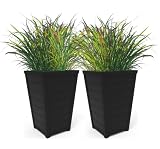


Match the Pot Diameter to the Spot
Most front-yard container failures are undersized pots. A 10-inch pot dries out in hours on a sunny step and swallows plants whole visually. Use this table to size containers by location before you buy anything.
| Spot | Recommended pot diameter | Soil volume (approx.) | Look that works best |
|---|---|---|---|
| Front door (matching pair) | 16–20 in each | 5–8 gal per pot | Symmetric thriller (evergreen or spike) + 2 filler colors max |
| Porch steps | 10–14 in, graduated sizes | 1.5–4 gal | One plant type per pot, repeated down the steps |
| Mailbox base | One 20–24 in, or a trio of 10–12 in | 10+ gal | Drought-tough sun lovers that survive missed waterings |
| Covered porch (low light) | 14–18 in | 4–6 gal | Bold foliage — ferns, hosta, coleus |
| Walkway / driveway edge | Cluster of 3 pots, 12–18 in | Mixed | Odd-number grouping, two repeated colors |
A useful sizing rule: pot diameter in inches divided by two roughly equals how many 4-inch nursery annuals fit for a full look — so a 16-inch pot takes about 6–8 plants, an 18-inch takes 8–9. Shrubs count differently: one dwarf evergreen or hydrangea fills an 18–24 inch pot on its own, with room for a thin ring of seasonal color at the base.
Drainage Rules That Actually Matter
Root rot kills more container plants than neglect. The non-negotiables:
- Holes, not hopes: pots under 12 inches need at least one ½–¾-inch hole; pots 16 inches and up need three or more. Many decorative resin and ceramic pots ship with a marked drill point — drill it before planting.
- Skip the gravel layer. Rocks at the bottom of a pot do not improve drainage — they raise the saturated zone closer to the roots. A pot with holes plus quality potting mix drains better than a pot with gravel.
- Use cachepots for hole-less containers. Keep the plant in a plastic nursery pot and drop it inside the decorative one; lift it out to water, or tip out standing water after rain.
- Raise the pot. Pot feet or a plant caddy keep holes clear and prevent staining on porch decking. Bonus: a soaked 20-inch pot can weigh 50+ lb, so set the caddy first, then plant.
Sun-Rated Plant Picks for the Front Yard
The most beautiful plants for front yard containers are simply the ones matched to your light. Count actual hours of direct sun at your spot between 9 a.m. and 5 p.m. before choosing.
Full sun (6+ hours): doors, steps, mailboxes
- Reliable bloomers: Supertunia petunias, Million Bells calibrachoa, lantana, geraniums (Pelargonium), verbena
- Height and structure: dracaena spike, dwarf fountain grass ‘Hameln’, salvia, rosemary
- Drought-tolerant spills: Dichondra ‘Silver Falls’, sedum ‘Angelina’, trailing portulaca
- Evergreen anchors: ‘Green Velvet’ boxwood, dwarf Alberta spruce
Part sun (3–5 hours): east-facing entries
- Dragon Wing begonias, ColorBlaze-type sun coleus, sweet potato vine, heuchera, fuchsia
- ‘Endless Summer’-type hydrangeas thrive in 20–24 inch pots here — a genuinely beautiful front-yard statement, but they wilt fast if the pot dries
Shade (under 3 hours): covered porches
- Boston ferns, hostas, caladiums, impatiens, torenia — lean on foliage color and texture rather than blooms
Four Copy-Ready Container Recipes
1. The can’t-miss sun combo — 18-inch pot
1 dwarf fountain grass (center) + 3 Supertunias (middle ring) + 2 Dichondra ‘Silver Falls’ (edge). Blooms from planting to frost; trim the silver falls if it swallows the pot rim.
2. The shaded porch pot — 16-inch pot
1 Boston fern or upright hosta + 4 impatiens around the base + 1 trailing torenia or creeping Jenny. Water less often than sun pots — soggy shade soil rots roots quickly.
3. The mailbox survivor — 22–24-inch pot
1 lavender ‘Munstead’ or rosemary + 3 lantana + 3 sedum ‘Angelina’. All tolerate missed waterings and reflected heat from pavement, which is what kills most mailbox plantings.
4. The year-round evergreen — 18–20-inch pot
1 dwarf Alberta spruce or ‘Green Velvet’ boxwood, underplanted by season: pansies in spring, impatiens in summer, ornamental kale in fall. You swap 4–6 cheap annuals three times a year instead of replanting the whole pot.
Watering, Feeding, and What Wears Out
Soil math: a 16-inch pot holds roughly 5 gallons (about 0.7 cubic feet) of mix, so a standard 1.5 cubic foot bag of potting mix fills about two pots. Always use potting mix — never garden soil, which compacts and smothers roots in containers.
Watering reality: full-sun pots in summer need daily water in heat waves, roughly until water runs freely from the drainage holes — about a gallon for a 16–18 inch pot. Self-watering planters (Mayne, Bloem Ariana, Crescent Garden’s TruDrop line are established options) stretch that to every 3–4 days via a built-in reservoir.
Feeding: mix a slow-release fertilizer (Osmocote-type, feeds about 4 months) into the top few inches at planting, then add a water-soluble feed every 1–2 weeks for heavy feeders like Supertunias and calibrachoa — they visibly pale and stall without it.
Durability notes by material: basic resin pots (typically $15–30 for 12–14 inch sizes) are light but dark colors fade after two or three summers of strong UV; fiberglass holds color better at roughly double the price. Glazed ceramic ($50–150 mid-sizes) chips and can crack in freezes. Terracotta breathes beautifully but must be emptied and stored dry before hard frost. Cast stone lasts decades but weighs enough that you plant it where it sits. Expect to refresh the top third of the potting mix each spring rather than replacing it all.
FAQ
Can I plant directly in a decorative pot with no drainage hole?
Don’t. Use it as a cachepot — plant in a plastic nursery pot that fits inside, and water by lifting the inner pot out or emptying overflow after rain. One forgotten rainstorm in a sealed pot drowns roots within days.
Which pots survive winter outside?
Fiberglass, thick resin, and cast stone handle freezes; terracotta and thin glazed ceramic usually don’t. For plants, choose evergreens rated two USDA zones colder than yours — roots in a pot freeze harder than roots in the ground.
How do I make cheap pots look intentional?
Repetition. Three identical 12-inch pots with the same plant read as a designed entry; three different pots with different plants read as clutter. Stick to two colors plus one foliage texture per grouping.