Key takeaways
- Choosing by exterior height only. A 24-inch-tall planter may have a planting opening only 12 inches wide. Check the top opening and interior depth before buying.
- Oversizing dramatically. A small root ball in a huge container stays wet too long, increasing the risk of root rot. Move up gradually.
- Forgetting drainage. A beautiful planter without drainage needs a removable nursery pot inside it. Never plant a live tree directly into a sealed decorative vessel unless you can manage water very carefully.
- Ignoring the base width. Tall, narrow containers can tip when paired with leafy or windswept trees. Select a wide base, add ballast, or use a heavier material.
- Buying for the current tree height alone. Root volume, trunk thickness, and canopy spread determine planter needs more accurately than height.
- Underestimating cost beyond the planter. Large planters can range from about $50 for lightweight plastic or resin styles to $190 or more for wheeled metal designs, before soil, drainage materials, and a plant caddy are added.
The Short Answer
For most small indoor trees, choose a planter that is 2 to 4 inches wider in diameter than the tree’s current nursery pot. A 10-inch nursery pot usually moves into a 12- to 14-inch planter; a 14-inch pot needs a 16- to 18-inch planter. For large patio trees, such as olive, citrus, ficus, or dwarf fruit trees, start with a 20- to 24-inch-wide container that holds roughly 20 to 30 gallons of soil.
When deciding what size planter for a tree to buy, width matters more than height. The planter should give the roots room to expand without leaving an excessive volume of wet, unused soil around the root ball. In general, use a container about one size larger at each repotting rather than jumping from a small pot to an oversized decorative planter.
Our top picks
 Kante Large 18" Round Concrete Planter
- 【Large 18" Concrete Planter for Statement Displays】: Create…
- 【Modern Bowl Design with Weathered Concrete Texture】: Featuring…
- 【Lightweight Concrete Blend Built for Durability】: Made with…


As an Amazon Associate we earn from qualifying purchases at no extra cost to you.
Also consider the finished weight. A 24-inch planter filled with moist potting mix, drainage material, and a tree can easily weigh 150 to 250 pounds. If it will live on a balcony, near an entry, or indoors on finished flooring, measure the space and confirm that the location can handle both its footprint and its weight.
Standard Sizes
Planter sizing is usually listed by top diameter or width. Tapered, square, and tall planters may have a smaller base, so always check the interior planting dimensions as well as the exterior measurements. The sizes below are practical starting points for common tree categories.
| Planter Size | Approximate Dimensions | Typical Soil Capacity | Best For |
|---|---|---|---|
| Small tabletop tree planter | 8–10 in. diameter x 8–10 in. high 20–25 cm diameter x 20–25 cm high |
1–3 gallons | Bonsai, young money trees, small citrus starts |
| Small floor planter | 12–14 in. diameter x 12–16 in. high 30–36 cm diameter x 30–41 cm high |
5–10 gallons | Young fiddle-leaf figs, dracaena, 3–5 ft. indoor trees |
| Medium tree planter | 16–18 in. diameter x 16–20 in. high 41–46 cm diameter x 41–51 cm high |
12–18 gallons | 5–7 ft. ficus, palms, rubber trees, larger houseplants |
| Large statement planter | 20–22 in. diameter x 20–28 in. high 51–56 cm diameter x 51–71 cm high |
20–25 gallons | 6–8 ft. indoor trees, small olive trees, entryway specimens |
| Extra-large patio planter | 24–30 in. diameter x 22–30 in. high 61–76 cm diameter x 56–76 cm high |
30–45 gallons | Citrus, olive, bay laurel, dwarf fruit trees, large palms |
An 18-inch round planter is a useful middle ground for a substantial indoor tree or compact outdoor specimen. For example, a concrete bowl-style planter in this size range can look grounded and architectural, but concrete is heavy before soil is added. A tall 22-inch planter creates more visual height and can suit an entryway, though its narrow base may hold less soil than a wide 22-inch round pot.
How to Measure Your Space
- Measure the tree’s current pot. Measure across the widest point of the nursery pot, then measure its height. Select a new planter 2 to 4 inches wider for a healthy tree being repotted. If the tree is root-bound, a 4- to 6-inch increase may be appropriate for larger containers.
- Measure the available floor area. Use painter’s tape to mark the planter’s full diameter or square footprint on the floor. Leave at least 6 inches between the planter and nearby furniture, walls, doors, or drapery. For a walkway, preserve 30 to 36 inches of clear passage.
- Account for the tree’s mature canopy. A planter may fit beside a sofa today while the branches do not. For indoor trees, leave 12 to 18 inches between foliage and walls where possible. This improves air circulation and prevents leaves from constantly brushing painted surfaces.
- Check vertical clearance. Measure from floor to ceiling, including the planter’s height. A 6-foot tree placed in a 24-inch planter reaches roughly 8 feet tall. Leave at least 12 inches beneath standard ceilings so the tree does not look crowded or require frequent pruning.
- Plan for a saucer, tray, or riser. Add 1 to 2 inches to the effective footprint for a water-catching tray. Outdoors, use pot feet or a rolling caddy to keep drainage holes clear and reduce staining on a patio.
- Estimate the loaded weight. Lightweight resin and fiberglass planters are easier to move than concrete, ceramic, or metal. A 30-gallon container can be too heavy to relocate once planted, so place it in its permanent position before adding soil.
By Room or Use Case
Living Room Trees
For a 4- to 6-foot fiddle-leaf fig, rubber tree, kentia palm, or dracaena, a 14- to 18-inch planter is usually the right range. Choose 14 inches for a tree currently in a 10- or 12-inch nursery pot, and 18 inches for one in a 14-inch pot. A low, wide planter is stable for top-heavy trees, while a tall planter gives a smaller tree more presence beside a chair or media console.
To avoid a cramped look, use a planter diameter that is roughly one-third to one-half the width of the furniture piece beside it. Next to a 72-inch sofa, a 16- to 22-inch planter generally feels balanced.
Entryway and Front Porch
Matching trees framing a front door need containers that are broad enough to resist wind and visually substantial enough for the architecture. For 4-foot artificial cedar trees, planters measuring 14 to 18 inches wide and at least 14 inches high are typically proportional. Artificial trees do not need root room, but they do need ballast. Add gravel, sandbags, or concrete pavers inside the planter base so each finished container weighs at least 25 to 40 pounds in a sheltered location, or more in a windy area.
For living evergreen trees, use 18- to 24-inch containers with drainage holes. Avoid placing a 6-foot tree in a 10-inch decorative pot; it can look undersized and may tip easily.
Patio Citrus and Olive Trees
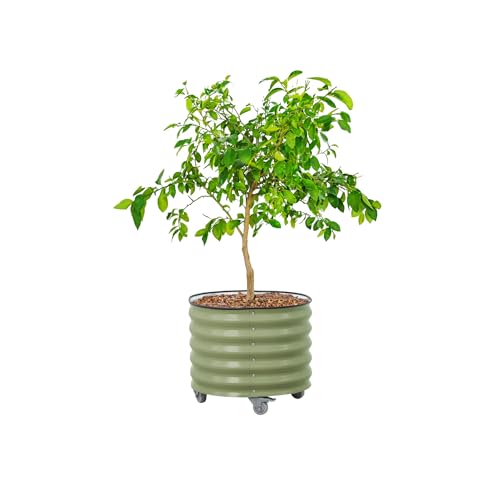
Citrus and olive trees need generous root volume, reliable drainage, and a stable base. A young tree can begin in an 18- to 20-inch container, but a mature patio specimen often needs a 24-inch planter holding about 30 gallons. A rolling 24-inch metal planter can be practical for moving a citrus tree into shelter during cold weather, but confirm that the wheels are rated for the fully planted weight.
For these sun-loving trees, choose a planter with several drainage holes rather than one tiny opening. Use a saucer only if necessary; standing water can damage roots. Metal planters can heat up quickly in direct summer sun, so consider a double-walled design, a liner, or a location with afternoon shade in very hot climates.
Balconies and Rooftops
Keep balcony planters conservative unless the building manager or structural professional has confirmed the load capacity. A 12- to 16-inch lightweight fiberglass or resin planter is often more realistic than a 24-inch concrete pot. Use dwarf varieties and keep the container close to a structural wall rather than at the outer edge. A 16-inch planter can still support a handsome 4- to 6-foot indoor-style tree, but it will require more frequent watering than a larger container.
Common Sizing Mistakes
- Choosing by exterior height only. A 24-inch-tall planter may have a planting opening only 12 inches wide. Check the top opening and interior depth before buying.
- Oversizing dramatically. A small root ball in a huge container stays wet too long, increasing the risk of root rot. Move up gradually.
- Forgetting drainage. A beautiful planter without drainage needs a removable nursery pot inside it. Never plant a live tree directly into a sealed decorative vessel unless you can manage water very carefully.
- Ignoring the base width. Tall, narrow containers can tip when paired with leafy or windswept trees. Select a wide base, add ballast, or use a heavier material.
- Buying for the current tree height alone. Root volume, trunk thickness, and canopy spread determine planter needs more accurately than height.
- Underestimating cost beyond the planter. Large planters can range from about $50 for lightweight plastic or resin styles to $190 or more for wheeled metal designs, before soil, drainage materials, and a plant caddy are added.
FAQ
How much bigger should a planter be than the tree’s root ball?
For most trees, choose a planter 2 to 4 inches wider than the current root ball or nursery pot. For a large, root-bound tree, increase by 4 to 6 inches. Avoid going much larger unless the tree species specifically needs a deep, roomy container.
Can a planter be too big for a tree?
Yes. An oversized planter holds more wet soil than a small root system can use. That soil dries slowly, which can lead to poor root health. A properly sized planter gives roots room to grow while still allowing the potting mix to dry at a reasonable rate.
What size planter do I need for a 6-foot tree?
Most 6-foot indoor trees need a 16- to 22-inch-wide planter, depending on the nursery pot and root mass. A compact tree in a 14-inch nursery pot may need an 18-inch planter, while a fuller palm or ficus may need a 20- to 22-inch option for stability.
Do tall planters need to be filled completely with soil?
No. If a tall decorative planter is deeper than the tree needs, place the tree in a nursery pot inside it and raise it with an upside-down plastic pot, sturdy riser, or planter insert. Do not use loose packing peanuts, which can shift and make watering uneven. Keep the nursery pot accessible so excess water can be emptied.