
Key takeaways
- Best overall automatic cover pump: Wayne WAPC250 (quarter-horsepower class, electronic sensor switch, strainer base).
- Best mid-range automatic cover pump: Little Giant APCP-1700 (about one-third horsepower class, float switch, three-quarter-inch hose connection).
- Best for faster cover removal: Acquaer quarter-horsepower automatic model (reported near 2,250 gallons per hour).
- Best for debris-heavy covers: Rule 1800 automatic (1,800 gallons per hour, strainer base).
- Best high-volume drain pump: AgiiMan 1 HP submersible (reported near 3,500 gallons per hour at no lift).
- Best budget manual option: Superior 91250 (1,800 gallons per hour class, manual operation).
For pool covers, the Wayne WAPC250 and the Little Giant APCP-1700 are the strongest automatic-shutoff choices, while the AgiiMan 1 HP submersible is the pick for emptying a whole pool quickly. The two jobs need different pumps: a cover pump removes a thin layer of rain or melt and shuts itself off, while a drain pump moves thousands of gallons and has to be watched the entire time it runs.
Buyers usually mix these up. A small automatic cover pump is built to sense an inch or two of water on a flat surface, push it through a garden hose and quit. A high-flow submersible is built for volume, usually has a plain float or manual switch, and will happily run dry if you walk away. This guide separates the two classes, gives the numbers you need to size either one, and shows how to estimate drain time for your own pool.
Our top picks
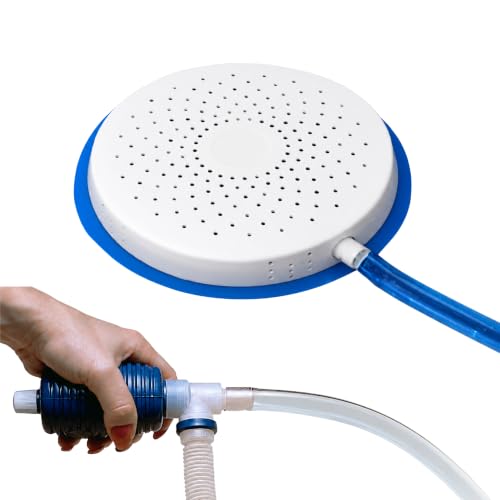


As an Amazon Associate we earn from qualifying purchases at no extra cost to you.
Quick Picks by Job
- Best overall automatic cover pump: Wayne WAPC250 (quarter-horsepower class, electronic sensor switch, strainer base).
- Best mid-range automatic cover pump: Little Giant APCP-1700 (about one-third horsepower class, float switch, three-quarter-inch hose connection).
- Best for faster cover removal: Acquaer quarter-horsepower automatic model (reported near 2,250 gallons per hour).
- Best for debris-heavy covers: Rule 1800 automatic (1,800 gallons per hour, strainer base).
- Best high-volume drain pump: AgiiMan 1 HP submersible (reported near 3,500 gallons per hour at no lift).
- Best budget manual option: Superior 91250 (1,800 gallons per hour class, manual operation).
How We Chose
This guide is based on research, not first-hand evaluation. We compared manufacturer specification sheets and published buyer comparisons, then checked that each named pump is still sold in 2026. Where two sources disagreed on a number, we describe the pump by its class (for example, “1,700 gallons per hour class”) instead of quoting a single figure. We weighted five criteria: whether the pump switches off automatically, the water level it leaves behind, rated flow, how much lift the hose run demands, and how easy the intake is to clean.
Cover Pump vs Drain Pump: The Core Difference
A pool cover pump is a low-profile submersible with a wide, flat intake. It sits on top of a solid or safety cover, and the pool-cover version usually leaves between a fraction of an inch and about an inch of water. Many models switch on at around two inches of standing water and off below roughly one inch, though the exact thresholds vary by model, so read the spec sheet.
A drain pump is a general utility submersible. Its job is to move water out of a basin or pool, and it assumes you supervise it. Flow ratings are quoted in gallons per hour at zero lift, which is the best case. Real output drops as you raise the discharge point or lengthen the hose.
| Pump class | Typical flow rating | Switch | Water left behind | Best use |
|---|---|---|---|---|
| Small automatic cover pump | 350 to 1,800 GPH | Float or electronic sensor | About 1/8 to 1 inch | Rain and melt on winter or summer covers |
| Large automatic cover pump | 1,800 to 3,000 GPH | Float or electronic sensor | About 1/8 to 1 inch | Big covers, heavy storms, long hose runs |
| Manual cover pump | 500 to 1,800 GPH | Plug in and unplug | Low, around 1/8 to 1/4 inch | Occasional use with you present |
| High-flow utility submersible | 3,000 GPH and up | Float or manual | Often 1 inch or more | Draining the pool itself |
Spec Criteria That Matter
Automatic Shutoff
If the pump will sit unattended on a cover, automatic shutoff is the most important feature. An automatic switch keeps the pump from cycling on wet cover fabric for hours and from running dry when the water is gone. Electronic sensor switches have no moving float to snag on debris, while mechanical floats can stick if leaves or silt build up under them.
Remaining Water Depth
The lower the shutoff level, the less standing water stays on the cover to stain it and to support algae. For a cover pump, aim for a pump that clears down to around one inch or less. For a pool drain, remaining depth matters less, because you will finish the last few inches with a wet vacuum or a smaller pump.
Discharge Rate and Hose
Most cover pumps use a three-quarter-inch garden hose connection. A longer or narrower hose reduces flow, and so does lifting the discharge end above the pump. Always run the hose downhill and away from the pool, and keep it as short and straight as the site allows.
Cord Length and Electrical Safety
Cord length of about 24 to 25 feet is common on cover pumps. Plug into a ground-fault circuit interrupter outlet, keep connections off the wet cover, and never touch pool water or the pump while it is plugged in. Do not use extension cords that are not rated for outdoor wet conditions.
Cover Pumps: Reviewed
Wayne WAPC250
Spec line: quarter-horsepower class · automatic sensor switch · strainer base · about 3,000 gallons per hour at no lift as listed by one comparison · garden hose outlet
Best for: homeowners who want a set-and-forget pump for a safety or solid cover that collects rain regularly.
Skip if: you only need a pump a few times a year and would rather save money on a basic manual unit.
- Pros: electronic switch with no float to jam; strong rated flow for a cover pump; strainer base keeps leaves out of the impeller.
- Cons: costs more than most rivals; real output drops quickly with a long hose.
Little Giant APCP-1700
Spec line: about one-third horsepower class · automatic float switch · 1,700 gallons per hour class (published figures vary, so confirm on the label) · 25-foot cord · three-quarter-inch connection
Best for: mid-size covers where you want a recognized brand and a durable thermoplastic body.
Skip if: your cover collects heavy debris that could foul a mechanical float.
- Pros: automatic operation; long cord; established brand with parts support.
- Cons: published flow figures are inconsistent between sources; a float can stick when silty water dries on it.
Acquaer Quarter-Horsepower Automatic
Spec line: quarter-horsepower · automatic water sensor · up to about 2,250 gallons per hour as reported · starts near two inches, stops near three-quarters of an inch
Best for: a value-oriented automatic pump with a low shutoff point.
Skip if: you want a long manufacturer track record; this is a newer, lightly documented brand.
- Pros: low residual water; strong rated flow for the size.
- Cons: less service history; manual details vary across listings.
Rule 1800
Spec line: 1,800 gallons per hour · automatic float switch · about 24-foot cord · strainer base
Best for: covers that collect leaves, pollen and grit, since the base screens large debris.
Skip if: you need the lowest possible residual water, since float-switch models usually stop higher than sensor models.
- Pros: widely stocked brand; solid mid-range flow; strainer base.
- Cons: shutoff level is higher than the lowest-level models.
Superior 92395
Spec line: about 2,100 gallons per hour as listed · automatic float switch · lightweight thermoplastic body
Best for: larger covers where weight on the fabric is a concern.
Skip if: you want a documented minimum water level before buying; confirm it in the manual.
- Pros: light; good rated flow for the money.
- Cons: thinner public documentation than the big brands.
Wayne WaterBUG
Spec line: about 1,257 gallons per hour as listed · manual operation · thermoplastic body · top or side discharge
Best for: anyone who wants an inexpensive pump they will switch on and watch.
Skip if: the cover is out of sight during storms; it has no automatic shutoff.
- Pros: simple; compact; flexible discharge position.
- Cons: it must be unplugged by hand, and it will run dry if forgotten.
Drain Pumps: Reviewed
AgiiMan 1 HP Submersible
Spec line: 1 horsepower · about 3,500 gallons per hour at no lift as reported · rated lift near 36 feet · garden hose and larger hose adapters
Best for: draining an above-ground pool or lowering an in-ground pool for a liner or plaster job.
Skip if: you want automatic cover-pump behavior; this is a drain tool, not a set-and-forget cover pump.
- Pros: highest flow in this guide; lift capacity covers most yards; easy to move.
- Cons: leaves an inch or more of water; must be monitored; brand documentation is limited.
Superior 91250
Spec line: 1,800 gallons per hour class · manual operation · removable intake screen
Best for: small pools, kiddie pools and occasional draining where you will stand by the pump.
Skip if: your pool is larger than about 10,000 gallons, because the job takes many hours.
- Pros: removable screen is easy to clean; inexpensive.
- Cons: no automatic shutoff; slower than a one-horsepower unit.
Information Gain: Estimate Your Drain Time
Manufacturers quote flow at zero lift. You can get a realistic drain time with three steps.
- Find the volume. For a round pool, multiply 3.14 by radius squared by average depth in feet, then multiply by 7.48 to convert cubic feet to gallons. A 24-foot round pool filled to 4 feet is about 3.14 x 12 x 12 x 4 x 7.48, or roughly 13,500 gallons.
- Derate the pump. A pump quoted at 3,500 gallons per hour loses output as discharge height and hose length rise. For planning, assume about half of the rated figure for a modest lift and a 50-foot hose. That is about 1,750 gallons per hour.
- Divide. 13,500 gallons divided by 1,750 gallons per hour is about 7.7 hours. A pump rated at 1,800 gallons per hour, derated by the same half, gives about 900 gallons per hour and a drain time near 15 hours.
For a rectangular in-ground pool, multiply length by width by average depth by 7.48. A 16-by-32-foot pool at an average depth of 5 feet holds roughly 19,000 gallons, which is about 11 hours with the high-flow pump and more than 20 hours with the 1,800-gallon class unit. The half-rate assumption is a planning figure, not a measured number, so check your pump’s performance curve if the manufacturer publishes one.
Cover Water Quick Math
One inch of water on a 16-by-32-foot cover (512 square feet) is about 320 gallons, since one square foot at one inch deep holds about 0.62 gallons. Even a modest cover pump rated at 1,000 gallons per hour clears that in about 20 minutes. The reason to prefer higher-rated cover pumps is storm surges and long hose runs, not routine rain.
Decision Matrix
| Your situation | Choose | Why |
|---|---|---|
| Safety cover, unattended all winter | Wayne WAPC250 or Little Giant APCP-1700 | Automatic shutoff, low residual water |
| Leafy, debris-heavy cover | Rule 1800 or Wayne WAPC250 | Strainer base keeps debris out of the impeller |
| Large cover, long hose to street or lawn | Wayne WAPC250 or Superior 92395 | Higher rated flow to offset hose loss |
| Occasional storm checks, you are home | Wayne WaterBUG | Low cost, simple |
| Draining a pool of 10,000 gallons or more | AgiiMan 1 HP | Highest flow and lift |
| Draining a small or inflatable pool | Superior 91250 | Easy to clean, adequate flow |
Safety and Pool-Care Notes
- Hydrostatic pressure. Emptying an in-ground pool can allow groundwater to push the shell upward. Check with your pool builder or installer before draining, especially after heavy rain.
- Chemicals and discharge. Pool water may contain chlorine, salt or other treatments. Check local rules for where it may be discharged, let chlorine dissipate before releasing water onto lawns, and keep it out of storm drains if your area forbids that.
- Electricity. Use a ground-fault circuit interrupter outlet, keep plugs dry and elevated, and disconnect power before touching the pump.
- Supervision. Never leave a manual or float-less pump running unattended. A pump that runs dry can overheat and fail.
- Covers and children. Standing water on a cover is a drowning risk. Clear it promptly even if the cover is rated for load.
Care and Maintenance
Rinse the intake and strainer after every use. Silt and pollen dry into a crust that blocks the impeller. Store the pump dry and clean through the off-season, and wipe the float or sensor so that it moves freely. Keep the hose free of kinks when you coil it, because creases weaken it over time. Check the power cord for nicks before each season, and replace the pump if the insulation is damaged.
Frequently Asked Questions
Can I use a cover pump to drain my whole pool?
You can, but it is slow. A cover pump moves a few hundred to a couple of thousand gallons per hour, so a typical pool takes many hours or more than a day.
A one-horsepower utility submersible finishes in a fraction of the time. Use the cover pump to clear the last inch or two.
How much water does an automatic cover pump leave behind?
Usually between about one-eighth of an inch and one inch, depending on the pump and switch type. Sensor-switch models tend to stop lower than float models.
Check the specification sheet because published thresholds vary by model.
How many gallons per hour do I need for a pool cover?
For most covers, 1,000 to 2,000 gallons per hour is enough. Choose higher flow only for large covers, heavy storms or long hose runs.
One inch on a 512-square-foot cover is about 320 gallons, so even modest pumps clear it quickly.
Is an automatic pump worth it over a manual one?
Yes, if you cannot check the cover during every storm. Automatic switching prevents both overflow and dry running.
Manual pumps suit occasional use when you are present and willing to unplug them.
How long does it take to drain a pool?
Divide the pool volume in gallons by the real hourly flow of your pump. For a 13,500-gallon pool and about 1,750 gallons per hour, plan on about eight hours.
Real flow is lower than the label because of hose length and discharge height.
Can I drain an in-ground pool completely?
Often it is unwise unless a professional confirms groundwater is low. An empty shell can lift or crack when water pressure builds underneath.
Check with your pool builder first, and pump out only as much as needed for the repair.
Why does my pump keep switching on and off?
Short cycling usually means a float catching debris, a kinked hose, or water draining back from the discharge. Clean the base, straighten the hose and check the connections.
If it continues, the switch may be worn, and the pump may need replacing.
Can I leave the pump on the cover all winter?
Many automatic pumps can sit on a cover, but freezing damages them. Remove it before hard freezes, or use a model rated for cold-weather use.
Check that the discharge hose does not freeze full of water and block the flow.


