
Key takeaways
- Best overall: Sun2Solar 1200 Series (12 mil)
- Best warranty-focused 12 mil: Blue Wave 12-mil solar cover
- Best thicker cover: Blue Wave NS520 (14 mil, clear)
- Best for durability: Sun2Solar 1600 Series (16 mil)
- Best entry-level for small soft-sided pools: Intex Easy Set solar cover (thin, light-duty)
- Best reel for easy storage: Aqua Splash Pool Solar Cover Reel
- Best wheelbarrow-style reel for small pools: VINGLI 18 ft cover reel
The best solar pool cover for most inground and above-ground pools is the Sun2Solar 1200 Series 12-mil cover, with the Blue Wave 12-mil cover as the warranty-minded alternative, the Blue Wave NS520 14-mil for owners who want something thicker, and the Sun2Solar 1600 Series 16-mil for the longest life. For a small round soft-sided pool, the Intex Easy Set cover is the entry-level option, and a reel such as the Aqua Splash Pool Solar Cover Reel makes the whole system easier to live with.
A solar pool cover (also called a solar blanket) is a floating sheet of air-bubble polyethylene. It does two jobs. It lets sunlight pass into the water and it traps that heat by stopping evaporation, which is the biggest way an outdoor pool loses warmth. A good cover can add several degrees to your water, shorten the time you need a heater, cut water top-ups and slow chemical loss. A poor one cracks, shrinks or turns brittle within a season. Thickness, UV stabilization, size and storage decide which one you get.
Our top picks

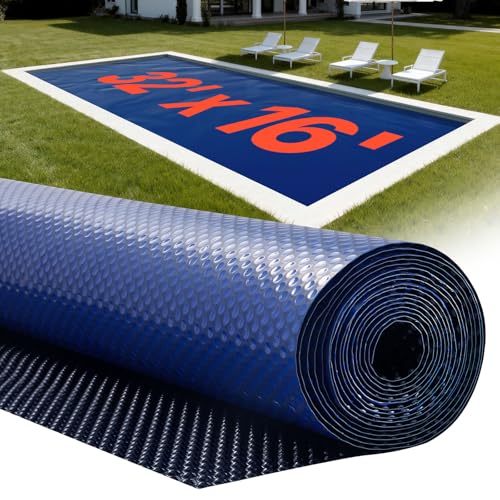

As an Amazon Associate we earn from qualifying purchases at no extra cost to you.
Quick picks
- Best overall: Sun2Solar 1200 Series (12 mil)
- Best warranty-focused 12 mil: Blue Wave 12-mil solar cover
- Best thicker cover: Blue Wave NS520 (14 mil, clear)
- Best for durability: Sun2Solar 1600 Series (16 mil)
- Best entry-level for small soft-sided pools: Intex Easy Set solar cover (thin, light-duty)
- Best reel for easy storage: Aqua Splash Pool Solar Cover Reel
- Best wheelbarrow-style reel for small pools: VINGLI 18 ft cover reel
How we chose
This guide is research-based. We compared manufacturer specifications, published pool-industry guidance on solar covers and evaporation, and what buyers and reviewers consistently report about each cover. We did not run measurements ourselves. Warranty terms and size ranges vary between listings and change over time, so confirm them on the product page before buying. Criteria, in order of weight:
- Thickness in mil. One mil is one thousandth of an inch. Thickness is the strongest single predictor of how many seasons a cover lasts.
- UV stabilization and colour. Sunlight is what destroys polyethylene. Stabilizers slow it down. Blue and clear covers behave differently for heating, as explained below.
- Size and fit. The cover must match your pool shape and be trimmable to fit.
- Heat gain versus evaporation savings. Most of the benefit comes from stopping evaporation, not from solar heating alone.
- Handling and storage. A heavy cover that is a chore to remove will not get used.
- Chemical tolerance and warranty. Chlorine and sun both wear covers. Warranty length is a weak but useful signal.
What a solar cover actually does
Evaporation is the real heat thief
An uncovered pool loses heat mostly as water evaporates from the surface, then through wind, night-time radiation and conduction. Public energy guidance commonly states that a pool cover can reduce evaporation by up to roughly 95 percent when it is on the pool. Because every gallon that evaporates carries heat away with it, stopping evaporation is the largest part of how a cover keeps the pool warm. Sunlight passing through the bubbles adds a smaller extra gain on top.
Typical gain
Manufacturers and reviewers commonly cite gains of roughly 8 to 15 degrees Fahrenheit over an uncovered pool in good conditions, but results depend on climate, shade, wind, pool depth and how many hours the cover stays on. Treat those numbers as a range, not a promise. A pool in full sun with the cover on overnight will see more than one in partial shade with the cover on only a few hours.
What it does not do
A solar cover is not a safety cover. It does not hold a person’s weight and it can trap a swimmer or child underneath. It also does not stop debris the way a winter cover does, and it is not meant to stay on during a shock treatment. Remove it fully before anyone swims.
Thickness guide: how many mil do you need
| Thickness | Typical use | Expected life (general guidance) | Handling | Cost tier |
|---|---|---|---|---|
| Around 6 to 8 mil | Small soft-sided pools, light seasonal use | Short, often a season or less in strong sun | Very light, easy to move | Entry-level |
| 12 mil | Most inground and above-ground pools | Commonly cited as about two seasons, sometimes more with care | Manageable by one person with a reel | Mid-range |
| 14 mil | Owners who want longer life without the heaviest option | Longer than 12 mil under similar conditions | Heavier, reel recommended | Mid-range to premium |
| 16 mil | Sunny climates, long seasons, owners who dislike replacing covers | Often described as the most durable | Heaviest, reel strongly recommended | Premium |
Life estimates are general industry guidance, not guarantees. Strong sun, high chlorine, pool chemicals sitting under the cover and rough handling all shorten life.
Colour: blue, clear and dark
- Blue: The common choice. It lets sunlight through while looking neutral on the pool and works well for most owners.
- Clear: Lets more sunlight into the water for heating and shows the pool surface through the cover. It can encourage algae if the water is poorly maintained, so keep chemistry in range.
- Dark or opaque: Absorbs heat into the cover itself and blocks sunlight from reaching the water, which can reduce algae growth. Heat transfers to the water through contact, and it can run hotter on the surface of the cover.
The covers, one by one
1. Sun2Solar 1200 Series (12 mil): best overall
Spec line: 12 mil · UV-stabilized bubble polyethylene · available in rectangular, round and oval sizes · trim-to-fit
Best for: Most home owners who want solid heat retention with a manageable weight and a mid-range cost.
Skip if: You get intense year-round sun and want to avoid replacing a cover in two or three seasons, in which case step up to the 16 mil.
- Pros: Widely recommended as a balanced choice, 12 mil sits at the point where durability and handling meet, and many size options cover common pool shapes.
- Cons: It is not the longest-lived option and will need replacement sooner than the thicker covers.
2. Blue Wave 12-mil solar cover: warranty-minded alternative
Spec line: 12 mil · UV-protected bubble polyethylene · multiple shapes and sizes · multi-year limited warranty (confirm length on the listing)
Best for: Buyers who weigh warranty length alongside price.
Skip if: You want something thicker, or you need an odd shape that is not offered.
- Pros: Well regarded for its warranty and for being a safe, mainstream pick.
- Cons: Warranty terms vary by seller and listing and normally exclude damage from chemicals and misuse.
3. Blue Wave NS520 (14 mil, clear): thicker clear cover
Spec line: 14 mil · clear · rectangular sizes such as 16 x 32 ft · UV-stabilized bubble polyethylene
Best for: Owners who want extra thickness and the added sunlight transmission of a clear cover.
Skip if: Your water chemistry is hard to keep stable, because clear covers let more light reach the water and can favor algae when sanitizer runs low.
- Pros: Thicker than the mainstream 12 mil, good light transmission for heating.
- Cons: Heavier to handle, and the clear colour offers no algae suppression.
4. Sun2Solar 1600 Series (16 mil): most durable
Spec line: 16 mil · UV-stabilized bubble polyethylene · same sizing approach as the 1200 Series · heavy gauge
Best for: Sunny regions, long swim seasons and owners who would rather pay more once than replace often.
Skip if: You will fold and carry the cover by hand, because it is heavy, or your pool is small and the weight will make it awkward.
- Pros: Commonly described as the longest-lasting of the mainstream covers, particularly suited to inground pools.
- Cons: Premium cost and weight, and a reel is almost essential.
5. Intex Easy Set solar cover: entry-level for small soft-sided pools
Spec line: Thin bubble polyethylene (roughly 6 to 8 mil class) · sized for round Easy Set style pools · light and simple
Best for: Small round soft-sided pools used casually where a few degrees and less evaporation are enough.
Skip if: You have a larger inground pool or strong sun and want a cover that lasts several seasons. Thin covers tend to wear faster under UV.
- Pros: Light, easy to put on and take off, and inexpensive.
- Cons: Thin material, limited lifespan and size fit tied to a specific pool family.
6. Aqua Splash Pool Solar Cover Reel: best reel
Spec line: Aluminum or metal frame reel · adjustable length for different pool widths · used to roll up covers for storage
Best for: Owners of covers 14 mil and above, and anyone who tends to leave the cover off because folding is a chore.
Skip if: Your pool is small, and the cover is thin enough to fold by hand in under a minute.
- Pros: Speeds up removal and extends cover life by preventing creasing and dragging.
- Cons: Needs assembly and storage space, and reel width must match your pool.
7. VINGLI 18 ft cover reel: wheelbarrow-style for smaller pools
Spec line: Roll-up reel for roughly 14 to 18 ft wide pools · wheeled design
Best for: Smaller above-ground pools where a full-size reel would be oversized.
Skip if: Your pool is wider than the reel supports.
- Pros: Mobile and sized for small pools.
- Cons: Limited width, so check your pool’s dimensions first.
Comparison table
| Product | Thickness | Colour | Best for | Handling | Cost tier |
|---|---|---|---|---|---|
| Sun2Solar 1200 Series | 12 mil | Blue (also other colours by size) | Most pools | One person with a reel | Mid-range |
| Blue Wave 12-mil | 12 mil | Blue | Warranty-minded buyers | One person with a reel | Mid-range |
| Blue Wave NS520 | 14 mil | Clear | Thicker clear cover | Reel advised | Mid-range to premium |
| Sun2Solar 1600 Series | 16 mil | Blue | Longest life, sunny climates | Reel essential | Premium |
| Intex Easy Set cover | About 6 to 8 mil class | Blue | Small soft-sided pools | Easy by hand | Entry-level |
Colour and size availability vary by listing, so confirm the exact configuration on the product page.
Worked example: how much heat and water a cover saves
Take a 16 x 32 ft rectangular pool with an average depth of 5 ft.
- Surface area: 16 x 32 = 512 square feet.
- Volume: 512 x 5 = 2,560 cubic feet. At about 7.48 gallons per cubic foot, that is roughly 19,150 gallons.
- Heat to raise the water 10 degrees F: One gallon of water needs about 8.34 BTU per degree F. So 19,150 x 8.34 x 10 is about 1.6 million BTU. That is the heat a heater would have to add to gain 10 degrees, and a cover helps you keep from losing it again.
- Water saved: A typical outdoor pool may lose around a quarter inch of water to evaporation per week in warm, dry weather, though it varies widely. One inch of water over one square foot is about 0.623 gallons. So 512 x 0.25 x 0.623 is roughly 80 gallons per week. If the cover cuts evaporation by around 90 percent, that is about 70 gallons a week not lost, along with the chemicals dissolved in them and the heat they carried away.
- Decision: If you only run a heater occasionally, a 12 mil cover is usually enough. If your pool is large, sunny and you want years of use from one purchase, the arithmetic favors the thicker 14 or 16 mil option, because the cover’s lifespan, not its first-year performance, drives cost per season.
Sizing and trimming
- Measure the water surface, not the coping. For rectangles, measure length and width. For rounds, measure diameter. For ovals, measure the longest and shortest dimensions.
- Buy the closest size up, not down. Covers are meant to be trimmed, and a cover that is too small leaves open water and wastes the benefit.
- Lay the cover bubble side down, with the bubbles touching the water. The flat side faces the sky.
- Trim with scissors about one to three inches smaller than the pool wall so the cover can float freely and expand in the sun. Trim in small cuts and check often.
- For round and oval pools, trim around the curve and keep the cut line smooth. For pools with steps or corners, cut a relief pattern and keep any cut-outs for later use.
- Keep the offcuts. If you need to adjust later, you can use them to patch edges.
Using and caring for the cover
- Remove during shock. Do not leave a cover on while shocking or while chlorine levels are very high. Chlorine gas can build under the cover and degrade the material.
- Rinse occasionally with clean water to remove chemical film and debris.
- Keep it off in very hot weather if water gets too warm. A cover can push water temperature above comfortable levels in peak summer. Pull it back for a few hours as needed.
- Store out of the sun. A reel kept in the shade or under a cover extends life. Leaving a rolled cover in direct sun degrades it fast.
- Do not drag it across rough decking or concrete. Use a reel or roll it onto a clean surface.
- Do not stand on it or let children or pets walk on it.
Safety notes
- A solar cover is not a safety cover and cannot support weight. Anyone who falls onto it may become trapped underneath. Keep it off the pool whenever people are in or near the water.
- Remove the cover completely before swimming. Do not swim under it or push it partly aside while you swim.
- If your pool needs a safety barrier or safety cover under local rules, a solar cover does not meet that need.
- Keep pool chemicals sealed, separate and out of children’s reach. Do not mix chemicals.
- When winterizing, use a winter or safety cover designed for the job rather than a solar cover.
Common mistakes
- Buying too thin to save money, then replacing the cover every season.
- Leaving the cover on while shocking and shortening its life.
- Cutting too aggressively and leaving large gaps around the edges.
- Folding by hand a heavy cover and giving up on using it. A reel changes that.
- Placing bubbles up, which reduces heat transfer and wears the cover faster.
- Storing the cover in the sun, where UV does its damage even while the pool is off-season.
Frequently asked questions
How much will a solar pool cover warm my pool?
Many sources cite roughly 8 to 15 degrees Fahrenheit in good conditions. Real results depend on sun, wind, shade, pool depth and how long the cover stays on.
Most of the benefit comes from stopping evaporation, so keeping the cover on overnight matters more than choosing a slightly thicker cover.
What thickness of solar cover is best?
For most pools, 12 mil is the best balance of cost, handling and life. Choose 14 or 16 mil if you want longer life or have very strong sun.
Thin covers around 6 to 8 mil suit small, casually used soft-sided pools but wear faster in direct sun.
Do I put the bubbles up or down?
Bubbles go down, against the water. The flat side faces the sky.
This position improves heat transfer to the water and protects the bubbles from direct sun.
Should I take the cover off when I shock the pool?
Yes. Remove the cover while shocking and until chlorine levels drop back to a normal range.
High chlorine and the gas it releases can degrade the cover and shorten its life.
Is a solar cover the same as a safety cover?
No. A solar cover cannot support weight and can trap a person underneath. It is for heat and evaporation, not safety.
Always remove it before swimming, and use a proper safety cover or barrier where required.
How do I size and trim a solar cover?
Measure the water surface, buy the closest size up, lay it bubble side down and trim one to three inches smaller than the pool wall.
Cut in small passes and check the fit often, since you cannot add material back.
Do I need a reel?
A reel is not required, but for 14 mil and thicker covers it is strongly recommended. It prevents creases and speeds up removal.
If removal feels like a chore, you will leave the cover off and lose most of the benefit.
How long does a solar cover last?
General guidance is about two seasons for 12 mil, longer for thicker covers, and less for thin ones. Sun, chemicals and storage habits affect life.
Rinse it, store it out of sunlight, and remove it during shock treatments to get the most out of it.
Final recommendation
Choose the Sun2Solar 1200 Series if you want the sensible default, the Blue Wave 12-mil if warranty weighs on your decision, and the Sun2Solar 1600 Series if you would rather buy once. Pair any 14 mil or thicker cover with a reel, trim it properly, take it off for shocking and swimming, and keep it out of the sun when it is not on the water. Those habits add more life to a solar cover than any brand choice.


