
Key takeaways
- Best floating skimmer for small ponds: OASE SwimSkim (rated to about 270 sq ft at roughly 580 GPH).
- Best budget floating skimmer: Jebao SK-30 (about 660 GPH) or Jebao SK-40 (about 790 GPH, up to roughly 290 sq ft).
- Best in-pond wall skimmer without cutting the liner: OASE AquaSkim 40 (about 40 cm wide intake).
- Best box skimmer for small ponds: Aquascape Signature 200 (ponds up to about 200 sq ft, pumps up to about 3,000 GPH).
- Best box skimmer for mid-size ponds: Aquascape Signature 400 (ponds up to about 400 sq ft).
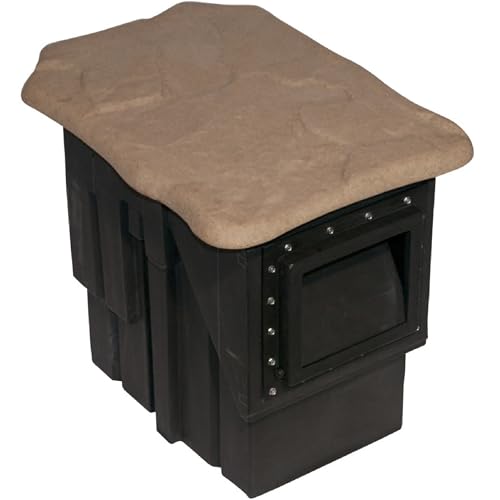
- Best value box skimmer with faux rock lid: The Pond Guy ClearSkim (up to about 3,000 gallons or 250 sq ft, pumps about 1,200-5,000 GPH).
- Best for heavy leaf fall: Savio HighFlow (16 inch faceplate, large basket).
- Best for larger ponds and koi: Atlantic Water Gardens PS7000 Big Bahama (rated for about 7,000 gallons).
- Best no-power option for large, still ponds: a pull-style mesh net (about 47 inches wide) used by hand.
For an existing small pond, the OASE SwimSkim and the Jebao SK-30 or SK-40 are the easiest floating skimmers to fit, while the Aquascape Signature 200 and The Pond Guy ClearSkim are the best built-in box skimmers for a new or rebuilt pond under about 3,000 gallons. For leaf-heavy ponds with a bigger footprint, step up to the Savio HighFlow or the Atlantic Water Gardens PS7000 Big Bahama. The choice comes down to whether you can dig into the pond edge, how much surface area you need to clear, and how much debris falls in.
Our top picks



As an Amazon Associate we earn from qualifying purchases at no extra cost to you.
Quick picks
- Best floating skimmer for small ponds: OASE SwimSkim (rated to about 270 sq ft at roughly 580 GPH).
- Best budget floating skimmer: Jebao SK-30 (about 660 GPH) or Jebao SK-40 (about 790 GPH, up to roughly 290 sq ft).
- Best in-pond wall skimmer without cutting the liner: OASE AquaSkim 40 (about 40 cm wide intake).
- Best box skimmer for small ponds: Aquascape Signature 200 (ponds up to about 200 sq ft, pumps up to about 3,000 GPH).
- Best box skimmer for mid-size ponds: Aquascape Signature 400 (ponds up to about 400 sq ft).
- Best value box skimmer with faux rock lid: The Pond Guy ClearSkim (up to about 3,000 gallons or 250 sq ft, pumps about 1,200-5,000 GPH).
- Best for heavy leaf fall: Savio HighFlow (16 inch faceplate, large basket).
- Best for larger ponds and koi: Atlantic Water Gardens PS7000 Big Bahama (rated for about 7,000 gallons).
- Best no-power option for large, still ponds: a pull-style mesh net (about 47 inches wide) used by hand.
How we chose
This guide is built on research, not on handling the skimmers ourselves. We compared manufacturer specification sheets, pond-supply sizing charts and independent roundups, and kept models that are sold in the United States and are sized for backyard ponds from a few hundred gallons to about 7,000 gallons. We grouped them by installation type, because that decides what you can actually fit. We stated flow and size ratings only where they appeared in several sources, and describe the rest by spec class. Check the current rating on the maker’s page before you buy.
Floating, wall-hung or box: which type fits
| Type | Install effort | Best pond size | Leaf capacity | Main trade-off |
|---|---|---|---|---|
| Floating skimmer | Drop in, plug in | Under about 1,000 gallons | Light to moderate | Less powerful; may need weighting or tethering |
| In-pond wall skimmer | Hang on edge, no liner cut | Small to medium | Moderate | Needs a stable edge and level water |
| Box (weir) skimmer | Dig, cut liner, plumb | Any, scaled up by model | Moderate to heavy | Most work to install; best at moving surface water |
| Pull-style net | None | Large, still ponds | Manual only | You do the work; no automatic cleaning |
Worked example: sizing a skimmer for a small pond
Skimmers are sized by surface area and by the flow of the pump that feeds them. Follow these steps.
- Estimate surface area. For an oval pond, multiply length by width by 0.785. A pond that is 8 ft by 5 ft covers 8 x 5 x 0.785, about 31 sq ft.
- Estimate volume. With an average depth of 2 ft, that is 31 x 2 x 7.5, about 470 gallons.
- Set the flow target. A common guideline is to pass the full volume through the skimmer every one to two hours. That is 235 to 470 GPH at working height.
- Check the rating. Every skimmer on this list is rated for much more than 31 sq ft, so surface area is not the limit. The limit is the pump: a skimmer that needs 1,200 GPH or more to work well is a poor match for a 470-gallon pond.
The takeaway is that small ponds are fine with a floating skimmer or compact wall skimmer carrying its own pump, while a built-in box skimmer only makes sense if you are building or rebuilding the pond edge anyway. As the pond grows, the numbers shift. A 12 ft by 8 ft pond at 2.5 ft deep is about 75 sq ft and 1,800 gallons, which brings the 900 to 1,800 GPH range into play and makes a box skimmer such as the Signature 200 or ClearSkim more attractive.
Floating skimmers
OASE SwimSkim
Specs: floating · self-adjusting to water level · carries its own pump · rated to about 270 sq ft at roughly 580 GPH.
Best for: an established pond that needs surface cleaning without any construction.
Skip if: overhanging deciduous trees drop heavy leaf loads; the basket will fill quickly.
- Pros: no digging, adapts to water-level changes, suited to pollen and light debris.
- Cons: premium tier for a floater; struggles under trees.
Jebao SK-30
Specs: floating · about 660 GPH · basket and sponge · drop-in.
Best for: small to mid-size ponds on a budget where gentle flow helps avoid disturbing the bottom.
Skip if: you need to clear heavy leaf drop; it may also need weighting to stay properly submerged.
- Pros: entry-level tier, no cutting, easy to move.
- Cons: lighter build than European brands; basket is small.
Jebao SK-40
Specs: floating · built-in pump · about 790 GPH · rated to roughly 290 sq ft.
Best for: slightly larger ponds that want a self-contained skimmer without a separate pump.
Skip if: you want a long warranty and a premium brand.
- Pros: higher flow than the SK-30, integrated pump, drop-in.
- Cons: budget build; check debris basket access for easy emptying.
OASE AquaSkim 40
Specs: in-pond wall skimmer · about 40 cm intake · removable basket · no wall cutting required · medium ponds.
Best for: owners who want a more powerful skim than a floater but cannot cut the pond edge.
Skip if: your edge is uneven or the water level swings a lot.
- Pros: wide surface coverage, handles water level changes, sits in the pond.
- Cons: needs a separate pump sized to your pond; rated flow is not listed on every source, so confirm with the maker.
Built-in box skimmers
Aquascape Signature Series 200
Specs: box skimmer · ponds up to about 200 sq ft · pumps up to about 3,000 GPH · debris basket and filter mat.
Best for: new small ponds where you are already digging and plumbing a waterfall.
Skip if: your pond is already built and sealed; installation means cutting liner.
- Pros: sized well for small to mid ponds, strong brand ecosystem, shared pump for skimmer and waterfall.
- Cons: installation work; plan pump placement early.
Aquascape Signature Series 400
Specs: box skimmer · ponds up to about 400 sq ft · rigid debris basket · filter mat included.
Best for: bigger backyard ponds with moderate leaf fall.
Skip if: your pond is under 1,000 gallons; the Signature 200 is the better fit.
- Pros: larger basket, handles more flow.
- Cons: larger excavation, higher tier.
The Pond Guy ClearSkim
Specs: box skimmer · up to about 3,000 gallons or 250 sq ft · pumps about 1,200-5,000 GPH · debris net and filter mat · faux rock lid.
Best for: mid-size ponds where you want the skimmer to blend into landscaping.
Skip if: your pump runs below roughly 1,200 GPH; it is the low end of the stated range.
- Pros: clear pump range, decorative lid hides the box.
- Cons: not designed for very small ponds.
Savio HighFlow
Specs: box (weir) skimmer · 16 inch faceplate · large debris basket · built into the pond edge.
Best for: leaf-heavy ponds where a floater would be overwhelmed.
Skip if: you do not want to rebuild the edge or seal the liner.
- Pros: wide weir, large basket, a serious option for heavy debris.
- Cons: premium tier, complex installation.
Atlantic Water Gardens PS7000 Big Bahama
Specs: box skimmer · rated for about 7,000 gallons · floating weir door · basket and mat stage.
Best for: larger water gardens and koi ponds.
Skip if: your pond is small; this skimmer is oversized below a couple of thousand gallons.
- Pros: floating weir copes with level changes, solid debris capture.
- Cons: large unit, needs a strong pump and plumbing.
Decision matrix
| Your pond | Debris load | Can you dig? | Pick |
|---|---|---|---|
| Under 500 gallons, built | Light | No | Jebao SK-30 or OASE SwimSkim |
| 500-1,000 gallons, built | Light to moderate | No | Jebao SK-40 or OASE AquaSkim 40 |
| New pond, under 2,000 gallons | Moderate | Yes | Aquascape Signature 200 or The Pond Guy ClearSkim |
| New pond, 2,000-4,000 gallons | Moderate to heavy | Yes | Aquascape Signature 400 or Savio HighFlow |
| Koi pond, 5,000+ gallons | Heavy | Yes | Atlantic PS7000 Big Bahama |
Installation tips that make a difference
- Place it on the downwind side. Position the skimmer where the prevailing wind pushes debris so the surface flow and wind work together.
- Keep the weir level. A box skimmer that sits crooked pulls water from one side only. Check with a level before backfilling.
- Match pump to skimmer. Choose a pump whose flow at your lift sits inside the skimmer’s stated range, not at its extreme.
- Add a bypass or valve. A ball valve on the outlet lets you balance flow between skimmer and waterfall.
- Protect fish. Fit a pre-filter or basket so fish cannot be drawn into the intake.
- Use a GFCI outlet. All pond pumps and skimmer pumps belong on ground-fault protected outdoor circuits.
How a skimmer fits with the rest of your pond system
A skimmer is the first stage of a three-part system. It removes floating debris at the surface, a mechanical or biological filter handles suspended particles and dissolved waste, and the pump ties the two together. Many box skimmers have room for a filter mat or a bio-media basket, which is why they are popular for new builds. If you run a floating skimmer, you will usually still need a separate filter for fish ponds, because the skimmer’s basket and sponge only capture larger particles.
Think about where the water goes after it leaves the skimmer. In a box-skimmer setup the same pump often feeds a waterfall or a filter, so the skimmer’s stated pump range must cover both the skimmer’s draw and the downstream load. In a floating setup, the integrated pump returns water straight to the pond, which keeps the system simple but means you add a second pump for any waterfall.
Skimmer versus net: when manual cleaning is enough
A pull-style mesh net of about 47 inches wide, towed with a rope, is the lowest-cost way to clear a large, still pond a few times a month. It has no pump and no moving parts, so it suits remote ponds without power. The trade-off is labor and timing: debris that sinks between passes begins to break down, adding nutrients that feed algae. For a backyard pond with fish, a powered skimmer that works all day is the better option. For a lightly stocked, open pond far from trees, a hand net and an autumn leaf cover may be enough.
A seasonal approach works well: run the skimmer from early spring through leaf drop, use a net cover over the pond during the heaviest leaf weeks, and check the basket more often after storms, which blow in extra debris and pollen. Keep a spare filter mat on hand so you can swap a clean one in while the dirty one is rinsed.
Maintenance routine
Empty the basket as often as debris requires: daily in autumn leaf fall, weekly the rest of the year. Rinse filter mats in pond water rather than tap water so you do not wipe out beneficial bacteria. Check the weir door and floating mechanism monthly for algae buildup. Before winter, either remove floating units and store them dry or follow the maker’s guidance for running a box skimmer in cold weather, and make sure no water can freeze inside the plumbing.
Common mistakes
- Buying a box skimmer for a pond you cannot reasonably excavate.
- Relying on a floater under a tree that sheds heavily; a leaf net over the pond in autumn helps more.
- Choosing a pump that is too small to pull water over the weir, which leaves surface debris sitting there.
- Skipping a second pass: a skimmer clears the surface, but you still need a filter for dissolved waste.
- Ignoring water level. A floating skimmer follows the level; a fixed wall skimmer does not unless it has a floating weir.
Frequently asked questions
Do I need a pond skimmer?
You do if leaves, pollen or grass clippings land on the water. A skimmer removes debris before it sinks and decays.
A small pond in an open yard can manage with a net and a filter, but a skimmer cuts the workload noticeably.
What is the difference between a floating skimmer and a box skimmer?
A floating skimmer drops into the water and carries its own pump. A box skimmer is built into the pond edge and uses a separate pump.
Floaters are easier to fit; box skimmers move more water and handle heavier debris.
How big a skimmer do I need?
Match the rating to your surface area and aim to pass the pond volume through it every one to two hours.
For ponds under 1,000 gallons, a compact floating or wall skimmer is usually enough.
Can I add a skimmer to an existing pond?
Yes. Floating and in-pond wall skimmers need no digging. A box skimmer requires cutting the liner and rebuilding the edge.
If the pond is already sealed and landscaped, choose a floating or wall type.
Will a skimmer hurt my fish?
Not if the intake is protected. Skimmers have baskets or nets, but small fish can be drawn toward strong flow.
Use a pre-filter or choose a model with a guarded intake, and keep flow within the rating.
How often should I empty the skimmer basket?
Check it weekly, and daily during autumn leaf fall. A full basket cuts flow and can cause the pump to run harder.
Clearing it regularly also keeps debris from breaking down and fouling the water.
Do skimmers work in winter?
It depends on your climate. In freezing regions, floating units are usually removed and box skimmers are shut down or protected.
Follow the maker’s winter guidance, and never let water freeze inside plumbing or a pump housing.
Is it safe to service a skimmer pump myself?
Yes, if you unplug it from the GFCI outlet first. Never reach into the water or handle the pump while it is powered.
Test the GFCI outlet monthly and replace any cord that is cracked or damaged.


