Key takeaways
- Welding helmets shield eyes and faces with auto darkening lenses, flip fronts, and wide view panels. Compare shade ranges, sensors, and headgear.
As an Amazon Associate we earn from qualifying purchases.
A home shop welder moves between jobs that a production line never mixes: a cracked mower deck in the morning, a gate hinge after lunch, and a trailer frame on the weekend. The helmet has to keep up with all of it, darkening the instant an arc starts and clearing fast enough that you can inspect the bead without lifting the shell. The five helmets below cover the main designs sold for this kind of work. Four are auto darkening models with adjustable shade ranges, including one panoramic design with side windows, and the fifth is a traditional flip front hood with a fixed shade filter for welders who prefer a passive lens. Each entry sticks to what the maker prints on its own listing: shade range, viewing area, sensor count, power source, and headgear style, so you can match the numbers to the work in your own shop.
Disclosure: This article may contain affiliate links. If you buy through these links, we may earn a small commission from Amazon.
Miller Classic Series Auto-Darkening Welding Helmet

See it on Amazon: https://www.amazon.com/dp/B096D7RCSH
Miller builds the Classic Series as its entry point into auto darkening helmets, and the listing aims it at entry-level, DIY, and occasional use. The variable shade runs from 8 to 13 for welding, with cut shades from 5 to 8, and the light state is a bright 3.0, so the hood can stay down between tasks while you line up the next joint. Two independent arc sensors watch for the arc, and the lens switches in 1/23,000 of a second according to the product description. Digital controls let you set shade, delay, and sensitivity rather than guessing with a single knob. The shell is durable nylon, and the headgear is an ergonomic ratchet style with precise adjustment controls, which matters on a long Saturday of tacking and grinding. Miller prints ANSI Z87.1 and CSA in the specification field of the listing, names CE in the description, and backs the helmet with a three year warranty. At 2 pounds, it is a full size hood rather than a featherweight, so the ratchet headgear does real work spreading that load.
Specs
- Variable weld shade 8-13, cut shade 5-8, light state 3.0
- Switching speed 1/23,000 second, two independent arc sensors
- ClearLight lens technology with high definition optics per the listing title
- Digital controls for shade, delay, and sensitivity
- Nylon shell, ratchet style headgear, 2 pounds
- Specification met as printed: ANSI Z87.1, CSA; three year warranty
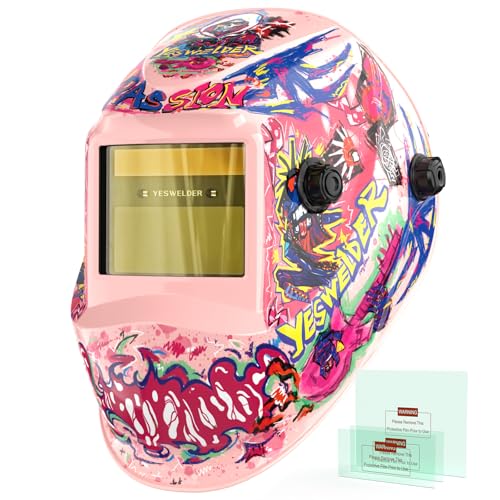
YESWELDER LYG-L600A Auto Darkening Welding Helmet
See it on Amazon: https://www.amazon.com/dp/B0F64PX1HV
The LYG-L600A is YESWELDER’s compact solar powered hood, and its listing leads with blue light blocking and a true color lens. The shade range printed in the title is 3.5/9-13, meaning a light state of DIN 3.5 and a dark range of DIN 9 to 13, which covers TIG, MIG, and stick work plus a grind setting. Two arc sensors trigger the filter, and the brand’s own comparison table on the listing gives this model a viewing area of 3.64 x 1.67 inches, an optical class figure of 1/1/1/1, and UV/IR protection at DIN 16. Power comes from the solar cell working with a replaceable CR2450 battery, so there is no charging cable to keep track of in the shop. The shell material is printed as PP, and the item weight is 0.89 kilograms. This is the straightforward pick in the group: a standard front window, a familiar control layout, and a model name the brand sells across its whole helmet line, which makes finding matching cover lenses simple later on.
Specs
- Shade range 3.5/9-13 (light state DIN 3.5, dark states DIN 9-13)
- Viewing area 3.64 x 1.67 inches, optical class 1/1/1/1 as printed
- Two arc sensors, UV/IR protection DIN 16
- Solar powered with replaceable CR2450 battery
- PP shell material, item weight 0.89 kilograms
- Model LYG-L600A-PK; welding helmet only in the box per the listing
YESWELDER LYG-Q800D Panoramic Auto Darkening Welding Helmet

See it on Amazon: https://www.amazon.com/dp/B08PV41XHQ
The Q800D takes a different approach to the window. Alongside the main front lens, it adds side view panels that give a 180 degree panoramic view, so you can see the bench, the clamp, and the cable beside you without turning your head. The title prints a wide shade of 3/5-9/9-13 and a 1/1/1/1 true color figure, and the lens is solar powered. The item details list the shell material as PP, the weight at 2.2 pounds, and the overall size at 10.14 x 7.8 x 12.87 inches. Power wording needs a careful read: the title says solar powered, while the details table lists the power source as battery powered and confirms one lithium ion battery is included in the box, along with a storage bag and three replacement lenses. Welders who work in tight engine bays, under vehicles, or inside farm equipment often find a plain front window restrictive, and this is the one helmet here built specifically around peripheral vision rather than a single forward pane.
Specs
- Side view design with 180 degree panoramic view per the listing title
- Wide shade 3/5-9/9-13, true color figure 1/1/1/1 as printed
- PP material, item weight 2.2 pounds, 10.14 x 7.8 x 12.87 inches
- One lithium ion battery included; solar powered per the title
- Box contents as printed: helmet, replacement battery, storage bag, three replacement lenses
- Model LYG-Q800D-ME
Jackson Safety PL280 Pipeline Welding Helmet

See it on Amazon: https://www.amazon.com/dp/B0BVTP7B7M
The PL280 is the traditional design in this group: a passive flip front hood with no electronics at all. A spring loaded lift front carries the filter, so you raise just the lens section for chipping, grinding prep, and fit-up work instead of lifting the whole hood. The listing states it comes with a high impact polycarbonate window and a 2 x 4.25 inch Shade 10 filter, a fixed dark shade that suits stick and MIG work at common home shop amperages. The shell is Super Tuff nylon, built, in the maker’s words, for harsh welding extremes, and the patented lens retention system is designed for easy loading of the filter and cover plates. Fit comes from the 370 Speed Dial ratcheting headgear, and the closure type is printed as ratchet. The specification field lists ANSI Z87.1 and CSA Z94.1, the title states the helmet is made in the USA, and the warranty description reads one year manufacturer. There is no battery to die and no sensor to fool, which is exactly why pipeline style hoods still sell.
Specs
- Flip front design with spring loaded lift front and fixed Shade 10 filter
- Window size 2 x 4.25 inches, high impact polycarbonate window
- Super Tuff nylon shell, material listed as nylon and polycarbonate
- 370 Speed Dial ratcheting headgear, ratchet closure
- Item weight 1.9 pounds, model 280PL
- Specification met as printed: ANSI Z87.1, CSA Z94.1; one year manufacturer warranty
Antra AH7-220-0000 True Color Auto Darkening Welding Helmet

See it on Amazon: https://www.amazon.com/dp/B01HQYKP34
Antra’s AH7-220-0000 is a light helmet at 16 ounces, built from high impact polyamide nylon. The title prints a wide shade range of 4/7-13, and the specification block in the listing breaks that down as a light state of DIN 4 and a dark state of DIN 9-13. The smart chip lens runs on two sensors, reacts in 1/25,000 of a second, and returns from dark to light in 0.2 or 0.5 seconds depending on the delay setting, which you adjust with a knob alongside the sensitivity control. The viewing area is 3.62 x 1.63 inches and the optical class is printed as 1/2/1/2. Power is a solar cell backed by two replaceable CR2032 batteries, and the listing notes a battery indicator and a test function. UV/IR protection is printed as a permanent shade DIN 13. The box includes six exterior and one interior lens cover, a practical touch for a home shop where spatter eats cover lenses. The listing prints ANSI Z87.1, EN379 CE, and CSA Z94.3 as the standards this model meets.
Specs
- Shade range 4/7-13 in the title; light state DIN 4, dark state DIN 9-13 in the listing specifications
- Viewing area 3.62 x 1.63 inches, optical class 1/2/1/2 as printed
- Two sensors, reaction time 1/25,000 second, dark to light 0.2 or 0.5 seconds
- Solar cell plus two replaceable CR2032 batteries; battery indicator and test function
- High impact polyamide nylon, 16 ounces, ratchet closure headgear
- Six exterior and one interior lens covers included
How to Choose
Start with the shade range, because it decides which processes the helmet can cover. A dark range that reaches DIN 13 handles higher amperage stick and MIG work, while the low end matters for TIG: the Miller listing, for example, separates its weld shades of 8-13 from cut shades of 5-8. Next, look at the light state. A brighter light shade, DIN 3 to 3.5 on the auto darkening models here, lets you see the joint with the hood down, while DIN 4 is dimmer but common on simpler lenses. Viewing area is a comfort choice: a standard window near 3.6 x 1.7 inches suits bench work, while the panoramic Q800D adds side panels for work in cramped spaces. Sensor count affects reliability when the arc is partly hidden behind a pipe or clamp; two sensors is the common home shop setup, and sensitivity and delay controls help any sensor set cope with low amp starts. Power is the last fork. Solar cells with replaceable coin batteries ask little of you, while a fixed passive lens like the Jackson’s asks nothing at all. Finally, weigh the headgear: a ratchet dial you can turn with a gloved hand is worth more than padding you cannot adjust.
FAQ
What shade range does a home welder actually need?
For most home MIG, stick, and TIG work, a variable dark range of DIN 9-13 covers the common amperage bands, and every auto darkening helmet here reaches DIN 13 at the top end. A wider printed range, such as the Antra’s 4/7-13 or the Miller’s separate cut shades of 5-8, adds lower settings for cutting and for low amp TIG starts.
How many arc sensors should I look for?
Two sensors is the standard setup on the home shop helmets in this list, and it works well when you weld in the open. More sensors help when your body, a clamp, or the workpiece can block one sensor’s view of the arc, because the remaining sensors still trigger the lens. Sensitivity adjustment matters as much as the count, since it lets the lens react to weaker arcs.
What is the difference between solar powered and battery powered helmets?
In practice the two overlap. Several helmets here pair a solar cell with a replaceable coin battery, so the cell stretches battery life instead of replacing it. The practical question is whether the battery can be swapped when it fades: the listings for the YESWELDER L600A and the Antra both name replaceable cells, while a sealed design eventually needs a new cartridge.
When does a flip front helmet beat an auto darkening one?
A flip front like the Jackson PL280 has no electronics, so it suits welders who work outdoors in dust and weather, who weld only occasionally, or who simply trust a fixed shade filter. You give up the convenience of watching the arc start through a clear lens, and you flip the front up and down for inspection, but there is nothing to charge, fog a sensor, or wear out beyond cover plates.
Conclusion
For a single all purpose hood, the Miller Classic Series pairs a wide 8-13 weld shade with digital controls and a three year warranty. The two YESWELDER models split the value end of the field: the L600A keeps things simple with a standard window, and the Q800D adds panoramic side panels for tight work. The Antra AH7-220-0000 is the light option at 16 ounces with spare cover lenses in the box, and the Jackson PL280 remains the no electronics flip front for welders who prefer a fixed shade. Match the shade range and window style to the work on your bench, and any of the five will serve a home shop well.
More from Amazon
Programs that pair well with the guide above. Offers and eligibility are set by Amazon and may change.
Collect the home and kitchen items you want in one registry that guests can shop from.
Create a wedding registrySet up recurring deliveries of everyday items on eligible products. Terms and savings are set by Amazon.
Explore Subscribe & SaveFree shipping on eligible items, Prime Video and more. Eligible new members can start with a free trial.
Start a Prime free trialAudiobooks and podcasts to listen to on the go. Eligible new members can start with a free trial.
Try Audible freeAs an Amazon Associate we earn from qualifying purchases.