Key takeaways
- Small plug-in (15 W): 0.015 kW × 24 h × 30 days = 10.8 kWh/month ≈ $1.80/month, or about $22/year at $0.17/kWh.
- Large cast stone (40 W): 28.8 kWh/month ≈ $4.90/month, around $59/year run continuously.
- Solar: $0 to run, but budget $20–$50 every 2–4 years for a replacement battery or pump — that’s the real cost cycle listings don’t mention.
The best water fountain ideas for a front yard come down to three decisions: how much footprint you can spare, whether you have a GFCI outlet or full sun nearby, and how much sound you want carrying to the street. Solar suits open beds with no wiring, plug-in recirculating models suit porches and shaded entries, and large tiered or pondless designs work as permanent anchors. Below are 15 ideas organized exactly that way, with the specs and running costs that product listings leave out.
Our top picks

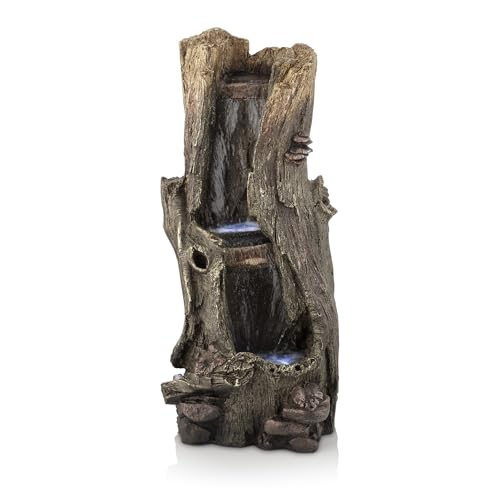

 Mademax Solar Bird Bath Fountains
- Mademax solar birdbath fountain only needs 3 seconds…
- We have designed a retainer to avoid the…
- The package comes with 8 nozzles and 4…
As an Amazon Associate we earn from qualifying purchases at no extra cost to you.
Match the Fountain to Your Yard First
Before picking a style, map your situation to a type. This matrix covers the five most common front-yard scenarios.
| Your situation | Best fountain type | Typical footprint | Why it fits |
|---|---|---|---|
| Sunny bed or lawn, no outdoor outlet | Solar birdbath or solar tiered | 1.5–3 ft | Panel on a 10–16 ft lead reaches sun while the fountain sits in partial shade |
| Covered porch or shaded entry with a GFCI outlet | Small plug-in urn or wall fountain | 1–2.5 ft | Constant flow regardless of light; cord runs stay short and hidden |
| Spot visible 10–20 ft from the sidewalk | 3–4 ft tiered, sphere, or bubbling boulder | 2.5–4 ft | Enough drop height for audible water that masks street noise |
| Circular drive island or large lawn anchor | Cast stone tiered or pondless boulder | 4–8 ft | 300–900 lb pieces read as permanent hardscape |
| Renting or wanting a movable piece | Resin solar fountain under 40 lb | 1.5–2.5 ft | Drains and lifts without tools; no hardwired install |
How the Main Types Compare on Specs
| Type | Footprint / height | Reservoir | Pump flow | Power draw | Weight | Market price range |
|---|---|---|---|---|---|---|
| Solar birdbath | 18–24 in dia. | 1–2 gal | 40–120 GPH | 1.5–5 W panel | 5–20 lb | $60–$180 |
| Solar tiered with battery backup | 20–30 in | 3–6 gal | 60–200 GPH | 5–10 W + lithium reserve | 25–45 lb | $150–$400 |
| Plug-in tiered resin | 30–48 in tall | 5–15 gal | 200–400 GPH | 8–25 W | 30–70 lb | $150–$500 |
| Cast stone 3-tier | 48–84 in tall | 20–40 gal basin | 500–1,200 GPH | 40–120 W | 300–900+ lb | $800–$3,000+ |
| Pondless boulder or column kit | 36–60 in basin (buried) | 30–50 gal underground vault | 500–1,500 GPH | 45–150 W | 200–600 lb stone | $400–$1,200 (DIY kit) |
Solar-Powered Ideas (No Wiring Required)
1. Floating Solar Birdbath
A classic for a reason: a 1–2 gallon pedestal basin with a floating pump and interchangeable spray heads reaching 12–20 in. Place it within sight of a front window — it doubles as bird habitat. Expect zero operation in cloud cover unless it has a battery.
2. Solar Tiered Fountain with Battery Backup
“Solar-on-demand” designs (Smart Solar popularized the format) charge an internal battery so the pump runs 2–6 hours into the evening — important if your curb appeal moment is dusk.
3. Stacked-Pot Cascade
Two or three glazed ceramic pitchers or pots at 24–30 in tall, spilling rim to rim. The narrow footprint tucks into foundation beds without crowding plants.
4. Solar Bubbler Urn
A low, wide urn where water wells up and sheets down the sides — quieter than tiered drops, so it suits spots near a porch bench where splashing would annoy.
5. Solar Animal Spitter into a Half-Barrel
A small sculptural spitter (koi, turtle, frog) feeding a lined half-barrel. Roughly a 3 ft footprint, easy to relocate, and the barrel reservoir holds 10+ gallons so refills are weekly, not daily.
Plug-In Recirculating Ideas for Porches and Beds
6. Classic 3-Tier Resin Fountain
The standard 35–45 in three-tier silhouette from brands like Sunnydaze Decor, Alpine Corporation, and John Timberland. Fiberglass-resin keeps weight to 30–70 lb, but add sand or water ballast in the base — they tip in wind when empty.
7. Modern Column or Sphere with LED Ring
A smooth column or polished sphere with an integrated LED light ring. The light matters: it’s what sells curb appeal after 6 p.m., which is when most buyers and guests actually see your yard.
8. Cascading Bowls on a Wide Base
Four or five graduated bowls (Teamson Home makes several) produce more sound per inch of height than tiered designs because each drop is short but wide — good for masking a noisy street.
9. Wall-Mounted Spigot Fountain
A flat-back lion head or spigot fountain mounted on a porch wall or fence panel. Zero floor footprint; the catch basin sits below. Needs solid wall anchors and an outlet within cord reach (most ship with 6–16 ft cords).
10. Bubbling Boulder
A drilled natural stone bubbling over a hidden basin. It disappears into a mulched bed visually but adds sound — the most low-maintenance plug-in look since there’s no finish to fade.
Statement Pieces That Anchor the Whole Front Yard
11. Cast Stone 3-Tier Estate Fountain
The 65–84 in tiered fountains from Campania International and Henri Studio weigh 300–900 lb assembled and arrive by freight. Budget for a level paver or concrete pad — a 600 lb fountain settles visibly on bare soil within one season.
12. Pondless Disappearing Fountain
Water vanishes into a gravel-covered underground vault (Aquascape sells the basin kits). No open water, so it’s the safest large option near a public sidewalk where children and pets pass.
13. Basalt Column Trio
Three graduated stone columns (roughly 18, 24, and 30 in) over a shared reservoir. The odd-number grouping photographs well from the street and reads as intentional landscaping, not an ornament.
14. Courtyard Wall Fountain
A tall flat-back fountain against the house facade near the entry. It borrows the architecture as a backdrop, so a 48 in piece reads larger than a freestanding fountain of the same size.
15. Single Oversized Glazed Jar
One 36–48 in ceramic jar with water overflowing the rim into a pebble surround. Minimal moving parts, one strong color statement, and the simplest winterizing job on this list — drain it and done.
What It Actually Costs to Run One
Pump wattage is the only real ongoing cost, and it’s smaller than most people assume. The math:
- Small plug-in (15 W): 0.015 kW × 24 h × 30 days = 10.8 kWh/month ≈ $1.80/month, or about $22/year at $0.17/kWh.
- Large cast stone (40 W): 28.8 kWh/month ≈ $4.90/month, around $59/year run continuously.
- Solar: $0 to run, but budget $20–$50 every 2–4 years for a replacement battery or pump — that’s the real cost cycle listings don’t mention.
Water cost is trivial but the refill schedule isn’t: a mid-size fountain loses 1–2 gallons per week to evaporation and splash in summer. Let the reservoir drop below the pump intake and you’ll burn out a $30–$80 pump in days. Set a weekly top-up reminder.
Ownership Realities: What Wears and What to Do About It
- Pump impellers clog first. Rinse the intake sponge monthly; flush lines with a 50/50 vinegar-water solution quarterly to clear mineral scale.
- Algae is constant in sun. Wipe basin walls weekly. In birdbaths, use bird-safe enzyme treatments, not bleach.
- Splash-out is the top beginner mistake. If the water line drops fast, wind is blowing droplets off tiers. Lower the flow rate or reposition — don’t just refill more often.
- Winterizing is non-negotiable in freeze zones. Drain completely, remove and store the pump indoors, and cover the basin. Cast stone can stay outdoors but must be dry and covered; trapped water freezes and spalls the surface.
- Resin finishes chalk in UV after 3–5 years. A coat of exterior clear spray refreshes them; dark finishes hide it longer than white.
- Cord safety: always plug into a GFCI outlet, route cords along bed edges rather than across walkways, and never use an indoor extension cord outside.
FAQ
Do front-yard fountains attract mosquitoes?
Moving water doesn’t — mosquitoes need still water to breed. Keep the pump running daily and refresh the reservoir weekly, and there’s no issue. A neglected, stagnant basin is the actual risk.
Will a solar fountain work in a shady front yard?
Direct-solar pumps stop the moment a cloud passes. Two fixes: choose a battery-backup model that stores 2–6 hours of runtime, or use the panel’s 10–16 ft cable to mount it in the one sunny patch while the fountain sits in shade.
How close does a plug-in fountain need to be to an outlet?
Most cords run 6–16 ft. If your spot is farther, a properly rated outdoor extension in a weatherproof connection box works, but many homeowners instead hire an electrician to add a GFCI outlet near the bed — typically a modest one-time cost that also serves holiday lighting.