Key takeaways
- A listing gives an LED count but no lumens, beam angle or useful description of coverage.
- “Waterproof” appears without an IP rating or installation guidance.
- The product claims extremely long run times but does not state panel size, battery capacity or lighting mode.
- The stake looks thin, short or permanently molded into a fragile housing.
- A solar panel is permanently shaded by the fixture, a wall or nearby planting.
- The battery is sealed and the warranty is short, making future repair uneconomical.
- Reviews mention condensation, leaning stakes, loose connectors or rapid brightness loss.
Garden lighting can transform a dark path, highlight planting and make a patio more useful after sunset. It can also become a disappointing purchase if you focus on appearance alone. Common mistakes include buying lights that are too dim for the intended job, assuming “waterproof” means they can withstand every weather condition, and overlooking where the solar panel will sit. Another frequent error is judging a product by its LED count rather than its useful brightness, beam spread and run time.
This guide explains what to look for garden lighting in 2026, whether you need inexpensive pathway markers, decorative lanterns or brighter spotlights for steps and borders. The right choice depends on the task, the garden’s exposure and how much maintenance you are willing to accept.
Our top picks


As an Amazon Associate we earn from qualifying purchases at no extra cost to you.
Decide These 3 Things First
- What job must the light do? Choose decorative lighting for atmosphere, pathway lighting for orientation or spotlights for visibility and accenting. A small decorative lantern may use less than 1 watt, while a useful outdoor spotlight may need 3–10 watts per head.
- Where will it be installed? Note whether the light is under cover, in an open lawn, beside a sprinkler or close to the coast. Check the IP rating and identify how much direct sunlight reaches the solar panel.
- How will it be powered? Solar lights avoid wiring and are easy to reposition, but performance varies with season, shade and weather. Plug-in systems provide more consistent output, while low-voltage wired systems suit larger, permanent layouts.
Size and Light Coverage
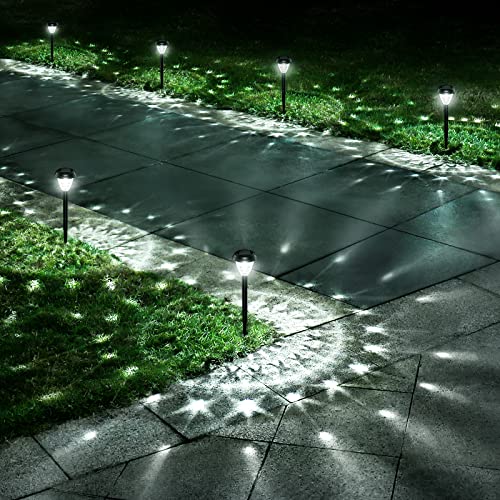
Size should match both the garden feature and the area that needs illumination. Path lights measuring approximately 12–20 inches high usually spread light across a narrow walkway without becoming a trip hazard. Space them about 6–10 feet apart for gentle guidance, bringing them closer together around steps, curves and changes in level.
For a planting bed, compact stake lights with a 2–4 inch head can add sparkle without competing with shrubs. Spotlights need more room to aim: a head with a 3–5 inch diameter is easier to adjust and usually provides a more useful beam than a tiny decorative LED.
Check the panel and battery dimensions, too. A solar light with a panel of roughly 4–8 square inches may work well for a small LED, but a brighter multi-LED fixture generally needs a larger panel or longer charging time. A claimed run time of “up to 12 hours,” such as the claim made for the 10-pack URAGO pathway lights, is a maximum rather than a guarantee for every night.
Material and Weather Resistance
Look for materials that suit the location, not simply the most attractive finish. ABS plastic is lightweight, affordable and resistant to rust, making it common in budget solar lights. It can become brittle after prolonged exposure to strong sunlight, particularly in thin housings. Aluminum generally feels sturdier and dissipates heat more effectively, but painted or powder-coated finishes can still scratch.
Glass shades create a more substantial appearance and can produce attractive patterns, but they add weight and may break if knocked by a mower, ball or falling branch. Stainless steel is useful in damp areas, though lower-grade steel may discolor or corrode near salt air.
For outdoor exposure, IP65 is a practical minimum for many fixed garden lights. The first number indicates protection from dust, while the second indicates protection against water jets. IP65 does not mean the fixture should be submerged. For lights placed in areas that flood or collect standing water, choose a product specifically rated for immersion or move the fixture to higher ground.
Construction and Installation
Inspect how the stake, housing and connections fit together. A long stake of at least 6–10 inches is more secure in loose soil than a short, narrow spike. In hard ground, pre-drill a hole rather than forcing the stake, which can crack plastic housings or bend metal stems.
For pathway lights, a broad base or reinforced stake helps prevent leaning. Hinged spotlights should hold their angle when tightened; an attractive light that slowly droops will illuminate the soil instead of the tree or steps. Look for sealed battery compartments, a clearly marked on/off switch and a panel that can be cleaned without disassembling the fixture.
Hanging lanterns need a reliable hook or loop capable of supporting at least twice the lantern’s stated weight. A two-pack of solar flame lanterns priced around $17.99 is suitable for decorative placement, but check whether the included hanger is intended for a permanent installation or occasional use.
Comfort, Brightness and Performance
Garden lighting should make the space easier to use, not create glare. Warm white light around 2,700–3,000K is generally comfortable for patios, seating areas and planting. Neutral white around 3,500–4,000K can make paths and steps look clearer. Very cool white light may feel harsh in a relaxed garden.
For decorative markers, approximately 5–30 lumens per fixture can be enough. A path used regularly may benefit from roughly 30–100 lumens per light, while a small spotlight for a tree or architectural feature may need 100–300 lumens. These are buying guidelines, not universal performance guarantees; beam angle, mounting height and surrounding darkness all affect the result.
Solar products with multiple modes can trade brightness for run time. The GKGG four-pack, for example, is listed with 76 LEDs and three lighting modes. Compare the available modes rather than assuming the highest LED count is automatically best. Flickering flame effects are atmospheric but are not a substitute for functional illumination.
Price Tiers: What You Get for Your Money
Budget: $10–$35. Expect plastic or light-gauge metal, simple solar charging, fixed color temperature and modest brightness. Multipacks can be excellent for outlining a border or path. The $25.97 URAGO 10-pack is an example of the value-focused format, while the $17.99 two-pack lanterns prioritize decoration over broad area lighting.
Midrange: $35–$100. This tier often brings stronger housings, better-adjustable heads, larger panels, replaceable batteries or more consistent controls. A four-pack such as the $35.99 GKGG spotlights sits at the lower end of this range. Expect to pay more for aluminum bodies, remote controls and separate solar panels.
Premium: $100–$300 or more. Higher-priced systems may include wired low-voltage components, transformers, dimming, smart controls, thicker cables and replaceable parts. Premium pricing makes the most sense for permanent entertaining areas, large properties or installations where consistent brightness matters more than portability.
Warranty and Replaceable Parts
Check the warranty length before buying, especially for lights exposed to rain and freezing temperatures. A one-year warranty is common on inexpensive solar products; two to three years is more reassuring for midrange fixtures, and premium systems may offer longer coverage on housings or electronics.
Find out what the warranty excludes. Battery wear, accidental damage, water entry caused by incorrect installation and cosmetic fading may not be covered. A replaceable rechargeable battery can extend the useful life of a solar light by several seasons. Common battery formats include AA and AAA rechargeable cells, but confirm the voltage and chemistry before replacing one.
Keep the receipt, product instructions and any small mounting parts. If a light uses a proprietary battery or sealed electronics, a failure may mean replacing the entire fixture rather than making a low-cost repair.
Delivery and Assembly
Solar stake lights are usually simple to assemble, but multipacks still need time. Allow about 5–10 minutes per pack to remove protective film, connect stakes, switch the units on and position the panels. Fully charge them according to the instructions before judging their performance; some products need a full sunny day.
For wired systems, measure the route before ordering. Add 10–15% to the cable length for gentle curves and repositioning. Keep connectors above ground where possible, and use outdoor-rated extension equipment rather than indoor power strips. Large orders should be checked immediately for cracked lenses, missing stakes and mismatched parts, since returning a fully installed system is more difficult.
Spec Checklist
| Spec | Budget | Mid | Premium |
|---|---|---|---|
| Typical price | $10–$35 | $35–$100 | $100–$300+ |
| Best use | Decoration and light path marking | Paths, beds and small accents | Patios, steps and permanent layouts |
| Typical brightness | 5–50 lumens per light | 30–150 lumens per light | 100–500+ lumens per light |
| Color temperature | Warm white, often 2,700–3,000K | Warm or neutral, about 2,700–4,000K | Selectable or adjustable options |
| Weather rating | IP44–IP65 | IP65 or better | IP65–IP67, depending on installation |
| Power | Solar, usually under 1W per fixture | Solar or low-voltage, about 1–5W | Low-voltage or mains-powered, about 3–10W per head |
| Warranty target | At least 1 year | 1–3 years | 2–5 years |
Red Flags
- A listing gives an LED count but no lumens, beam angle or useful description of coverage.
- “Waterproof” appears without an IP rating or installation guidance.
- The product claims extremely long run times but does not state panel size, battery capacity or lighting mode.
- The stake looks thin, short or permanently molded into a fragile housing.
- A solar panel is permanently shaded by the fixture, a wall or nearby planting.
- The battery is sealed and the warranty is short, making future repair uneconomical.
- Reviews mention condensation, leaning stakes, loose connectors or rapid brightness loss.
FAQ
How many garden lights do I need for a path?
Start with one light every 6–10 feet for gentle guidance, then add fixtures near steps, corners and changes in elevation. A 30-foot path may need four to six lights, depending on beam spread and desired brightness. Avoid placing lights in a perfectly straight line if that creates glare; alternating sides usually gives a softer result.
Are solar garden lights bright enough?
They can be bright enough for marking paths, highlighting borders and creating atmosphere. They are less dependable for security lighting, reading or consistently lighting steps through long periods of cloudy weather. Choose a fixture with a stated lumen output, position the panel in direct sun and use a brighter mode only where necessary to preserve run time.
What IP rating should outdoor garden lights have?
IP44 can be adequate under a covered porch, but IP65 is a better general target for exposed garden fixtures. IP67 offers additional protection against temporary immersion, although the product’s installation instructions still matter. No IP rating makes a damaged cable, loose seal or cracked housing safe to ignore.
Should garden lights be warm white or cool white?
Warm white, around 2,700–3,000K, is usually the most comfortable choice for patios, seating and decorative planting. Neutral white, around 3,500–4,000K, can improve visual clarity on paths and steps. Choose cool white only when you specifically want a crisp, high-contrast appearance and can control glare.