Key takeaways
- No stated overall dimensions, basin capacity, pump wattage, or cord length.
- A dramatic spray photo paired with a small, shallow birdbath; expect water loss from splash.
- “Solar powered” wording that does not clarify whether a battery is included.
- Heavy stone-look construction with no product weight or installation guidance.
- A pump compartment that cannot be reached without major disassembly.
- LED lighting described without saying whether it needs a plug-in transformer.
- No instructions for winter storage or freeze protection in a fountain intended for outdoor use.
What's inside
Most garden fountain regrets come down to buying for the photo instead of the setting. A fountain may look right online but arrive too large for a narrow patio, too light for a windy yard, too loud for a seating area, or too dependent on direct sun to run reliably. Buyers also underestimate practical details: where the cord will go, how often the basin needs topping off, whether winter freezing is an issue, and how difficult it is to clean the pump.
The best garden fountain is not necessarily the tallest cascade or the cheapest solar float. It is the one that suits your available space, power source, climate, and tolerance for maintenance. In 2026, shoppers can find everything from under-$10 floating solar pumps for birdbaths to substantial multi-tier resin waterfall fountains under $200, but these categories perform very differently.
As an Amazon Associate we earn from qualifying purchases at no extra cost to you. Product prices and availability are accurate as of the date shown and are subject to change.


Decide These 3 Things First
- Choose the fountain type. Floating solar pumps are inexpensive and easy to place in a birdbath or shallow basin, but their output depends on sunshine. Self-contained plug-in fountains include a reservoir, pump, and fountain body; they offer more dependable operation and a stronger visual presence. Wall fountains save floor space but require a stable wall and nearby power.
- Measure the installation area and access route. Leave at least 18 to 24 inches of clear walking space around a freestanding fountain. Also measure gates, stairs, and doorways before ordering. A 30-inch-wide fountain is not useful if it must pass through a 28-inch side gate.
- Settle power and water logistics. Plug-in models need a weather-protected GFCI outlet, ideally within 6 to 10 feet of the pump cord. Solar models need several hours of unobstructed direct sun. Nearly all garden fountains recirculate their water, but every one loses water to evaporation and splash.
Size and Placement
Scale matters more than many buyers expect. For a small balcony or compact courtyard, a tabletop fountain or birdbath pump with a basin measuring 18 to 24 inches across is usually enough. A floating pump such as the 6.3-inch Maraiss solar fountain is intended for an existing birdbath, pond, or tub; it is not a standalone landscape focal point.
For a patio seating area, look for a self-contained fountain around 24 to 36 inches tall and 16 to 24 inches wide. This size is visible from a dining set without dominating the space. Larger yard fountains commonly stand 40 to 60 inches tall and need a footprint of roughly 24 by 24 inches or more. Place these at least 3 feet from doors, exterior walls, and delicate furniture to limit overspray and simplify access.
Consider the basin volume, not just overall height. A shallow bowl under 2 gallons can need refilling every few days during hot, dry weather. A 3- to 8-gallon reservoir generally gives a more forgiving buffer, especially with a cascading design. If the fountain will sit on a deck, confirm its filled weight. Water weighs about 8.3 pounds per gallon: a 5-gallon reservoir adds more than 41 pounds before counting the fountain itself.
Material and Weather Resistance
Resin and fiberglass are the most common choices for mid-priced outdoor fountains. A quality resin fountain can mimic stone while weighing 25 to 60 pounds rather than several hundred. That makes it practical for patios and decks, though it should still have a stable, level base. Look for UV-resistant finishes and thick, reinforced edges around bowls and spillways.
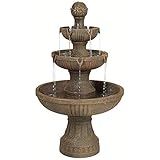
Cast stone and concrete fountains offer convincing texture and excellent stability. Small pedestal models can weigh 100 to 250 pounds, while large pieces can exceed 500 pounds. They are a good choice for permanent ground-level installations, but moving them is a multi-person job. Concrete can crack if water freezes inside it, so it needs winter preparation in cold climates.
Metal fountains are less common but can suit contemporary landscapes. Powder-coated steel should be protected from chips, while copper develops a natural patina. Avoid thin, uncoated metal components in constantly wet areas. Ceramic fountains can be attractive for sheltered patios, but glazed ceramic is vulnerable to cracking in freeze-thaw conditions and should be brought indoors where winters are severe.
Construction and Pump Design
A garden fountain should have a pump that is accessible without dismantling the entire structure. On a self-contained model, the pump is typically hidden behind a removable rear panel or inside the lower reservoir. If access requires removing glued-on decorative pieces or lifting a 50-pound upper tier, cleaning will become a neglected chore.
For small floating solar fountains, wattage is a useful shorthand for expected output. A 1-watt solar pump is generally suitable for a small birdbath in full sun, while a 1.4-watt model can provide more nozzle options and a somewhat taller spray. The Mademax 1W solar birdbath pump, priced around $14.99, is an entry-level example. The Mademax 1.4W version, around $16.79, includes eight nozzles and four stabilizing brackets; those brackets matter because they help keep the pump from drifting against the bowl edge.
Do not judge a pump by nozzle count alone. More nozzles create more visual options, but a tall spray can throw water out of a shallow birdbath. For bowls less than 18 inches in diameter, choose a low or medium spray setting. In a deeper 20- to 24-inch birdbath, a modest center plume is more workable.
For plug-in cascading fountains, seek an adjustable-flow submersible pump. A lower setting reduces splash and sound; a higher setting produces a more noticeable waterfall. Pumps commonly use 5 to 25 watts depending on the fountain’s size and lift requirement. Check that the listed cord is long enough; 6-foot cords are common, but 10-foot cords are much easier to place discreetly.
Performance: Water Sound, Splash, and Solar Reality
The “right” sound depends on placement. A gentle trickle works well beside a reading chair or bedroom window. A multi-tier cascade creates more masking sound for traffic or neighboring noise, but it can overpower conversation if placed within 6 to 8 feet of a dining table.
Water should fall from one basin to the next rather than shoot beyond the fountain’s edge. Before final placement, run the fountain for 20 to 30 minutes and check nearby surfaces for mist. If the fountain splashes, reduce pump flow, level the base, or reposition decorative stones only if the manufacturer allows it. Never block the pump intake.
Solar fountains are best considered daylight features, not all-day water features. Direct overhead sun produces the most consistent spray. Partial shade from trees, fences, or rooflines can make a floating solar fountain pulse, weaken, or stop. Models with battery storage cost more but can continue briefly through passing clouds or into evening; confirm whether the battery is included and whether it is replaceable.
A five-tier resin fountain such as the Grepatio cascading rock model, listed around $89.99 and fitted with four LED lights, is a different proposition from a floating solar pump. It can create a more continuous waterfall effect and evening ambiance, provided it has dependable electrical access and the reservoir stays filled.
Price Tiers and What You Actually Get
Budget: $8 to $35. This range covers basic floating solar pumps, small tabletop fountains, and replacement pumps. The $7.99 Maraiss 1.4W solar fountain is typical: economical, compact, and appropriate for a sunny birdbath. Expect lightweight plastic parts, modest spray height, and no integrated basin. This is a sensible tier for attracting birds or testing whether a fountain suits your routine.
Mid-range: $60 to $180. Here you will find freestanding resin cascades, pedestal fountains, larger reservoirs, adjustable pumps, and sometimes LED lighting. Expect dimensions around 24 to 40 inches high and weights of 25 to 70 pounds. This is the sweet spot for most patios and small gardens because the fountain looks intentional without requiring masonry-level installation.
Premium: $200 to $800 and up. Higher-priced options include substantial fiberglass, cast stone, copper, and architectural wall fountains. The extra cost should buy thicker materials, a more capable pump, better finish quality, a larger water capacity, and serviceable replacement parts. Do not assume a high price guarantees quiet operation or easy assembly; inspect those details individually.
Warranty and Replacement Parts
Look for at least a 1-year limited warranty on a plug-in fountain and clear replacement-pump availability. The pump is the component most likely to need replacement over time, so a fountain with standard-size tubing and a separately available pump is more practical than a sealed proprietary system.
For solar birdbath pumps, warranties are often shorter and may cover defects rather than reduced solar performance. Keep expectations realistic: lightweight solar panels, nozzles, and small impellers are consumable outdoor components. A replacement cost of $10 to $25 can be reasonable, but only if the fountain’s size and fittings are easy to match.
Read exclusions closely. Damage from freezing, running a pump dry, mineral buildup, and wind damage may not be covered. If customer support does not specify pump wattage, cord length, basin capacity, or compatible replacement parts, treat that as a warning sign.
Delivery, Assembly, and Seasonal Care
Small solar pumps usually require only nozzle selection and placement in water. They should be fully submerged before operation, with the solar panel kept clean and unshaded. Larger fountains can arrive in two to six pieces and take 30 to 90 minutes to assemble. Expect to connect tubing, seat tiers, secure a pump, and route a cord through a rear channel.
Set a freestanding fountain on level pavers, concrete, or a compacted gravel base. Do not place it directly on soft soil; settling can tilt the fountain and cause overflow. For a 50- to 100-pound resin fountain, a 24-by-24-inch paver pad is often a practical minimum, provided it extends beyond the base on all sides.
Clean the pump intake every 2 to 4 weeks during active use, more often if leaves, pollen, or bird debris collect in the basin. Drain and clean the reservoir before winter where temperatures fall below freezing. For many resin and ceramic fountains, the safest approach is to empty them, remove the pump, cover the piece, and store removable components indoors.
Spec Checklist
| Spec | Budget | Mid | Premium |
|---|---|---|---|
| Typical price | $8-$35 | $60-$180 | $200-$800+ |
| Best format | Floating solar pump or tabletop | Resin cascade or pedestal | Cast stone, fiberglass, copper, wall fountain |
| Typical size | 6-18 inches | 24-40 inches tall | 40-60+ inches tall |
| Power | 1-1.4W solar or small plug-in pump | 5-25W plug-in pump | Adjustable plug-in pump, often 15-40W |
| Water capacity | Uses an existing basin | About 3-8 gallons | About 8-20+ gallons |
| Expected upkeep | Refill often; clean nozzle weekly | Clean pump every 2-4 weeks | Regular pump cleaning and seasonal winterizing |
Red Flags
- No stated overall dimensions, basin capacity, pump wattage, or cord length.
- A dramatic spray photo paired with a small, shallow birdbath; expect water loss from splash.
- “Solar powered” wording that does not clarify whether a battery is included.
- Heavy stone-look construction with no product weight or installation guidance.
- A pump compartment that cannot be reached without major disassembly.
- LED lighting described without saying whether it needs a plug-in transformer.
- No instructions for winter storage or freeze protection in a fountain intended for outdoor use.
FAQ
Do solar birdbath fountains work in cloudy weather?
They may work weakly or intermittently, but basic floating models perform best in direct sun. A 1W or 1.4W floating fountain can stop when clouds pass or when its panel is shaded. Choose a plug-in fountain for consistent water movement, or a solar model with battery storage if evening operation matters.
How often should I add water to a garden fountain?
Check the water level every day during the first week, then adjust based on weather and splash. Small birdbaths may need topping off daily in hot, dry conditions. Larger self-contained fountains may need water every few days to once a week. Never let the pump run dry.
Can a garden fountain stay outside in winter?
It depends on the material and local temperatures. In freezing climates, drain the fountain, remove the pump, and follow the manufacturer’s storage instructions. Water left in bowls, tubing, or porous stone can freeze, expand, and crack components.
What size fountain is best for a typical patio?
For most patios, a fountain 24 to 36 inches tall with a 16- to 24-inch footprint is a versatile starting point. It is substantial enough to see and hear without taking over the seating area. Leave 18 to 24 inches around it for cleaning and comfortable circulation.