
Key takeaways
- Return line already in the wall, tank water heater: Grundfos Comfort System GRU-595916 or Taco 006-B4 with a timer.
- No return line, tank water heater: Watts Heat H2O or Laing AutoCirc, both of which use the cold line as the return path through a crossover valve.
- Tankless water heater: check the heater manufacturer’s recirculation rules first; roundups list the Grundfos Comfort System as tankless compatible and the Watts Heat H2O as not compatible.
- You want savings above comfort: an on-demand (push-button or motion-triggered) kit such as the Metlund D’MAND, because it moves water only when you ask.
- Large house with a long loop: a higher-flow circulator such as the Grundfos SuperBrute 59896155 (15.5 gal/min listed).
The Grundfos Comfort System (GRU-595916) is the best pick for most homes that already have a dedicated hot-water return line, the Watts Heat H2O kit is the easiest retrofit for homes with no return line, and the Laing AutoCirc (LHB08100092) is the quietest under-sink option. The Taco 006-B4 suits a plumbed loop where you add your own timer or aquastat, and the Metlund D’MAND is the push-button choice if you want the pump to run only when someone asks for hot water. Which one is right depends on three facts you can check in ten minutes: whether a return line exists, what kind of water heater you own, and how far the farthest fixture sits from it.
Our top picks


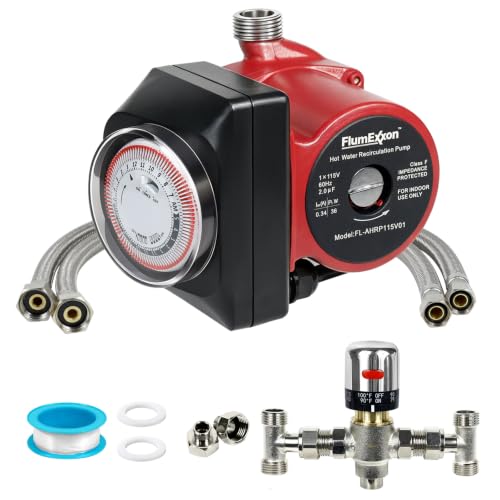

As an Amazon Associate we earn from qualifying purchases at no extra cost to you.
Quick answer: match the pump to your plumbing
- Return line already in the wall, tank water heater: Grundfos Comfort System GRU-595916 or Taco 006-B4 with a timer.
- No return line, tank water heater: Watts Heat H2O or Laing AutoCirc, both of which use the cold line as the return path through a crossover valve.
- Tankless water heater: check the heater manufacturer’s recirculation rules first; roundups list the Grundfos Comfort System as tankless compatible and the Watts Heat H2O as not compatible.
- You want savings above comfort: an on-demand (push-button or motion-triggered) kit such as the Metlund D’MAND, because it moves water only when you ask.
- Large house with a long loop: a higher-flow circulator such as the Grundfos SuperBrute 59896155 (15.5 gal/min listed).
How we chose
This guide is based on published manufacturer specifications and the model lists that appear repeatedly in 2026 buyer’s roundups, rather than on any work by us with the products. We kept a pump on the list only when it is a currently sold model from an established plumbing or circulator maker, when its installation method is clearly documented, and when it solves a distinct plumbing situation. Where a spec could not be confirmed we describe the pump by spec class instead of quoting a number. We weighted six criteria:
- Return-line requirement. Dedicated return line versus crossover valve on the cold line.
- Control method. Built-in timer, thermostat or aquastat, push button, or none.
- Water heater compatibility. Tank, tankless with built-in recirculation, tankless without.
- Wattage and noise. Low-wattage pumps in the 14 to 25 W range run quietly and draw little power.
- Materials. Stainless steel or bronze wetted parts, because a standard cast-iron circulator corrodes in a potable system.
- Serviceability. Standard flanges or unions, so a failed pump can be swapped without re-plumbing.
Two ways to get instant hot water
Dedicated return line (true loop)
A pump at the water heater pushes hot water through the supply pipe, around the farthest fixture, and back to the heater through a separate return pipe. Hot water is always close to every tap. Because the cold lines stay cold, it is the cleanest result, but it only works when the house was plumbed with a return line, or when you are willing to open walls to add one.
Crossover valve (cold line as return)
A small pump goes at the water heater or under the farthest sink, and a thermostatic crossover valve connects the hot and cold lines at that sink. The pump pushes warm water backward through the cold line until the valve senses a set temperature, then closes. The result is no wall work, but the cold line will carry lukewarm water for a short stretch after each cycle. Many people notice this at the cold tap of the farthest fixture; some find it acceptable, and some do not.
Timer versus thermostat versus on-demand
A timer runs the pump during set hours, such as morning and evening. A thermostat or aquastat shuts the pump off when the line is hot, which limits extra water-heater load. An on-demand kit stays idle until you press a button or trigger a sensor. The less the pump runs, the less standby heat is lost through the pipes, which is the main efficiency risk of any recirculation system.
Comparison table
| Model | Install type | Control | Verified specs | Tankless |
|---|---|---|---|---|
| Grundfos Comfort System GRU-595916 | Crossover or return line | Built-in timer and aquastat | 115 V · 25 W · up to 9 gal/min | Listed as compatible |
| Watts Heat H2O | Cold-line crossover, no return line | 24-hour programmable timer | 120 V · 1/2 in. adapters · 3-year warranty | Not compatible |
| Laing AutoCirc LHB08100092 | Under-sink crossover | Built-in thermostat, 85 to 95 F range | 115 V · 14 W | Not confirmed |
| Taco 006-B4 | Dedicated return line | None (external timer or aquastat) | 115 V · up to 10 gal/min · 3/4 in. sweat | Not confirmed |
| Grundfos SuperBrute 59896155 | Dedicated return line | Pre-programmed timer with temperature sensors | 115 V · 15.5 gal/min | Listed as compatible |
| Metlund D’MAND | On-demand pump with sensor or button | Push button or remote trigger | Specs not verified here | Check heater maker |
| APCOM UT1 | Under-sink smart kit | App and schedule | Specs not verified here | Check heater maker |
The seven best hot water recirculating pumps
1. Grundfos Comfort System GRU-595916
Spec line: 115 V · 25 W · up to 9 gal/min · stainless steel pump · built-in timer and aquastat · works with a return line or cold-line crossover
Best for: Homes with a tank heater and a hot-water return, or owners who want a single kit that can serve either plumbing layout.
Skip if: You need a fully adjustable seven-day schedule, because a basic timer is the control here.
- Pros: Complete kit with the pump, timer, and valve; stainless steel suits potable water; very quiet at its low wattage; the aquastat prevents unnecessary running.
- Cons: Crossover installs still send lukewarm water through the cold line; priced above a basic bronze circulator.
2. Watts Heat H2O recirculating system
Spec line: 120 V · 1/2 in. adapters · 24-hour programmable timer · uses the existing cold line · 3-year warranty
Best for: Retrofits in houses without a return line when you want the simplest DIY job. The pump goes at the water heater and the valve at the farthest sink.
Skip if: You have a tankless water heater, because roundups list this kit as not compatible with tankless models.
- Pros: No wall work; clear instructions; programmable timer; three-year warranty.
- Cons: Cold line runs warm for a short while after cycles; one valve serves only the fixture it is fitted to.
3. Laing AutoCirc LHB08100092
Spec line: 115 V · 14 W · built-in thermostat (85 to 95 F range) · crossover valve design · under-sink mounting
Best for: Apartments, condos, and bathrooms where you can reach the plumbing under the farthest sink and want the pump to be almost inaudible.
Skip if: The farthest fixture is more than one bathroom away from the others, since one under-sink pump serves a single branch.
- Pros: Lowest wattage on the list; thermostat control; small footprint; simple retrofit.
- Cons: The thermostat range means the cold line can end up in the mid-80s to mid-90s F; needs a nearby outlet under the sink.
4. Taco 006-B4 bronze circulator
Spec line: 115 V · up to 10 gal/min · 3/4 in. sweat connections · bronze body · always on unless you add control
Best for: A true return-line loop where you plan to add a plug-in timer or an aquastat, or where a plumber is already working on the loop and wants a standard, serviceable part.
Skip if: You want a plug-and-play kit; this is the pump only, and you supply the control and fittings.
- Pros: Proven circulator format; bronze is suitable for potable lines; common service part; flow range suits most single-family loops.
- Cons: Runs continuously without a controller, which adds heat loss; heavier and louder than a low-wattage kit pump.
5. Grundfos SuperBrute 59896155
Spec line: 115 V · 15.5 gal/min · pre-programmed timer with integrated temperature sensors · dedicated return line · listed as tankless compatible
Best for: Larger homes with long loops, two-story layouts, or more than one water-heater branch, where a 9 gal/min pump may feel slow to move the loop.
Skip if: The house is small, because the extra flow adds noise and needs larger piping to avoid erosion without making hot water arrive noticeably faster.
- Pros: Highest flow of the group; sensor-driven control; suits long loops.
- Cons: More than a typical three-bedroom house needs; requires a real return line; confirm the exact connection type before buying.
6. Metlund D’MAND system
Spec line: on-demand pump with push-button or remote activation · shuts off when hot water reaches the pump · detailed electrical specs not verified for this guide
Best for: People who care most about wasted energy, because the pump runs only for the short time after someone requests hot water.
Skip if: Several household members will forget to press the button; the benefit disappears if no one uses it.
- Pros: Minimal standby heat loss; no clock programming; works well with irregular schedules.
- Cons: Needs a button or sensor at each activation point; a short wait still exists; typically costs more than a basic timer kit.
7. APCOM UT1 under-sink smart kit
Spec line: under-sink crossover pump · app and schedule control · electrical specs not verified for this guide
Best for: Renters and condo owners who want a scheduled, app-controlled pump without touching the water heater.
Skip if: You dislike Wi-Fi devices on plumbing or want a pump with a long, documented service history.
- Pros: Easy scheduling; small; no heater-side work.
- Cons: Relies on an app and home Wi-Fi; depends on the manufacturer’s support for long-term updates; same cold-line warmth tradeoff as other crossover systems.
Decision matrix
| Your situation | Best match | Why |
|---|---|---|
| Return line, tank heater, want a kit | Grundfos Comfort System GRU-595916 | Timer plus aquastat, stainless, low wattage |
| Return line, plumber installing loop | Taco 006-B4 with controller | Standard serviceable bronze pump |
| No return line, one branch to fix | Laing AutoCirc LHB08100092 | Under-sink, 14 W, thermostat |
| No return line, whole-house timer | Watts Heat H2O | Heater-side pump with timer |
| Big house, long loop | Grundfos SuperBrute 59896155 | 15.5 gal/min flow |
| Lowest energy waste | Metlund D’MAND | Runs only on demand |
Worked example: how much water and time do you actually save?
Use this method to see whether a pump is worth installing. The numbers below are rounded approximations meant to show the steps; check your own pipe sizes and lengths.
- Measure the run. Say the farthest bathroom is 60 ft of pipe from the water heater, and it is 1/2 in. copper. Half-inch copper holds roughly 0.015 gal per foot, so the pipe holds about 0.9 gal.
- Find the flow at the tap. A bathroom faucet at about 1 gal/min takes about 54 seconds to push that cold slug out. A shower at about 2 gal/min takes about 27 seconds.
- Scale by uses. If four people each run the faucet three times a day, that is 12 waits of roughly 0.9 gal, or about 11 gal daily, which is about 4,000 gal per year going down the drain unused.
- Compare with run time. A 25 W pump on a timer for four hours daily uses 0.1 kWh per day. A 14 W pump used the same way uses about 0.06 kWh. Left on around the clock, the 25 W pump uses 0.6 kWh per day.
- Account for heat loss. Pipes in an unconditioned crawlspace lose heat to the air while the loop circulates, and the water heater must replace it. Insulate the hot line; this is why a timer or on-demand control matters more than pump wattage.
Result: the pump saves roughly 1 gal and about 30 to 55 seconds per use at the farthest tap, but its energy use can eat into the benefit if it runs all day. Treat the pump as a comfort and water-saving upgrade, not a guaranteed energy-saving one.
Compatibility checks before you buy
Water heater type
Tank heaters accept almost any of these pumps. Tankless heaters vary: some have a built-in recirculation pump and buffer tank, some accept an external pump on a dedicated return line, and some do not allow cold-line crossover systems at all. Check the heater manual first. Pushing lukewarm water into a tankless unit in short bursts can trigger error codes, and the heater’s warranty may require its own recirculation components.
Return line or no return line
Look at the water heater. If you see a third small pipe or a capped tee beside the hot outlet and cold inlet, you may already have a return. Check the manual and any plumbing drawings. If there is none, choose a crossover valve kit.
Materials
Use stainless steel or bronze in potable systems. Cast-iron circulators designed for heating loops corrode and can discolor the water.
Electrical
All kits above plug into standard household current. The heater-side kits need an outlet near the water heater; under-sink kits need one in the cabinet. Never use an extension cord on a plumbing pump, and use a ground-fault outlet where local code requires it.
Installation and safety notes
- Shut off power and water, and let the heater cool, before cutting into pipes.
- Set the water heater thermostat no higher than 120 F unless you need more for a specific appliance; hot water above that can scald quickly, and children and older adults are most at risk.
- Insulate hot lines to reduce standby loss and noise.
- Follow the kit’s instructions for check valves so water cannot flow backward through the loop.
- After installing a crossover valve, run the farthest cold tap until the water cools, and tell the household that the cold line may be warm for a minute after the cycle.
- If you are unsure about soldering, gas heaters, or local plumbing code, hire a licensed plumber.
Noise, lifespan, and maintenance
Low-wattage pumps are quiet because the motors are small and the flow is slow. The most common noise complaint is not the pump itself but air in the loop or water hammer when the valve closes. Bleed air after installation, and if you hear a tick when the valve closes, a small water hammer arrestor can help. Most pumps last for years if the water is not heavily scaled. In hard-water areas, flush the water heater yearly and expect to replace crossover valves sooner than the pump. A pump with standard unions or flanges, such as the Taco, lets you swap it out in minutes.
Common mistakes
- Buying a pump without checking the return line. A true-loop pump will not work if the house has no return.
- Running the pump 24 hours a day. It wastes electricity and heat. Use a timer or aquastat.
- Using a heating-system circulator. Heating loops often use cast iron, which is not for drinking water.
- Ignoring tankless rules. Follow the heater manufacturer’s guidance.
- Skipping insulation. Bare hot lines will lose most of the benefit.
Which pump for which home: short scenarios
Two-story house with a master bath far from the heater
If the original plumber ran a return, the Grundfos Comfort System on a timer covers morning and evening use, while the SuperBrute makes sense only when the loop is long enough that 9 gal/min cannot keep the temperature up. If there is no return, the Watts Heat H2O at the heater keeps the loop warm during set hours, though only the fixture with the crossover valve gets the full benefit.
Condo with one distant bathroom
The Laing AutoCirc under the bathroom sink is the least invasive approach. There is no work at the heater, which in many condos is shared or inaccessible, and the thermostat limits running time. The same logic applies to the APCOM UT1 if you prefer app scheduling.
Home with solar thermal or a heat pump water heater
Heat loss from a recirculating loop is expensive for these systems, because they rely on slow, efficient heat transfer. Choose on-demand control such as the Metlund D’MAND, or a timer with the shortest practical windows, and insulate every hot pipe.
Rental where you cannot cut pipes
An under-sink crossover kit installs with hose-style connections in minutes and removes just as easily. Check the lease and use only kits that do not require soldering.
Frequently asked questions
Do hot water recirculating pumps save water?
Yes, they cut the water you send down the drain while waiting for heat, but they may add electricity and heater load. The net gain depends on pipe length and how often the pump runs.
The saving is largest in homes with long pipe runs and frequent short uses. Use a timer or thermostat so the pump only runs when hot water is needed.
Do I need a return line?
No, not always. Crossover kits such as the Watts Heat H2O and Laing AutoCirc use the cold line as the return path, so you can install them without adding pipe.
The tradeoff is that the cold line will carry warm water for a short time after each cycle. A true return line avoids that.
Can I use these pumps with a tankless water heater?
Sometimes. Check the heater’s manual first, because some brands require their own recirculation hardware or only allow a dedicated return line.
Roundups list the Grundfos Comfort System as tankless compatible and the Watts Heat H2O as not compatible, but your heater maker’s rules take priority.
How much electricity does a recirculating pump use?
Kit pumps typically draw between 14 W and 25 W, which equals about 0.3 to 0.6 kWh per day if left on all day, and far less on a timer.
A four-hour daily timer cuts that to roughly 0.06 to 0.1 kWh per day. The larger cost is heat lost from the pipes, not the pump motor.
Why is my cold water warm after I install a crossover valve?
The pump pushes hot water into the cold line until the valve closes, so the cold line holds warm water for a short time.
Run the cold tap briefly to flush it. If this bothers you, consider a dedicated return line or an on-demand system that runs less often.
What is the quietest hot water recirculating pump?
Low-wattage under-sink pumps such as the Laing AutoCirc (14 W) are among the quietest, and the Grundfos Comfort System is also described as very quiet.
Air in the loop or water hammer causes more noise than the pumps do, so bleed the lines after installation.
Is an on-demand pump better than a timer?
It uses less energy, because it runs only after a button press or sensor trigger. A timer is simpler if your schedule is predictable.
On-demand works best for households that will reliably press the button, and a timer works best for fixed morning and evening routines.
Can I install one myself?
Under-sink and heater-side kits are designed for DIY installation if you are comfortable with basic plumbing and have a nearby outlet.
True return-line loops, gas water heaters, and any work involving soldering or permits are better left to a licensed plumber.


