Key takeaways
- Best Overall: VAGKRI electric infrared heater with remote and 12-hour timer (IP65, 3 heat levels)
- Best Value: hykolity 1500W wall-mount infrared heater, 35.5 inch (IP55, remote, 24-hour timer)
- Best Freestanding: HAIMMY 42 inch infrared heater (remote, 9 heat levels, 9-hour timer)
- Best for Large Decks: DR. INFRARED HEATER DR-239 3000W (wall or ceiling mount, IP55)
- Best Rugged Option: Heat Storm Tradesman 1500W weatherproof infrared heater with remote
- Best Standing Heater for Patios: SereneLife 1500W electric standing heater with remote (IP44)
- Best Budget: VEVOR 1500W infrared heater with remote, LED screen and timer
The best infrared patio heater with a remote for a covered deck is usually a 1500W electric wall-mount unit, because it plugs into a standard outdoor outlet, has no flame or exhaust to manage under a roof, and keeps the floor clear for furniture. Our top pick is the VAGKRI electric infrared heater for its remote, 12-hour timer and IP65 water-resistance rating, with the hykolity 35.5 inch wall-mount as the best-value runner-up. If you want a freestanding unit that can move around the deck, the HAIMMY 42 inch is the one to look at first. The sections below explain how wattage, mounting height and clearances change what you should buy for a covered space.
A covered deck is a different heating problem from an open patio. The roof traps some warmth and blocks wind, which helps, but it also means you must follow the maker’s clearance rules to the ceiling and nearby walls, avoid gas heaters that need open air, and think about circuits. This guide is research-based: we compared manufacturer listings and spec pages, and we did not personally use these heaters. Treat everything here as shopping guidance and always follow the instruction manual for your specific model, because installation clearances and electrical needs vary.
It is also useful all year. An infrared heater that takes the chill off a deck in October can extend a screened porch in spring, warm a garage workspace in winter, or give a cool evening corner on a summer night at the coast.
Our top picks


As an Amazon Associate we earn from qualifying purchases at no extra cost to you.
Top Picks at a Glance
- Best Overall: VAGKRI electric infrared heater with remote and 12-hour timer (IP65, 3 heat levels)
- Best Value: hykolity 1500W wall-mount infrared heater, 35.5 inch (IP55, remote, 24-hour timer)
- Best Freestanding: HAIMMY 42 inch infrared heater (remote, 9 heat levels, 9-hour timer)
- Best for Large Decks: DR. INFRARED HEATER DR-239 3000W (wall or ceiling mount, IP55)
- Best Rugged Option: Heat Storm Tradesman 1500W weatherproof infrared heater with remote
- Best Standing Heater for Patios: SereneLife 1500W electric standing heater with remote (IP44)
- Best Budget: VEVOR 1500W infrared heater with remote, LED screen and timer
Quick Comparison Table
| Product | Best for | Key specs | Watch for | Price tier |
|---|---|---|---|---|
| VAGKRI infrared | Covered decks, wall mounting | Remote, 12 h timer, IP65, 3 heat levels | Wattage on the full listing; check circuit | Mid-range |
| hykolity 35.5 in | Value wall-mount | 1500W, IP55, remote, 24 h timer | Compact, so best for seating zones | Mid-range |
| HAIMMY 42 in | Moving the heater around | 1500W, remote, 9 heat levels, 9 h timers | Freestanding units need a stable base | Mid-range |
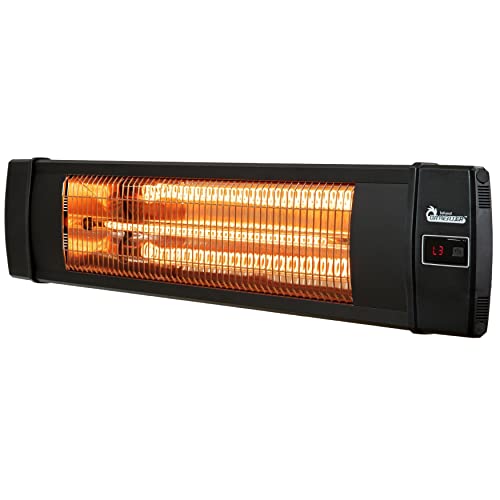
| DR. INFRARED DR-239 | Large covered areas | 3000W, wall or ceiling mount, IP55 | Higher power; confirm voltage and wiring | Premium |
| Heat Storm Tradesman | Tough, plain performance | 1500W, weatherproof, remote | Basic styling | Mid-range |
| SereneLife standing | Freestanding patio use | 1500W, remote, IP44, 3 power settings | Lower IP rating than wall units | Premium |
| VEVOR 1500W | Budget buyers | 1500W, remote, LED screen, 3 speeds, timer | Check outdoor rating on the product page | Budget |
1. VAGKRI Electric Infrared Heater: Best Overall for a Covered Deck
- Electric infrared patio heater
- Remote control and 12-hour timer
- IP65 waterproof rating per the listing
- 3 heat levels
- Wall mounted design
- Exact wattage: check the full product page, not shown in our summary
Best for: a covered deck or porch where you want a permanent heater out of the way. Skip if: you need to move the heater between rooms.
The VAGKRI combines the features most covered-deck buyers actually use: a remote so you can start it from a chair, a timer so you are not worried about leaving it on, and a water-resistance rating that stands up to blown rain and humidity. IP65 means protection against dust and water jets, which is a step above IP44 or IP55 and a sensible spec for a heater that sees cold, damp weather. Three heat levels give you enough control to turn it down on mild evenings.
Infrared heaters warm objects and people directly instead of heating the air, which is why they perform better outdoors than a fan heater. On a covered deck, the roof reduces the loss of that radiant energy, and you feel warmth within a few seconds of switching on. The benefit is strongest in the zone the heater points at, so mount it on the wall or beam above the seating area and angle it toward where people sit.
Installation is the part to plan. Wall mount heaters need to be hung at the height the manual specifies, usually well above head level and away from the ceiling and combustible materials. Check the maker’s clearance chart before you drill. If the unit has a plug, use a properly rated outdoor outlet with ground-fault protection, and do not use a household extension cord unless the manual allows it.
Pros: strong water-resistance rating; remote and 12-hour timer; wall mounting saves floor space; three heat settings. Cons: wattage not shown in our summary; fixed location; installation skills required.
2. hykolity 1500W 35.5 Inch Wall-Mount Heater: Best Value
- 1500W electric infrared
- 35.5 inch wall-mount body
- IP55 rating
- Remote control
- 24-hour timer
Best for: small and medium covered seating areas on a budget. Skip if: your deck is large and you want to heat more than one zone from a single heater.
The hykolity is a straightforward 1500W wall unit, and that is the point. 1500W is the standard maximum on a 120V household circuit in North America, which means it can run on common outlets without special wiring, but only if the circuit is not shared with other heavy loads. It is not a heater that will warm an entire large deck. It does well in a seating area of roughly 10 by 10 feet, if the person is within a few feet of the radiant zone.
The 24-hour timer is more flexible than a 12-hour limit, and an IP55 rating covers dust and water jets while being slightly lower than IP65. For a deck with a solid roof and limited exposure to driven rain, that rating should be adequate, but always confirm that the placement matches the manual’s outdoor mounting guidance.
At 35.5 inches wide, it is compact, so you may want to install two at the corners of a larger space rather than one heater with a large radius. This also lets you run each at a lower setting, spreading load across two circuits if they are on separate outlets.
Pros: low cost for a remote-controlled unit; standard 1500W on 120V; long timer; compact. Cons: IP55 rating below IP65; coverage limited; basic styling.
3. HAIMMY 42 Inch Infrared Heater: Best Freestanding Pick
- 42 inch infrared heater
- 1500W instant heating per the listing
- Remote control
- 9 heat levels
- 9-hour timer settings
Best for: renters, shared decks and anyone who wants to move the heater to the right spot. Skip if: you have pets or kids who could knock over a tall unit.
If you cannot drill into the deck structure, a freestanding heater is the practical choice. The HAIMMY offers nine heat levels, which gives more control than the usual high, medium, low choices. That granularity helps in a covered deck, where the roof traps some heat and you may only need a small boost on a cool evening.
Because the unit is freestanding, placement and stability are important. Put it on a level surface, keep it a safe distance from furniture, curtains and anything flammable, and anchor or weight it if it is tall and light. Check the manual for the tip-over protection feature. Many freestanding heaters include an automatic shut-off if tilted, which is a feature worth confirming before you buy.
The convenience of moving a heater is real. You can warm the dining table at dinner, move it to the lounge area after, and store it in a dry place off-season. Make sure you coil the cord neatly and keep it out of walkways.
Pros: portable; nine heat levels; remote and timer; no drilling. Cons: takes floor space; stability needs attention; cord management.
4. DR. INFRARED HEATER DR-239 3000W: Best for Large Covered Areas
- 3000W infrared heater
- Indoor and outdoor use
- Wall or ceiling mount
- IP55 weatherproof rating
- Remote: check the variant, not shown in our summary
Best for: large decks, covered pavilions, pergolas with roofs and commercial-style spaces. Skip if: you only have a standard 120V outlet and no electrician.
A 3000W infrared heater delivers roughly twice the radiant output of a 1500W unit. That difference is noticeable on a large deck, where one 1500W heater would leave guests at the far end cold. The DR-239 is a wall or ceiling mounted model, so it can sit up and out of the way while projecting warmth down onto a bigger zone.
The catch is electrical. 3000W typically needs a 240V circuit, hardwiring and a licensed electrician, and a 15 amp, 120V outlet cannot supply that much power safely. Check the product page for the exact voltage and amp rating, and plan for installation costs on top of the heater price. If your deck is in a rental or you do not want an electrical project, choose one or two 1500W plug-in heaters instead.
Because this is a heavier, more powerful unit, mounting hardware matters. Fasten it to studs or structural framing, follow the clearance chart for the ceiling and walls, and never mount it where a person could touch it.
Pros: high output; suitable for big areas; wall or ceiling mounting. Cons: likely needs 240V wiring; professional installation; higher price.
5. Heat Storm Tradesman 1500W: Best Rugged Option
- 1500W infrared
- Weatherproof construction per the listing
- Remote control
- Designed for patios, garages and workspaces
- IP rating: not listed in our summary
Best for: deck owners who also want the heater to work in a garage or workshop. Skip if: you want a stylish heater for a lounge.
The Heat Storm Tradesman is a plain, work-focused model. The weatherproof construction means it is built for damp or dusty spaces, and it uses the same 1500W power level as most plug-in heaters. Remote control is a useful addition for a unit that may be mounted high.
Its practical advantage is flexibility. Many people buy one heater that does double duty, warming the deck in the evenings and heating a garage or workshop in the colder months. Confirm that the mounting kit suits both uses, and that you can move it without damaging the wall.
Pros: sturdy; multi-use; remote included; standard power. Cons: basic appearance; IP rating not listed in our summary; coverage similar to other 1500W units.
6. SereneLife 1500W Standing Heater: Best Standing Patio Heater
- 1500W electric infrared standing heater
- Remote control
- IP44 rating
- Three power settings
- Stand design for freestanding use
Best for: covered patios with a nearby outlet and little protection from rain. Skip if: your deck is open to heavy rain or wind.
An IP44 rating gives protection against splashing water, which is lower than IP55 or IP65. Under a solid roof, that is acceptable. On a deck with exposed edges where rain blows in, it is less ideal. Store the heater indoors during storms or heavy weather if the manual says so.
Three power settings keep control simple. Many people only need low or medium on a covered deck, and keeping the heater at a lower setting reduces electricity use and extends the life of the element.
A standing model gives you the same radiant warmth as a wall unit with the freedom to reposition. Keep it away from walls, railings and furniture by the distance listed in the manual.
Pros: freestanding; remote; simple controls. Cons: lower IP rating; takes floor space; premium price for a 1500W unit.
7. VEVOR 1500W Infrared Heater: Best Budget
- 1500W infrared heater
- Remote control
- LED screen
- 3 speeds and a timer
- Outdoor suitability: check the full product page
Best for: shoppers who want a low-cost remote-controlled heater for a sheltered porch. Skip if: you need a verified weatherproof rating.
VEVOR lists the heater for indoor and outdoor use, and the specs match what most buyers want: a remote, a clear LED display, three heat settings and a timer. The unknowns are weather ratings and long-term durability, so read the product page for the IP rating or the manufacturer’s statement on outdoor use. If the heater is not rated for damp conditions, keep it in a fully covered space away from rain.
At this price level, it is a reasonable way to try infrared heating before investing in a premium wall-mounted heater.
Pros: low cost; clear display; remote and timer. Cons: weatherproof rating needs checking; fewer details on construction; basic warranty expectations.
Also Consider
SereneLife Wall-Mounted Infrared Heater (IP65)
A 1500W wall-mounted unit with remote control and an IP65 rating. A strong alternative if you want a wall heater from a brand with lots of model variety.
ThermoMate 3000W Hard-Wired Carbon Fiber Heater
A 240V hard-wired infrared unit for permanent installs. Best for large decks when you have an electrician on hand.
Heat Storm Wi-Fi Wall-Mounted Heater
A wall-mounted infrared model with Wi-Fi control, useful if you want to warm the deck before you step outside.
MOMOKOVA Tabletop Infrared Heater
A tabletop 1500W model for small bistro-style spaces. Check the manual for table clearance and stability guidance.
How We Chose
This is a research-based guide. We reviewed manufacturer listings and product pages for each heater, compared them against general safety guidance from fire-safety organizations and electrical codes, and checked that each model is currently sold. We did not personally use these heaters. Where wattage, IP rating or remote details were not stated in the listing summary, we say so.
Our criteria were electric infrared heating (no flame or combustion in a covered space), a remote control, a timer, an outdoor-suitable rating where listed, and a spread of wall-mount and freestanding options. We also limited each brand to a single main pick and excluded gas and propane heaters because they come with ventilation and clearance requirements that are different on a covered deck.
Buying Guide: Choosing a Patio Heater for a Covered Deck
Electric infrared versus gas
Propane and natural gas patio heaters produce combustion gases, including carbon monoxide, and manufacturers generally say they must be used with adequate ventilation and not in enclosed or partly enclosed spaces. On a covered deck, the roof and walls may qualify as partly enclosed, so electric infrared is the simpler choice. Always follow the manual, local codes and any insurance guidance.
Wattage and coverage
1500W is the usual plug-in limit on a 120V circuit, and it suits a seating zone of roughly 10 by 10 feet. 3000W heaters need 240V and cover more area. Rather than one very large heater, many owners find two 1500W units at opposite corners give more even warmth. As a rule of thumb for a mild-cold evening, a 1500W infrared unit might serve two to four people sitting within a few feet of the radiant zone.
Mounting height and angle
Follow the manual. Wall and ceiling heaters are typically mounted well above head height and angled slightly downward toward the seating area. Mounting too low raises the risk of contact and overheating nearby materials, while mounting too high weakens the effect on people. A heater that is too close to the ceiling can damage wood or vinyl, so respect the minimum clearance listed.
Weather and water resistance
IP ratings tell you how well a heater resists dust and water. IP44 resists splashing, IP55 resists dust and water jets, and IP65 offers stronger protection against dust and water jets. A covered deck sees less direct rain, but humidity and blown spray still matter. Pick the higher rating if the deck edges are open.
Electrical requirements
Check how many amps the heater draws. A 1500W heater on 120V draws about 12.5 amps, which is most of a 15 amp circuit. Do not plug other high-draw devices into the same circuit. Use an outdoor-rated, GFCI-protected outlet, and avoid thin extension cords. If you are unsure, ask a licensed electrician.
Controls and safety features
Look for a remote, timer, tip-over protection on freestanding models, and overheat protection. These do not replace common sense: keep the heater away from flammable materials, do not drape cloth over it, and never leave it running unattended for long periods.
Quick Sizing Example
Imagine a 12 by 14 foot covered deck with a seating group at one end. A single 1500W infrared heater mounted on the wall above that seating area, aimed at the sofa and chairs, will usually cover the seated group. If you also want to warm the dining table at the other end, add a second 1500W heater at that end rather than upgrading to a single 3000W unit. Two smaller heaters give you separate control and cost less than a hard-wired 240V installation.
Common Mistakes
- Choosing a gas heater for an enclosed or partly enclosed deck
- Mounting a heater too close to the ceiling, railing or siding
- Running a heater on a circuit already loaded with other appliances
- Using a light-duty indoor extension cord outdoors
- Expecting a single 1500W heater to warm a large deck evenly
- Leaving a heater running with no one nearby
Frequently Asked Questions
Is an electric infrared heater safe on a covered deck?
Electric infrared heaters have no flame or exhaust, which makes them a common choice for covered spaces. Safe use still depends on following the manual for clearances, mounting height and electrical needs. Nothing replaces those instructions.
How many watts do I need?
1500W suits a seating zone of roughly 10 by 10 feet. For larger areas, use two 1500W heaters or a 3000W model on 240V.
Can I plug an infrared patio heater into a regular outlet?
1500W models are designed for standard 120V outlets, ideally outdoor-rated and GFCI protected. 3000W models usually need 240V and professional wiring.
What does IP65 mean?
It indicates strong protection against dust and water jets under a standard rating system. It does not mean the heater is submersible, and the manual still governs how and where to mount it.
Do infrared heaters work in wind?
Infrared warms people and objects directly, so it holds up better in light breezes than a fan heater. A covered deck with some wind protection works best.
How high should I mount a wall heater?
Follow the manufacturer’s stated height and clearance. Most are mounted well above head level and angled down, but the exact figure differs by model.
Can I use one all year?
Yes. Many owners use the same heater on cool spring and autumn evenings, and as a supplement to winter warmth on a sheltered porch. Store freestanding units indoors in harsh weather if the manual recommends it.
Which One Should You Buy?
For most covered decks, the VAGKRI wall-mount heater is the best all-round pick. The hykolity gets you a similar setup for less. If you can not drill, choose the HAIMMY or the SereneLife standing heater. For large decks, step up to the DR. INFRARED DR-239 and budget for professional wiring. The Heat Storm Tradesman is a good dual-use option, and the VEVOR is the budget pick for sheltered spaces. Whichever you choose, read the manual first and follow the clearances.
Sources
- Manufacturer product pages for VAGKRI, hykolity, HAIMMY, DR. INFRARED HEATER, Heat Storm, SereneLife and VEVOR
- National Fire Protection Association safety guidance on portable heaters
- Consumer Product Safety Commission heater safety tips
- International Electrotechnical Commission IP rating definitions
Last updated: October 2026